Introduction:
George Bernard Shaw’s Candida stands out in modern drama as a compelling example of the “problem play.” Candida by G.B. Shaw is indeed a problem play. Written in 1894, the play challenges the traditional ideals of marriage, morality, gender roles, and romantic love by placing its characters in a situation where social assumptions collapse under psychological truth.
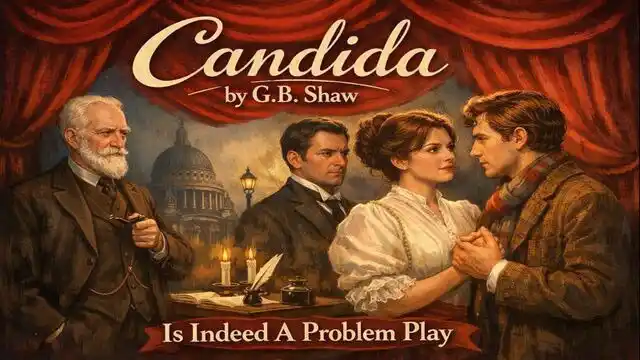
Rather than offering a straightforward romantic plot, Shaw presents a moral dilemma: the conflict between Reverend James Morell, a confident Christian socialist, and Eugene Marchbanks, an idealistic young poet, both in love with Candida. Through their struggle, Shaw exposes deeper social and emotional issues—such as the power dynamics within marriage, the illusion of male authority, and the complexity of female choice.
Because Candida raises questions instead of supplying easy answers, it perfectly fits the definition of a problem play: it confronts a social issue, provokes critical thinking, and leaves the audience to reconsider what constitutes love, strength, and dependency in human relationships.
Candida, A Problem Play:
If we apply Shaw’s own definition of the “problem play,” then Candida by G.B. Shaw certainly fits the category. At its core lies a difficult and frequently debated issue: the classic love triangle. The relationship among Candida, her husband Morell, and the young poet Eugene Marchbanks forms this triangle.
Traditionally, in plays dealing with such situations, either the unfaithful woman was cast out by her enraged husband and driven into the illicit union, or she was forgiven after expressing remorse and returned to her husband’s home. Shaw rejected both of these approaches as inadequate. Instead, he explored the dilemma in an entirely new manner, addressing it from a purely rational and intellectual standpoint—one that leaves no room for guilt or sentimentality.
For Shaw, intelligence was the deciding force, and it is Candida who embodies that intelligence. She assumes control of the circumstances and resolves them with striking clarity. In choosing to belong to the weaker of the two men, she ultimately remains with her husband, James Morell, the Christian socialist. Despite his eloquence and outward confidence, he proves to be emotionally dependent and childlike, making Candida’s decision both logical and humane.
Shaw’s Aim of Social Reform::
Shaw’s central purpose in his drama is to improve human life by exposing accepted customs and institutions to the sharp, analytical gaze of his intellect. Each of his plays deals with a significant issue in modern social existence—some pressing social evil or an institution he regards as harmful—and he approaches these subjects with boldness and resolve.
In the character of the lively Burgess, Shaw introduces the groundwork for another social concern. This conflict becomes evident when Morell’s Christian Socialism stands in opposition to Burgess’s blatant exploitation of the impoverished working class. Shaw compels us to hear Morell’s moral outrage at social injustice, yet he consistently ensures fairness by allowing opposing ideas to be voiced and understood, always giving the ‘Devil his due.’
Discussion of Social Problems, but Absence of Proposed Solutions:
Shaw’s works can, in many ways, be described as discussion dramas, for in a number of his plays the plot or action is minimal, and the central focus lies in the exploration of an idea. He presents both sides of the social issues he tackles with fairness and depth, yet he refrains from offering definite solutions. Shaw deliberately leaves the responsibility of forming conclusions to his audience. His purpose is to encourage readers and viewers to think independently about a wide range of social concerns.
In Candida, this artistic design becomes particularly noticeable. The play concludes with a remarkably enlightening conversation shaped by Shaw’s brilliance. After making the provocative declaration that she belongs to the weaker of the two men, Candida suggests, “Let us sit and talk comfortably over like three friends.” What follows is one of Shaw’s most compelling exchanges.
Candida explains how Eugene Marchbanks has always stood alone against society, and therefore has developed the strength to endure loneliness and suffering. James Morell, in contrast, has spent his life nurtured and spoiled—first by his mother and sisters, and now by Candida, who must take up their duties. Through this intense dialogue, the seemingly complex love triangle resolves itself naturally.
What we truly witness is the profound transformation of Marchbanks. It appears as though a new soul has come into being. The timid, painfully shy eighteen-year-old gains a new aura of dignity and tragic grandeur, and feels suddenly ancient, as though he has inherited the wisdom of the ages.
Staying with Husband or Leaving with Lover – The Core Dilemma:
After touching upon several social concerns, the play ultimately settles on a crucial question: should a woman remain with her husband even when emotional harmony between them no longer exists, or should she leave with a lover with whom she feels genuine understanding and compatibility? This conflict lies at the very heart of the drama and challenges its main characters.
The superficial nature of Morell, the play’s protagonist, is gradually exposed. Emotionally shaken, he fails to truly understand his wife. He does not realise that Candida plays multiple roles for him—both affectionate sister and caring mother—and that the comfort and freedom from anxiety she offers enable him to produce his eloquent sermons.
In contrast, the dreamy ideals of Marchbanks, the young poet, are also tested and dismantled. Marchbanks genuinely loves and comprehends Candida, yet his love remains romantic and idealistic, distant from the practical demands of reality—though it remains pure and admirable.
Thus arises the central question: should Candida remain with her husband, or should she go away with the man who loves her romantically? Ultimately, she decides to stay, yet a doubt persists—was she right to let the poet walk alone into the dark night? The play leaves this tension unresolved, inviting every reader to form an answer according to their own insight and judgement.
Introducing the Problem of Employer–Employee Relations:
Another significant social issue raised is the complex relationship between employers and their workers. Should employers impose heavy workloads and offer meagre wages, or should they deal with their employees with greater humanity and fairness by improving their pay? Morell condemns Burgess for his harsh and exploitative treatment of his labourers, calling him a scoundrel.
Burgess, however, argues from a different angle: according to him, higher wages often lead workers to indulge in excessive drinking, which in turn gives rise to numerous moral and social problems. This raises a troubling dilemma—should wages remain low and working conditions unimproved simply to prevent such behaviour? What, then, is the most just and sensible approach? Despite extended debate, no definitive solution emerges.
Shaw’s Exposure of the Flaws in the Modern Education System:
Shaw points toward another significant social issue—the condition of contemporary education. He raises a crucial question about what true education should achieve. In his mind occurs a constant debate over the type of learning young people ought to receive and whether the existing system really serves its purpose or demands reform.
Lexy Mill, the curate working under Morell, symbolizes the kind of graduates produced by English universities. Young men like him leave college with very little real understanding. Their thinking lacks originality; rather than developing independent ideas, they merely reproduce what others have said. They simply trace the footsteps of those who influence them. Although they speak and behave with refinement, their minds remain unproductive, and they are unable to think for themselves.This is clearly presented by the words of Miss Prossy:
“Yes, you do: you imitate him. Why do you tuck your umbrella under your left arm instead of carrying it in your hand like anyone else? Why do you walk with your chin stuck out before you, hurrying along with that eager look in your eyes? You! Who never get up before half past nine in the morning. Why do you say “knoaledge” in church, though you always say “knolledge” in private conversation.”
Shaw as a Firm Advocate of Social and Economic Justice and Personal Freedom:
Throughout his life, Shaw consistently championed socialist ideals. He raised his voice for political liberty, and for fair economic and social conditions. A believer in the sanctity of personal freedom, Shaw rejected violent upheaval, preferring steady, democratic reform. Yet, like many English thinkers of the late nineteenth and early twentieth centuries, he had long abandoned faith in the promise of capitalism, seeing socialism as the only effective remedy for social ills. He maintained that any real improvement in the condition of the working class could be achieved only through laws that promoted equality—laws that would moderate the wealth of the rich so that the poor might be supported and elevated.
Shaw’s Rational Outlook on Religion:
Shaw strongly opposed the organised form of religion. His views were shaped by rational thinking rather than blind faith. For him, religion was acceptable only when it supported the welfare and progress of humanity; if it failed to do so, he saw no reason to respect it. Shaw was not religious in the traditional sense and could even be regarded as leaning towards atheism. The God he envisioned was not an all-powerful, all-knowing Supreme Being; intellectually, he could not submit to such a belief. In Shaw’s view, religion held value only if it did not obstruct his ideal of the ‘Life-Force’; otherwise, it had no significance at all.
Thus, it can be observed that the play Candida has a prominent place among Bernard Shaw’s problem plays. It is, Shaw’s aim is to make the people think for themselves on a number of social problems. In the words of Rickett: “He went on banging the drum and playing the fool ; and although the crowd still preferred to regard his homilies in the light of an amusing jest , many of the shafts had struck home.”
