Introduction:
Theodore “Hickey” Hickman is the central and most compelling character in The Iceman Cometh by Eugene O’Neill. He is a travelling salesman who arrives at Harry Hope’s saloon once a year, bringing with him an atmosphere of excitement, generosity, and drunken celebration. However, in the play, Hickey’s personality undergoes a dramatic transformation, making him a deeply complex and psychologically intriguing figure.
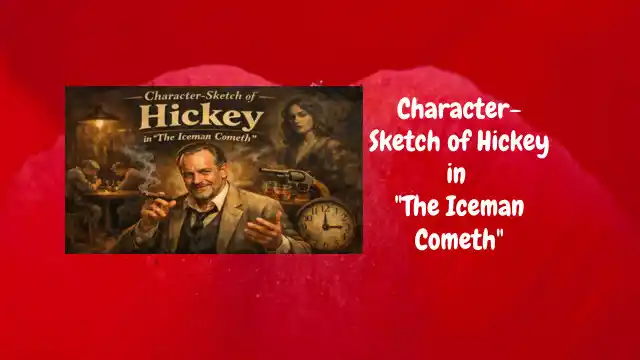
At first glance, Hickey appears to be cheerful, friendly, and full of life, acting as the emotional center of the group of derelicts and dreamers who inhabit the bar. Yet, beneath this jovial exterior lies a man burdened by guilt, inner conflict, and a desperate desire for peace. Unlike his earlier visits, Hickey now advocates a disturbing philosophy—urging others to abandon their “pipe dreams” and face the harsh truths of reality.
Hickey’s character serves as a catalyst for the play’s central conflict. His relentless attempt to strip others of their illusions not only disrupts their fragile sense of happiness but also reveals his own troubled psyche. Ultimately, his confession exposes the tragic irony of his mission: in trying to liberate others, he is himself trapped by guilt and self-deception.
Thus, Hickey stands as a powerful representation of the human struggle between illusion and reality, making him one of the most memorable and tragic figures in modern drama.
In Harry Hope’s bar there are many drunkards who remain lost in their pipe dreams. Their lives are devoid of joys. They wait for Hickey who always visits the bar to celebrate his friend Harry Hope’s birthday. Hickey is such a jolly fellow that he makes all of them delighted.
Hickey’s Personal Appearance:
Hickey is about fifty, medium height, stout figure. His face is round, smooth and big boyish. He has bright blue eyes, a button nose and small pursed mouth. His head is bald except for a fringe of hair round his temples and the back of his head. He wears a salesman’s winning smile. His twinkle with humour and delight. He has a friendly generous personality that attracts everybody to him. His manner is full of an efficient, business-like approach. He asks Rocky to do his duty and bring on the rat poison.
Hickey’s Warm Welcome:
Hope welcomes Hickey who shakes hands with Mosher and Mcgloin and others. Rocky hands over the key to his old room. Hickey tells that he is tired and will have a bit of sleep before doing anything else. Hope remarks that it is for the first time that he finds Hickey worry about sleep. To give company he takes drink. Hope asks if he has become President of W.C.T.U. or has joined Salvation Army. Hope asks Rocky to take away the bottle for they do not want to tempt him into sin. All laugh but Hickey admits that now he is a changed man. Hope suggests to sing in the chorus:
“No drunkard can enter this beautiful home.”
Hickey clarifies that he is not against drinking but he has got rid of pipe dream that had been making him miserable.
Hope asks Hickey to have a drink at least in the name of Christ. Hickey does not intend to spoil their joyfulness.
Hickey’s Call for Return to Reality:
Hickey asks his friends to come out of the world of imagination. Nobody can make his tomorrow bright without working hard today. It is useless to waste time in pipe dreams. It is no better than poison that will ruin their lives. It will never fill their minds with peace. In fact, they are deceiving themselves by neglecting bitter reality of life. He presents his own example before them. There was a time when like them he too used to be over drunk all the time. But now he does not drink. He has become a new man. He faces reality with boldness. Now he is honest with himself. He knows what he is. It is useless to dream what he may be tomorrow. But for this realization a bit of determination and resolution ought to be developed.
I meant save you from pipe dreams. I know now, from my experience, they’re the things that really poison and ruin a guy’s life and keep him from I knew how free and contented I feel now. I’m like a new man. And the cure for them is so damned simple, once you have the nerve. Just the old dope of honesty is the best policy-honesty with yourself, I mean. Just stop lying about yourself and kidding yourself about tomorrows.
Hickey’s Practical Suggestions:
Hickey asks all to give up pipe-dreams and recognize the truth. He begins with Harry Hope who dreams that he would walk round the ward tomorrow to meet his friends. But he knows well that he will never take that walk. Hope contradicts him saying that he is going to take it. Hickey too confirms it saying that this time he will help him in doing that for after that he will experience real peace.
Now Hickey turns to Jimmy Tomorrow and asks him to try to get his old job back. There should not be any talk of tomorrow. On getting back the job he will feel peace of mind. When Jimmy tries to speak otherwise Hickey asks him to remain silent. But Jimmy claims that he has just made up his mind that he will do it as soon as he gets back his lost strength. Hickey appreciates his spirit. Hickey promises to help in that matter. He includes all the rest of them, ladies too to realize the fact.
Larry approves Hickey’s attempt to expose the reality. The place had become the palace of pipe dreams. But Hickey blames Larry too for being lost in pipe dream. He asks Larry to think himself how to get rid of the miserable situation. Larry asks Hickey to mind his own business. It is not good in keeping them all in suspense. They wish to know how Hickey is going to save them. Hickey asks Larry not to be upset. They all have always been good friends. Larry supports the claim. Hickey appreciates the spirit. He looks round and finds that others have forgotten their drinks. He asks them not to be serious but come on and drink. They all drink. He asks them to have another. Hickey refuses to drink and asks others to follow his example.
No, boys and girls, I’ve never known what real peace was until now. It’s a grand feeling, like when you’re sick and suffering like hell and the Doc gives you a shot in the arm, and the pain goes and you drift off. (His eyes close) You can let go of yourself at last. Let yourself sink down to the bottom of the sea. Rest in peace. There’s no farther you have to go. Not a single damned hope or dream left to nag you.
Hickey’s Claim—His Personal Experience:
Hickey claims that he had forgotten the true pleasure of life when he used to drink to be lost in pipe dreams. When he has given up drinking, he is enjoying himself in real peace of mind. It is a sublime sense that is not attained with recognizing the basic truth of life. The world of imagination is bright but relieves for a short while. Permanent peace of mind is the outcome of a brave struggle in life. To make his view-point clear Hickey refers to a sick man suffering bitterly. The doctor gives an injection and the pain disappears. The patient’s mind feels at case. Only the patient knows the worth of that injection and joys of that ease. Likewise, these drunkards can’t know what a great feels the true peace of mind is. The man feels satisfied in what he is. He does not need to have hopes or dreams for future to feel happy for contentment is the greatest wealth in the world.
I know every one of you, inside and out, by heart. I may have been drunk when I’ve been here before, but old Hickey could never be so drunk he didn’t have to see through people. I mean, everyone except himself. And, finally, he had to see through himself, too. But here’s the point to get. I swear I’d never act like I have if I wasn’t absolutely sure it will be worth to you in the end, after you’re rid of the damned guilt that makes you lie to yourselves, you’re something you’re not, and the remorse that nags at you and makes you hide behind lousy pipe dreams about tomorrow. You’ll be in a today where there is no yesterday or tomorrow to worry you. You won’t give a damn what you are any more. I wouldn’t say this unless I knew, Brothers and Sisters. This peace is real! It’s a face! I know! Because I’ve got it! Here! Now! Right in front of you! You see the difference in me!
Hickey claims that all people present there are well-known to him. He has passed such a long time with them that he well-acquainted with their inward thoughts also. He knows what they really are in what pipe dreams they have lost themselves. It is true whenever he met them, he was overdrunk but his senses are so sharp that nothing could remain hidden from his perception. But it was great irony that even in that state he could not know himself. Being overdrunk he too was lost in a pipe dream. But now he has got rid of that pipe dream. He has realized what he really is and everybody can make the great difference in him. He is happy and satisfied. He is not willing to drink for he does not need any intoxication to forget reality. He asks all these people to get rid of their pipe dreams. They should give up the artificial means of forgetting reality. They should try to attain the real peace of mind that is not to be disturbed by any today, yesterday or tomorrow. It is a guilt to remain blind to reality. It is no life that they are trying to deceive themselves.
Hickey-As A Killer:
Hickey tells all of them that he has given up drinking since his wife’s death. His overdrinking made him deprived of his beloved wife. Since her death he has not touched wine. Larry accuses Hickey for forcing his wife Evelyn to commit suicide. Hickey advises Larry not to conclude anything without having complete knowledge. In fact, she has not committed suicide. When he is alive there was none to treat her ill or force her to do that. He is sorry to tell them that she was killed.
Later on, Hickey tells that his wife Evelyn always remained very kind to him and forgave all of his guilts saying that he will not do that again. It was her pipe dream that had no reality for he never gave up his wrong doings. She still kept on saying that he would not do that again. Her kind attitude irritated him so greatly that he killed her to end her pipe-dream.
“Oh, that’s all right, Larry. But don’t jump at conclusions. I didn’t say poor Evelyn committed suicide. It’s the last thing she’d ever have done, as long as I was alive for her to take care of and forgive. If you’d known her at all, you’d never get such a crazy suspicion. (He pauses-then slowly) No, I’m sorry to have to tell you my poor wife was killed.”
Hickey accounts for his wife’s kind behaviour to him. She loved him so deeply that she was blind to his faults. He used to drink in excess and have relations with other women but she always forgave him with the belief that he would never do that again. It was her pipe dream. But this overkind attitude irritated Hickey. He wished for her anger when he was in the wrong. He began to suffer heavily with the sense of guilt. It became intolerable. He had only two options either to kill her or himself. He knew she would not be able to live without him. To save her from that grief he decided to kill her when she was in sound sleep. Thus, she died in peace and he too attained peace by getting rid of that heavy sense of self-guilt.
And then I saw I’d always known that was the only possible way to give her peace and free her from the misery of loving me. I saw it meant peace me, too, knowing she was at peace. I felt as though a ton of guilt was lifted off my mind.
A Man with Divided Self:
Hickey confesses that he killed his wife but it can never be denied that he loved her very much. He suffers from a split personality. In that case the mind is for all psychological purposes becomes divided into two contradictory parts. One is dominated by reality and the other by imagination. To some extent everybody suffers from these two but mental harmony saves mind from being separated. Here in case of Hickey his realistic self has confessed the guilt of killing the wife but his other self denies for the vice.
HICKEY. (bursts into frantic denial) No! That’s a lie! I never said-! Good God, I couldn’t have said that! If I did, I’d gone insane! Why, I loved Evelyn better than anything in life! (He appeals brokenly to the crowd) Boys, you’re all my old pals! You’ve known old Hickey for years! You know I’d never— (His eyes fix on HOPE) You’ve known me longer than anyone, Harry. You know I must have been insane, don’t you, Governor?
Hope replies that he does not care for him. Moran comes forward to arrest Hickey but he claims that he has been insane and all the people present there would testify it. But Moran, the detactive calls it his cunning.
Hickey—The Castaway:
Within no doubt the whole company of drunkards and dreamers go against Hickey and discards him regarding him as a mad man.
Hope declares that Hickey is mad and his madness is exposed in his efforts to bring all of them about peace by giving up wine. All confirm Hope’s viewpoint. Moran is surprised to see how these people are trying to defend a murderer. But by the time Hickey’s realistic self dominates his mind and he tells Moran.
HICKEY. (with a strange mad earnestness) Oh, I want to go, Officer. I can hardly wait now. I should have phoned you from the house right afterwards. It was a waste of time coming here. I’ve got to explain to Evelyn. But I know she’s forgiven me. She knows I was insane. You’ve got me all wrong, Officer. I want to go to the Chair.
Hickey further explains his strange state of mind.
HICKEY. (as they start walking toward rear-insistently) All I want you to see is I was out of my mind afterwards, when I laughed at her! I was a raving rotten lunatic or I couldn’t have said—Why, Evelyn was the only thing on God’s earth I ever loved! I’d have killed myself before I’d ever hurt her! (They disappear in the hall. HICKEY’S voice keeps onprotesting.)
But Hickey is arrested. Now all of them take their glasses. Rockey asks Hope to permit all to get drunk.
Hugo tells Larry that it is good Hickey has been taken away by the police. According to Hugo, Hickey was mad and was filling minds of all those people with crazy thoughts and lies. He was claiming that pipe dreams would ruin their lives and they all should recognize the truth and come in reality. He was asking them to give up drinking. They can’t live without drinking. He was ill-intentioned. He was trying to kill them. It is good that they have got rid of him.
It is a great irony that they regard Hickey as a mad man who was the only sane man among them.
“I’m glad, Larry, they take that crazy Hickey avay to asylum. He makes me have bad dreams. He makes me tell lies about myself. He makes me want to spit on all I have ever dreamed. Yes, I am glad they take him to asylum. I don’t feel I am dying now. He vas selling death to me, that crazy salesman.”
Hickey’s Effect on Larry and Parritt:
Hickey’s confession of guilt inspires Parritt to confess his own guilt to Larry. But Larry does not pay attention to him. Hickey’s confession affects Larry too. He feels sympathy with Hickey. All dreamers declare Hickey was insane therefore, he suggested all these people to transport their minds from imagination to reality. Now once again they restore their delight by forgetting reality.
Hope decides to celebrate his birthday party once again in full joyfulness. Suddenly he marks that Larry is missing.
Rocky remarks that Larry’s eyes are shut. He seems asleep. He ought to be given a drink. But Larry comments in a sad tone:
LARRY. (torturedly arguing to himself in a shaken whisper) It’s the only way out for him! For the peace of all concerned, as Hickey said! (Snapping) God damn his yellow soul, if he doesn’t soon, I’ll go up and throw him off! —like a dog with its guts ripped out you’d put out of misery!
The sound of something hurtling down is heard. It is learnt that Parritt has committed suicide. No one gives importance to it but Larry remarks:
LARRY. (in a whisper of horrified pity) Poor devil! (a long-forgotten faith returns to him for a moment and he mumbles) God rest his soul in peace. (He opens his eyes—with a bitter self-derision) Ah, the damned pity—the wrong kind, as Hickey said! Be God, there’s no hope! I’ll never be a success in the grandstand— or anywhere else! Life is too much for me I’ll be a weak fool looking with pity at the two sides of everything till the day I die! (With an intense bitter sincerity) May that day come soon! (He pauses startedly, surprised at himself—then with a sardonic grin) Be God, I’m the only real convert to death Hickey made here. From the bottom of my coward’s heart I mean that now!
Hope is lost in delight. All other people are enjoying themselves in their pipe dreams. Only Larry stares in front of him.