Introduction:
Cultural synthesis in the poetry of Gabriel Okara—the blending of diverse cultural elements into a harmonious whole—is a central theme in the poetry of Gabriel Okara, one of the pioneering voices of modern African literature. Writing during a period marked by colonial influence and the search for postcolonial identity, Okara explores the tension and interaction between traditional African values and Western modernity. His poetry does not advocate a rejection of either culture; instead, it seeks a meaningful integration that preserves the richness of indigenous heritage while engaging with contemporary realities.
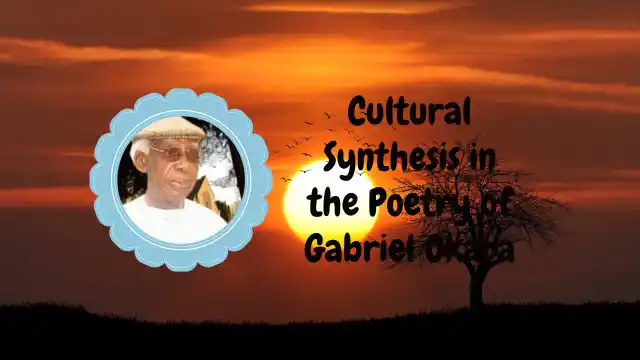
Deeply rooted in his Ijaw cultural background, Okara’s work often reflects African thought patterns, oral traditions, and linguistic rhythms, even when expressed in the English language. By infusing English with the syntax and sensibility of his native tongue, he creates a unique poetic style that itself becomes a form of cultural synthesis. His poems frequently portray the inner conflict of individuals caught between two worlds, highlighting both the loss and the possibilities that arise from cultural contact.
Thus, Okara’s poetry stands as a significant artistic attempt to reconcile tradition and modernity. Through his exploration of identity, language, and cultural coexistence, he contributes to a broader understanding of how cultures can merge without losing their distinctiveness, making his work both relevant and enduring in the study of postcolonial literature.
Conflict Between Tradition and Modern Influences:
Okara saw himself and other members of the educated elite being tempted to abandon tradition in favour of modern influences and was filled with trepidation at the prospect of this happening. He felt that Africans would fall into a trap, by choosing a way of life built on shifting sands which would freeze them like the character in You Laughed and Laughed and Laughed. The answer to the problem as indicated in The Fisherman’s Invocation, is to effect reconciliation, tọ bring the two sets of values together by ensuring that the new values have a strong link with tradition. Okara is obviously a writer who values traditional cultural values but who also realises that it is futile in this day and age to ignore the concrete reality of modern technology and civilization, or what is referred to as ‘western civilization’.
Limitations and Complexity of Okara’s Ideology:
This account of Okara’s authorial ideology is obviously a simplified one and can be accused of reductionism. There are indeed other currents that should be taken into account, such as the fact that the poet’s development in ideological consciousness was a process, and crystallization of ideology that appears in The Fisherman’s Invocation is the result of that process; such as the religious undercurrents and the mysticism referred to earlier while there is a strong element of mysticism, his poetry is devoid of the subjective idealism of Senghor.
There is no suggestion that the African has certain qualities and talents that other races do not have. Such symbols as the ‘mystic drum’, ‘the sun’, ‘the black’ are only used as aesthetic motifs that express the poet’s vision of tradition as a life-giving force. Nor is the dialectic between tradition and modern influences couched in political terms in Okara. There is no overt reference to Neo-colonialism or cultural imperialism, and, unlike Ngugi, Okara does not relate the problem of culture to the economic sphere. His poetry is in that sense apolitical and would seem to indicate the need for further development in consciousness on the part of the writer.
Aesthetic Ideology and Poetic Techniques:
On the other hand, Okara the poet is guided by a consciously formulated aesthetic ideology. His poetry reveals certain patterns—the use of images of nature, and of things associated with the African traditional mode of life, the use of simple words, the creation of rhythms patterned on the drumbeat, the use of Ijaw modes of expression and so on. All this is clearly linked to his authorial ideology, and in few poems where images referring to modern technology an employed it is quite clear that they are used to show the contrast in values that the poet is anxious to articulate. This is true of Piano and Drums, and You Laughed and Laughed and Laughed.
Simplicity and Complexity in Okara’s Poetry:
The recourse to images referring to nature and tradition gives Okara’s poetry an aura of simplicity, rather like Blake’s Songs of Innocence and Songs of Experience. This simplicity conceals a complexity of thought and poetic structure which at times makes Okara’s poetry quite difficult to interpret, although it remains immensely readable. A close examination of Okara’s poetry reveals that there is no emotion in the manner in which it gives expression to the ideological imperative.
There is no attempt to sentimentalise the problem, yet the genuineness with which the poet articulates it and the lyrical quality of the verse speak of deep feeling. The reader’s own ideology may be quite at variance with the poet’s, yet Okara says what he has to say so naturally and often with such grace and lyricism that the reader cannot but derive pleasure from experience of reading the poetry. Much of the pleasure comes from a combination of rhythm and the melodious chiming of sounds. This is even true of such a slow-moving poem is The Snowflakes Sail Gently Down:
“The snowflakes sail gently
Down from the misty eye of the sky
and fall lightly on the winter-weary elms.”
Use of Poetic Devices: Parallelism and Repetition:
This lyrical quality results from a judicious use of poetic devices such as parallelism, repetition and linking, all of which are fully utilized in The Fisherman’s Invocation. In the following lines, for example, parallelism consists in repeating elements at the beginning and the end while invariant elements occur in the middle:
“You are seeing the sun in my hands
You are seeing Gods in my hands You are seeing the Back in my hands
You are seeing the Front in my hands.”
Use of Linking and Incantatory Effect:
In the following lines the device of linking—where a word used in one line is repeated in the next—is effectively employed together with free verbal repetition to produce an incantatory effect:
“And let O let the deep drums
of deep waters boom and mingle
with deep drums of deep Gods
in their play in your inside.”
Dramatization and Objective Correlative:
A device Okara uses particularly effectively is dramatization. This is seen in many of the major pieces, including, The Call of the River Nun, You Laughed and Laughed and Laughed, The Mystic Drum and The Revolt of God. In these poems, the poet creates dramatic situations. The device is particularly effective in The Fisherman’s Invocation, in which we are presented with two principal actors—the protagonist or the fisherman and the other person, who is not clearly identified. The two are involved in both an activity and communicative act. These are the casting of a net, the paddling of a canoe, an invocation, a dance and a concluding ceremony. By the time we are told in the last movement that the celebration for the Child-Front is over, we too have gone through the experience of dancing and have witnessed the birth of the Child-Front. Okara has created an objective correlative, a set of events and objects which together form a vivid picture of the reconciliation of tradition and modernity.
Related Questions with the same Topic:
“Okara advocates neither a total rejection of modern civilization, nor a complete return to the past.” Discuss with reference to his poems.
Or
Write a note on ideology and communication in Okara’s poems.