Introduction:
Realistic traditionalism in the poetry of Gabriel Okara reflects a unique blending of indigenous African cultural values with modern poetic expression. As one of the foremost voices in African literature, Okara presents the realities of his society while remaining deeply rooted in traditional beliefs, customs, and worldview. His poetry does not merely romanticize the past; rather, it realistically portrays the tension between the old African way of life and the influence of Western civilization.
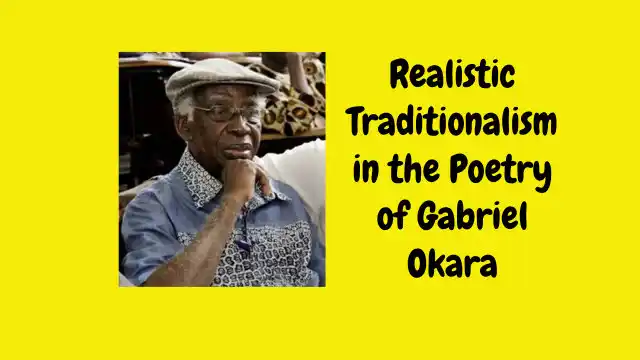
Okara’s work is marked by a sincere effort to preserve the essence of African tradition, especially through language, imagery, and symbolism. He often incorporates native thought patterns and translates them into English in a way that retains their original cultural flavor. This technique gives his poetry an authentic voice, allowing readers to experience the richness of African heritage alongside the challenges posed by cultural change.
At the same time, his poetry reflects realism by addressing themes such as identity crisis, cultural conflict, alienation, and the loss of traditional values in a rapidly modernizing world. Through this realistic lens, Okara highlights the struggles of individuals caught between two contrasting cultures. Thus, his poetry stands as a powerful expression of realistic traditionalism, where tradition is neither idealized nor rejected, but examined thoughtfully within the context of contemporary reality.
Gabriel Okara is one of the oldest contemporary writers from English-speaking Africa. He started writing poetry in the early 1950s, so that some of his poems were written before the nationalist campaign for independence in his country had reached its peak, while some were written as late as 1976, sixteen years after Nigeria had attained independence. Much of his poetry is reported to have been lost, and what has survived is published in The Fisherman’s Invocation.
Some of the poems in the collection evidently fall outside the central theme that runs through the major part of the volume, which is concerned with exploring the dialectic between tradition and modern influences, including the influence of technology and western civilization. Among the major poems that fall outside this central concern are The Revolt of the god, Franvenkirche and in a sense, The Snowflakes Sail Gently Down.
In the first- mentioned poem, written in 1969, Okara is as far from his central theme as can be. In this rather unsuccessful poem, he dramatises the idea that gods are in reality creations of human beings who create these figments in their minds and then turn round to worship them. The light hearted tone of this poem contrasts rather sharply with the style of Franvenkirche, which Okara wrote in memory of his visit to Our Lady’s Cathedral in Munich, West Germany. This monument fascinates Okara and gives him a feeling that makes his hands one ‘with those that set brick upon brick/to build this memorial’. These lines strike the present writer, who witnessed Okara being fascinated in the same way by Great Zimbabwe in 1983.
On reaching that part of the lower enclosure of Great Zimbabwe which pierces the sky in the form of a temple, Okara touched it with great reverence, saying, ‘Let my hands touch where our ancestors touched’. The incident at Great Zimbabwe and the poem on the Munich Cathedral reveal something of Okara’s religious turn of mind.
In The Snowflakes Sail Gently Down, Okara creates a poem that focuses on one his most frequently used motifs—the dream. The motif is used in such poems as Rural Path, Silent Girl, To Star and The Fisherman’s Invocation. In The Snowflakes the poet sees snowflakes coming gently down as he sleeps and succeeds in creating a dream like atmosphere. But this poem points obliquely to the poet’s central theme—that of his roots, of his culture on the one hand, and modernity on the other, the two being seen in binary opposition at first.
The Contradiction between Tradition and Modernity:
Contrast Between Old and New Culture in Piano and Drums:
In Piano and Drums, the contrast between the old and new culture is shown in their apparently contradictory influences on the protagonist. The contradiction is expressed in terms of the very different ways in which the rhythmic drums and the music of the piano affect him. The drum is a symbol of tradition and it is associated with natural images—’the mystic rhythm’, ‘the panther ready to pounce’, ‘the leopard snarling’ and ‘the naked warmth of hurrying feet’. The drum is also associated with life. Everything is galvanised into action by its sound. The protagonist himself is turned into a frenzy of activity, almost wild, like Rousseau’s noble savage:
“And my blood ripples, turns torrent,
topples the years and at once I’m
in my mother’s laps a suckling;
at once I’m walking simple
paths with no innovations,
rugged, fashioned with the naked
warmth of hurrying feet and groping heart
in green leaves and wild flowers pulsing.”
The Piano as a Symbol of Modern Complexity:
The wailing piano, on the other hand, only manages to produce discordant and what appear to be futile sounds. It speaks of complex ways in tear-furrowed concerto. Instead of making him feel at home with his environment it takes him to ‘far-away lands’ and ‘new horizons’ speaking in such strange sounds as ‘diminuendo’, ‘counter-point’ and ‘crescendo’ so confused in the piano itself with its own complex system that it ends in the middle/of a phrase at a dagger point’.
Tension Between Tradition and Modernity:
The tension between the past and the present cum future, between tradition and modernity, is at its worst in this poem. The poet is ‘lost’, he keeps ‘wandering’ not knowing which rhythm to follow—that the jungle drums or that of the piano’s ‘concerto’. The poet or protagonist of course stands not only for himself, but for his generation, his class, which finds itself facing this dilemma of a society in transition. The class’ confusion and lack of sense of direction is symbolised by ‘the morning mist’ in which it is lost in an age which is at a riverside, namely at cross-roads.
Conflict in Other Poems:
The conflict persists in such poems as Were I to Choose, Spirit of the Wind, The Mystic Drum and You Laughed and Laughed and Laughed. In the last- mentioned poem there is no hint of any kind of synthesis between tradition and modernity. Okara is firmly on the side of tradition. The contradiction between the two is expressed in terms of the incongruity between the traditionalism of the poet-protagonist and the contrary views and outlook of another person who scorns tradition and takes pride in modern technology and new ideas. Here modernity is represented by imagery of the motor car’ and ‘ice-blocks’. When the traditionalist sings, his song is so unpleasant to the modern man that it strikes the latter as a ‘motor car misfiring/stopping with a choking cough’. He is not in touch with mother earth and with nature because he shuts himself in this machine—the motor car—which is mechanical and prevents him from growing close to nature. His laughter is consequently unnatural and as cold as ice-blocks and freezes the one who laughs:
“You laughed and laughed and laughed
But your laughter was ice-block
laughter and it froze your inside froze
your voice froze your ears
froze your eyes and froze your tongue.”
Natural Self of the Protagonist:
The protagonist on the other hand is his natural self. He does not use a car as a means of transport but walks on his bare feet. The rhythm of his dance is that of talking drums, and he opens not a car, but his ‘mystic inside’, and when he laughs, he laughs a natural laughter which, far from destroying him or his rival, positively affects and transforms the latter. It warns the man of modern ways, and it illuminates him by its fire of life:
“My laughter is the fire
of the eye of the sky,
the fire of the earth, the fire of the air,
the fire of the seas and the
rivers fishes animals trees
and it thawed your inside,
thawed your voice, thawed your
ears, thawed your eyes and
thawed your tongue.”
Transformative Power of Natural Laughter:
Because the laughter of the protagonist issues from a life-giving force, it warns and invigorates every sense, every organ and every tissue of the other man so that awakening to this new life he is filled with the amazement and asks for an explanation:
“So a meek wonder held
your shadow and you whispered:
Why so?
And I answered:
Because my fathers and I
are owned by the living. warmth of the earth
through our naked feet.”
Criticism of Okara’s Traditionalism:
In this poem Okara can be accused of being downright reactionary. He sees no compromise between tradition on the one hand and technology and modern or western influences on the other, and he seems to be advocating a Rousseauesque return to the past. It is as if walking on foot is inherently virtuous and using a car inherently bad and evil. There is no indication of the poet’s attempt to explore the conditions under which this or what means of transport is either salutary or likely to dehumanise one.
Romanticism and Nature Imagery:
There is a strong element of romanticism in Okara’s traditionalism. This romanticism comes out in the ubiquitous images of nature that occur in ‘You Laughed’ and other poems. Throughout this collection of poems there are references to the earth, the sky, fire, the sea, rivers, waves, fish and other natural objects. In this set of images, we can see a combination of romanticism and traditionalism—a refusal to come to terms with the world of modern technology. The drum is also a key symbol. Okara is anxious to be guided by the rhythm of the drum, and following the rhythm of the drum symbolises obedience to nature, being guided by tradition. He or she who refuses to obey the drum is only heading for destruction. This seems to be the message of The Mystic Drum where everything else follows the beat of the drum—people, fishes, the dead, trees, the sun and the moon—everything except she who stands behind a tree ‘with leaves around her waist’, for ‘she only smiled with a shake of her head’. She refuses to accept the rhythm of the drum and consequently she gets destroyed. When the mystic drum stops beating everything also finds its place but not the girl:
“And behind the tree she stood
with roots sprouting from her
feet and leaves growing on her head
and smoke issuing from her nose
and her lips parted in her smile
turned cavity belching darkness.”
Social and Spiritual Themes in Okara’s Poetry:
Piano and Drums, You Laughed and Laughed and Laughed. Once Upon a Time and other poems are concerned with matters of a social nature. They allude to the contradictory forces that put Okara and other members of the African intelligentsia of his time on the horns of a dilemma. But some of the other poems seem to be concerned more with spiritual matters. The Call of the River Nun and Spirit of the Wind can be included in this category. The Call of the River Nun has a distinctly religious flavour. There is, in the first place, the use of the word ‘nun’, which has an obvious religious connotation in the context of Christianity. On the other hand, ‘the river nun’ could be a mermaid. There are several references to mermaids in The Fisherman’s Invocation. Okara may be using the word with both meanings in mind. With regard to the Christian sense of the word, there is in fact an allusion to Gerard Manley Hopkin’s poem The Wreck of the Deutschland, which deals with the drowning of nuns, one of whom calls out like Okara’s nun.
Spiritual Interpretation and Prayer:
Whatever meaning the reader attaches to the word ‘nun’—and both are perfectly acceptable—Okara’s poem ends as a prayer. The call of the river nun is transformed into the call of the protagonist’s river:
“My river’s calling too!
Its ceaseless flow impels
my found ring canoe down
its inevitable course.”
Spiritual Anguish and Inner Conflict:
In the final stanza there is an anguished call to the poet’s God, to his ‘incomprehensible God’. This spiritual anguish is akin to the inner turmoil that is depicted in Spirit of the Wind, when the poet contrasts the freedom with which the storks move ‘beyond the god’s confining/hands’ and his own imprisonment, which gives him the sense of his ‘spirit’, his ‘stork’, being ‘caged’:
“But willed by the gods
I’m sitting on this rock
watching them come and go
from sunrise to sundown, with the spirit
urging within.”
Conclusion: Clash of Opposing Forces
There is unrest in him, a feeling of being spiritually shackled as he struggles to break free. This turbulence that Okara expresses is similar to the tension that characterises what he sees as the relations between old and new values in his society. So, whether he is treating a spiritual or social theme Okara tends to see a violent clash between two principles and he becomes the focus of that violent clash-he and his fellow intellectuals, in whom the antagonistic forces to meet.