Introduction:
There is satiric-ironic treatment of prayer in the play Tughlaq. In Girish Karnad’s play Tughlaq, the act of prayer becomes a powerful dramatic device through which the playwright exposes the contradictions between religious ideals and political reality. Instead of treating prayer as a sacred, spiritual practice, Karnad often frames it within satire and irony to reveal the moral decay, hypocrisy, and opportunism of Sultan Muhammad-bin-Tughlaq and the society around him.
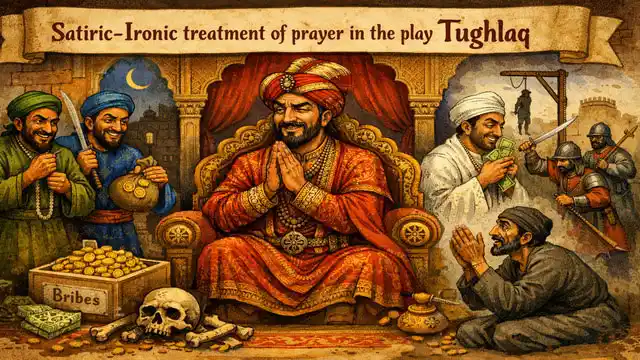
Prayer, which traditionally symbolizes humility and divine connection, turns in the play into an instrument of pretension and public performance. The Sultan’s outward displays of devotion contrast sharply with his violent actions, creating an ironic gap that questions his sincerity and the legitimacy of his rule.
By blending satire with irony, Karnad not only comments on Tughlaq’s character but also critiques the broader socio-political misuse of religion for power, thereby giving the play a timeless relevance.
Muhammad Tughlaq remains one of the most debated monarchs in Indian history. He was a man of learning, courage, vision, and idealism, yet his reign continues to be widely misunderstood. Traditional Muslim historians often denounce him as a shame to Islam, though this view is unfounded. In reality, Tughlaq was a sincere follower of the faith. Well-versed in Islamic teachings and the Quran, he made the five daily prayers compulsory for all Muslims, just as prescribed in the holy text.
As a ruler, he was known for his fairness and open-mindedness. He made no distinction between Hindus and Muslims, believing firmly that harmony between the two communities was vital for the nation’s progress and stability. To nurture this unity, he worked constantly to strengthen ties between them and even removed the Jiziya tax imposed on Hindu subjects.
Sultan Muhammad Tughlaq was strict about his religious duties and never neglected his prayers. His devotion to Islam, combined with his benevolence toward Hindus, puzzled the orthodox clergy. At the same time, many Hindus doubted his intentions, suspecting that his friendliness concealed hidden motives. Despite his efforts, mistrust from both sides continued to shadow his rule.
Mixing Religion with Politics:
Many people believe the Sultan failed because he attempted to combine religion with political affairs. They argue that politics and religion are two separate domains that should never overlap. Both assumptions are misleading. Politics without the guidance of morality or religion easily turns into oppression. Some form of restraint must exist, and religion alone offers ethical principles that can keep political power in check.
History shows that several rulers who outwardly posed as religious were not genuinely pious. They faced ruin because they used religion merely to fulfil personal ambitions, even distorting the purpose of prayer for political gain. On the other hand, there were rulers who, in trying to appear generous and just, violated religious principles altogether.
Religion, therefore, cannot be blamed for Muhammad Tughlaq’s decline. It is true that he was a well-read scholar of Islam and the Quran and that he observed Namaz with discipline, even making it compulsory for Muslims.
However, knowledge and prayer alone do not make one a sincere Muslim. Islam offers a complete lifestyle and provides clear guidance for every aspect of human conduct. It promises success and dignity only to those who genuinely practise its teachings. Anyone who exploits religion for personal benefit is a hypocrite and destined to fail.
Misuse of Prayer:
Sultan Muhammad Tughlaq’s downfall can be traced to his misuse of prayer. His decision to murder his father and brother during the sacred hour of prayer is indefensible from any angle. He turned prayer into a tool for fulfilling his personal ambition of claiming the throne of Delhi. As a result, the people began to distrust him.
When he removed the Jiziya tax for Hindus, they assumed he had some hidden motive behind the gesture. Muslims, on the other hand, believed that since the Sultan had lost respect among them, he was attempting to win Hindu support. At the very beginning of the play, we encounter two examples of the Sultan violating Islamic principles: first, the assassination of his father, and second, the abolition of the Jiziya tax imposed on Hindus.
Committing crimes and sins while hiding behind religious authority:
Consider the incident of Sheikh Imamuddin’s death. The Sheikh, a fierce critic of the Sultan, was revered as a saint across the land. He encouraged the people to revolt, and under his influence, half the city of Kanpur was set ablaze. He publicly accused the Sultan of murdering both his father and brother, condemned him as anti-Islamic, and declared him a disgrace to the faith.
From an Islamic perspective, killing one’s own father is indeed a grave sin deserving capital punishment. However, such an act alone does not make a person an enemy of Islam, nor does it justify the Sheikh’s call for rebellion against a ruler who genuinely seeks justice for his subjects. Yet, the Sultan’s response—having the Sheikh killed through trickery—also stands at odds with religious principles. No faith grants a ruler the right to eliminate an adversary through deception and treachery.
Hypocrisy at the name of religion and Prayer:
The Amirs, Sayyids, and Sheikhs are displeased with the Sultan for various reasons. Feeling that he does not show proper respect to the religious class—and angered because some among them have been jailed or driven into exile—they conspire to murder him. Shihabuddin, once a loyal companion of the Sultan, joins their plot, and together they decide to assassinate the Sultan during prayer.
Ironically, these same religious leaders who had once condemned the Sultan for killing his own father are now prepared to shed his blood without hesitation. They accuse the Sultan of supporting the Hindus, whom they dismissively brand as unbelievers, yet they ignore the fact that the very idea to kill the Sultan comes from Ratan Singh, who ultimately betrays them by revealing the scheme to the Sultan.
As a result, the conspiracy collapses. Shihabuddin is killed, and the Amirs, Sayyids, and Sheikhs are arrested. In this incident, the Sultan cannot be blamed for Shihabuddin’s death; instead, the fault lies entirely with the Amirs, Sayyids, and Sheikhs.
Banning Prayer Is Contrary to Every Faith:
After this incident, the Sultan prohibits all forms of prayer and declares that anyone caught engaging in worship will face harsh punishment. This is the one action that truly positions him as acting against Islamic principles and makes him worthy of removal from the throne. However, it remains uncertain whether this detail is a product of the playwright’s imagination or grounded in historical evidence.
The Sultan’s policies regarding the relocation of his capital and the introduction of token currency do not violate any religious doctrine. Recent scholarly studies indicate that adequate provisions were made for the welfare of the people and that the hardships described by Karnad were not as severe in reality.
The Poetic Justice:
In the matter of Najib’s murder, it can be argued that a kind of poetic justice takes place. He ultimately faces the same fate he once designed for Sheikh Imamuddin. The saying “you reap what you sow” fits well here. Najib orchestrated Imamuddin’s death, and he, in turn, meets a similar end. His stepmother has him poisoned because she believes that he is misleading the Sultan. Yet, her death cannot be defended on moral grounds. Even the Sultan confesses that he is uncertain whether she truly had Najib killed. Once again, the Sultan stands at fault for making no attempt to uncover the truth behind Najib’s death.
The Sultan is often blamed for ordering executions and tortures without proper evidence, but there is no concrete example to support this accusation. The wrongdoings attributed to Aziz and Aazam also fail to hold weight, since these two are fictional characters and bear no historical link to the Sultan or real events.
Downfall of Tughlaq Due to Misusing Prayer and Religion:
The truth remains that it is extremely challenging to apply the true essence of religion to every aspect of life. A ruler must shoulder countless responsibilities—managing allies and adversaries alike, safeguarding the empire, and working for the welfare of his subjects. Inevitably, in this process, he may make errors. Yet such minor lapses are often overlooked if the ruler is fundamentally fair, compassionate, and sincere.
Muhammad Tughlaq’s downfall does not stem from his religious inclination or from blending politics with faith. Rather, his failure arises from his deliberate misuse of prayer. Throughout the play Tughlaq, almost every major figure—from the Sultan himself to religious professionals—manipulates religion to fulfil corrupt motives, which ultimately leads to their ruin.
Their defeat, however, does not imply that politics must be divorced from religion. In Muhammad Tughlaq’s situation, religion itself is not responsible for his collapse. What truly causes devastation, death, and misery for both the Sultan and his people is the conscious abuse of religion by Tughlaq and the clergy.