Introduction of the Poem “The Patriot”:
The Patriot was first published in Browning’s collection Men and Women in 1855. The poem is generally believed to have been inspired by Browning’s observation of the sudden rise and tragic downfall of leaders during Italy’s early and unsuccessful attempts to free itself from Austrian domination between 1841 and 1849.
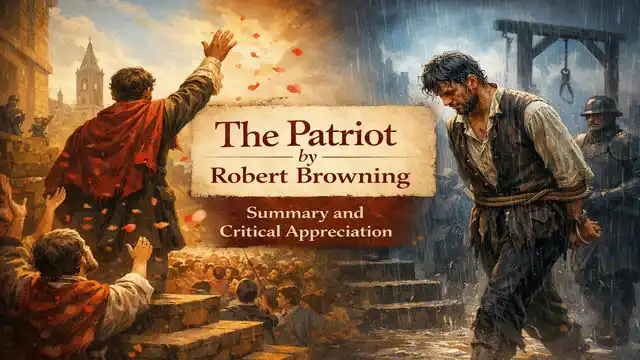
Austrian control over Italy was deeply resented, leading to continuous unrest and public resistance. Incidents like the one depicted in the poem were quite common during this period. However, there is no concrete proof that the poem is based on a real or historically accurate event.
The poem portrays the life of a political leader who once enjoyed immense public admiration but later experiences disgrace and possible execution. The patriot belongs to the Italian town of Brescia and is named Arnold.
Like many figures before him, he becomes a victim of the changing moods of the masses. At one time, he was celebrated and honoured by the people; later, he is mocked by the same crowd, which now takes satisfaction in his suffering and death.
Through this poem, Browning explores themes of politics, patriotism, religious belief, and the grim realities faced by sincere national leaders. It highlights the sacrifices made by such individuals, who are often misunderstood and abandoned by the very people they serve.
The poem serves as a powerful illustration of public ingratitude and human instability. It also conveys the idea that joy is temporary and that every individual must ultimately face the consequences of their actions in life.
Summary of the poem “The Patriot by Robert Browning”:
Grand Reception of the Patriot:
Long ago there lived a celebrated hero named Arnold of Brescia. He had proved his bravery through countless courageous exploits. When he came back to his homeland after overcoming his foe, the people welcomed him with magnificent celebrations. Fragrant flowers and myrtle branches carpeted the road before him. As the crowd shouted one cheer after another, the very rooftops seemed to tremble. Flags fluttered brightly from the church towers, creating a truly splendid and awe-inspiring sight.
Downfall and Public Humiliation:
Barely a year later, the patriot’s fortunes took a tragic turn. He was condemned to death on charges of political wrongdoing. As he was taken to the scaffold, the very people who once admired him now jeered at him, subjecting him to ridicule and disgrace. Rather than bidding him a respectful farewell, they found pleasure in his suffering. The compassion they had shown him the previous year had completely transformed into hatred and hostility.
Physical Suffering of the Patriot:
The patriot was in a wretched and heartbreaking state. His hands were bound so firmly with a rope that it seemed to bite into his wrists. As stones were hurled at him by the crowd and struck his forehead, he could feel the warm flow of blood.
Optimism and Faith in Divine Justice:
The patriot was a man full of enthusiasm and inner strength. Even in failure, he managed to find a sense of triumph. He comforted himself with the belief that God is the only true judge. He was unconcerned about people who receive recognition and rewards in this worldly life. Rather than being honored, he faced completely opposite treatment. Yet he remained confident that God would reward him in heaven, revealing his deeply optimistic outlook.
Theme of the Poem:
In the poem, the poet presents a vivid and realistic portrayal of the mentality of common people. He reveals that the masses lack firmness in their principles and convictions. Because of their unstable nature, they quickly shift their attitudes, opinions, and loyalties. They are highly emotional and sentimental rather than logical or sensible. Guided mainly by feelings, they lose the ability to judge what is right or wrong and refuse to be directed by reason or intellect.
Through the poem, the poet clearly exposes this weakness of human nature. He depicts two contrasting phases in the hero’s life—his rise and his downfall. A year earlier, the people admired the hero and followed him devotedly. Within a year, however, the same people ridicule and insult him. In another scene, when the hero is being punished, the crowd worsens his suffering. As he is led to the scaffold, they stone him mercilessly.
This sharp contrast in the public’s behaviour under different circumstances vividly highlights the unstable and fickle character of the mob.
Like many of Browning’s poems, this one is also pervaded by a spirit of optimism. The final stanza clearly reveals the poet’s hopeful outlook. The patriot is about to be put to death in a deeply tragic and disturbing situation. He stands disgraced, insulted, and stripped of honour, quietly waiting for his execution.
It is indeed painful that the sincere services rendered by a loyal servant of the nation are branded as political crimes and repaid with death. Yet Browning’s philosophy is rooted in faith and hope in God. He suggests that God alone is the true judge, and that He is indifferent to those who have already received their rewards in this world and therefore place no trust in life beyond it.
Critical Appreciation of the Poem “The Patriot”:
Introduction:
The Patriot first appeared in Robert Browning’s renowned collection Men and Women in 1855. Most poems in this volume explore themes that highlight the paradoxes and ironies inherent in human life. Browning expresses deep compassion for those heroic figures who willingly surrender everything in devotion to their homeland. As a whole, the collection vividly presents the intensity of human emotions, the grace of sympathy, and the nobility of courage.
During Browning’s stay in Italy, the country was caught in a fierce nationalist movement against Austrian control. Italians displayed remarkable bravery in their efforts to free their land from foreign rule, and numerous patriots emerged—only to meet tragic ends. In this poem, Browning draws upon one such episode, shaping it into a powerful poetic narrative. By grounding the poem in this historical struggle, he succeeds in giving it a universal and enduring appeal.
Thought – Content:
Once, the patriot Arnold of Brescia was greatly loved and respected by the people. His path was carpeted with sweet-smelling flowers, and he was welcomed with immense joy after his victory. A vast crowd gathered to greet him, overflowing with happiness and admiration. The towers of the church shone brightly, decorated with banners celebrating his success. The atmosphere was charged with excitement as the people honoured their hero. The patriot, in turn, devoted himself entirely to their welfare. There was a bond of mutual love between him and the people.
However, within a year, the people’s attitude towards their hero changed completely. Misfortune overtook him, and the same crowd that once praised him now gathered to witness his downfall. Instead of a grand farewell, he was led away for execution. The people cruelly enjoyed the spectacle; some even hurled stones at him, accusing him of wrongdoing. They mocked, insulted, and humiliated him mercilessly. He was dragged along like a criminal, his hands tightly bound with rope, his forehead bleeding. The treatment he received was deeply degrading and reflected the unstable and selfish nature of the mob. The contrast between his glorious welcome and his shameful departure was shocking.
Yet, despite this apparent defeat, the patriot achieved a moral victory. God alone is the ultimate judge, and He does not reward those who have already received honour in this world. Since the patriot suffered unjustly on earth, he could be certain of divine justice and reward in heaven for his selfless service and sacrifices.
Moral of the Poem:
The poem depicts the painful transformation of a once-admired patriot and leader into a figure condemned as a traitor. Through this tragic shift, the poet highlights how human destiny is often shaped by forces beyond an individual’s control. At the same time, he draws attention to excessive ambition, suggesting that unchecked desire for power or glory can bring about one’s ruin. This idea is reflected in the speaker’s life, as it was his soaring ambition that ultimately caused his fall. By going too far and crossing moral and social limits, he lost the love and support of the people. The poet further conveys that fame, popularity, success, and joy are temporary; no matter how bright they shine, they eventually fade away.
A Note of Optimism:
Like many of Browning’s poems, this one is marked by an underlying spirit of hope. The final stanza, in particular, reveals the poet’s optimistic outlook. Even in apparent defeat, the patriot transforms loss into a moral victory. Though he is unjustly disgraced and put to death by the people of this world, he does not surrender to despair. Instead, he places his faith in the future, believing that God will grant him true justice and reward in heaven for his noble service on earth. He refers to this hope in the following lines:
“Thus I entered Brescia, and thus I go!
In triumphs, people have dropped down dead
Paid by the world, what dost thou owe
‘Me? -God might question; now instead,
Tis God shall repay: I am safer so.”
The Use of Irony:
It is deeply ironic that a man who was once adored as a beacon of hope for his people is later reduced to a figure of mockery and disgrace. Earlier, he enjoyed abundant hero-worship; now he must endure the taunts of a hostile crowd that takes pleasure in his public suffering and execution. Where flowers once carpeted his way on his return to the land, the same people had greeted him with overwhelming enthusiasm and reverence. The poet refers to this fact in the following lines:
“It was roses, roses, all the way,
With myrtle mixed in my path like mad:
The house – roofs seemed to heave and sway,
The church – spires flamed, such flags they had,
A year ago on this very day.”
Form and Structure:
The poem takes the form of a dramatic monologue, presenting a speech by a political figure who was celebrated as a hero only a day earlier but, following an unexpected political upheaval, is now condemned as a traitor. Structurally, the poem is distinctive, consisting of six stanzas with five lines each.
A brief metrical analysis shows that it does not conform to a rigid metrical pattern. Most lines contain nine syllables, though some extend slightly beyond this count. Rather than relying on strict metre, the poet creates musicality through deliberate and effective word placement.
The rhyme scheme, ababa, is consistently sustained across all stanzas. Like many accomplished poems with a fixed rhyme pattern, this work makes generous use of assonance and consonance. The opening two stanzas describe the favourable circumstances of the past. In the third stanza, the poet explains the reasons for the sudden reversal of fortune, particularly how it turned against him.
The fourth and fifth stanzas set the glory of the past against the harshness of the present. The final stanza conveys the speaker’s acceptance of his fate along with a note of hope. Overall, the poem unfolds in a well-organised narrative sequence, moving from the past, through the cause of change, to the present condition, and concluding with a reflective resolution.
The Use of Symbols and Imagery:
The poem is rich in symbolism, and these symbols significantly enhance its meaning. The “rose,” commonly associated with love, represents honour and affection in the poem. The “path” symbolizes the journey of life; in a wider sense, it refers to one’s career, and here it specifically suggests the political journey of the patriot.
The “sun” stands for authority and supremacy, highlighting an overwhelming and uncontrollable power that the patriot attempts to challenge. “Palsied,” traditionally believed to be a curse-induced illness, symbolizes the moral and social sickness of Victorian society. “Rain” usually signifies nature’s blessing, arriving when it is most needed; in this poem, it appears as though the sky is weeping for the patriot’s tragic fate, expressing sympathy and sorrow.
Through these meaningful symbols, the poet effectively presents the life of a patriot caught between the shifting forces of trust and suspicion of his time.
The poet has used various kinds of images. There are some instances of visual images:
1. “The path strewn with roses and myrtle.”
2. “The church – spires blazing with flags of victory.”
3. “The few paralysed persons sitting at the window.”
4. “The patriot being led in the rain, with his forehead bleeding.”
The poet has used auditory images. There are some instances of auditory images:
1. “The ringing of the church bells.”
2. “The joyous cries of the crowd.”
The poet has used tactile and kinesthetic images there are some instances of tactile image .
1. “The feeling of blood coming down from the forehead of the patriot.”
2. “The feeling of the tight rope cutting his hands:”
There are some instances of kinesthetic image:
1. “The old walls ‘rocking’ with the crowd and cries.”
2. “The act of ‘leaping’ as one sun.”
The Use of Allusion:
The poem contains two allusions, one of which refers to the Greek myth of Icarus. Icarus was the son of Daedalus, who once fashioned a pair of wings made of a wooden framework held together with wax. Icarus longed to fly using these wings, but his father cautioned him not to soar too high, as the sun’s heat would melt the wax. Ignoring this warning, Icarus flew higher and higher until the wax melted, causing him to fall into the sea and lose his life.
In a similar manner, the patriot behaves like Icarus. He becomes excessively ambitious and dares to rise too close to the “sun.” This overreaching ambition proves unsuitable for him, and as a result, he ultimately brings about his own downfall.That’s why he said:
“Alack it was I who leaped at the sun,
To give it my loving friends to keep.”
The second allusion makes us remember the crucifixion of Christ in the fifth stanza. How Jesus Christ was rewarded! He was bled for his good task. Anyone can throw stone to bleed him. The people had right to do so. That’s why he said:
“For they fling, whoever has a mind,
Stones at me for my year’s misdeeds.”
The Use of Figures of Speech:
The poet has used the figure of speech hyperbole in the following lines:
“Had I said, “Good folk, mere noise repels –
But give me your sun from yonder skies! ”
They had answered, “And afterward, what else?”
Figure of speech metaphor has been used in the following line:
“And you see my harvest, what I reap.”
(In the above line the patriot’s deeds have been referred to as reaping).
In the following lines, figure of speech alliteration has been used:
1.“With myrtle mixed in my path like mad.”
2. “The church – spires flamed, such flags they had.”
3. “In triumphs, people have dropped down dead.”
Figure of Speech personification has been used in the following line:
1. “The house roofs seemed to heave and sway.”
In the above line, the roofs of the houses have been given the human characteristics of hearing and swaying.
Pathetic fallacy has been used in the following line:
“I go in the rain.”
Narrative Perspective:
The poem is narrated in the first person by the patriot himself, making the perspective intradiegetic. His account is reflective in tone and coloured by self-pity. Through the inclusion of the crowd’s voices, Browning initially presents the speaker as a figure who was once genuinely celebrated and respected, which makes the sudden reversal of public opinion appear implausibly abrupt.
This shift encourages the reader to question the speaker’s trustworthiness, especially since he portrays himself as entirely blameless. The omissions and silences within the poem further imply that he may be concealing darker truths, choosing instead to dwell on the positive moments of his past in order to console himself.