Introduction of the Poem “The Second Coming”:
“The Second Coming” stands among W. B. Yeats’s most powerful poems. In this work, Yeats attempts to transform his personal sense of dread into a broad historical vision. However, because his historical concept remains uncertain and open to interpretation, the poem ultimately reinforces the mixture of anxiety and expectation from which it arises.
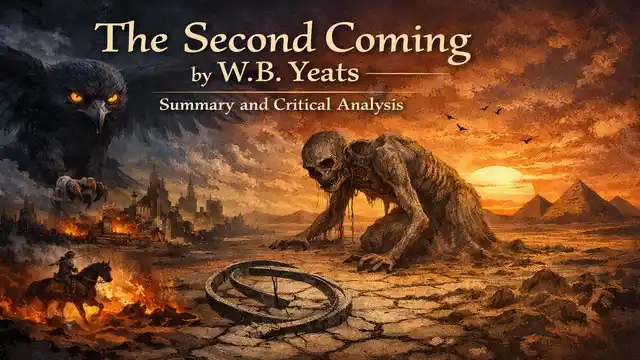
Yeats composed the poem during a period when he was deeply disturbed by the violence of his time, including events such as the Easter Rising of 1916, the Irish Civil War, and the First World War.
To Yeats, the age seemed profoundly disordered, suggesting that a major transformation of the world was imminent. The poem reflects his belief that history moves in recurring cycles, symbolised by the widening motion of revolving gyres.
According to him, the existing phase of history is nearing its conclusion, and a new civilization will emerge from the collapse of the old one. He portrays a world breaking apart, overwhelmed by chaos and lawlessness, and thus anticipates the downfall of the present materialistic order.
Summary of the Poem “The Second Coming”:
Stanza 1:
Turning and turning in the widening gyre
The falcon cannot hear the falconer,
Things fall apart, the centre cannot hold,
Mere anarchy is loosed upon the world,
The blood dimmed tide is loosed, and everywhere
The ceremony of innocence is drowned
The best lack all conviction, while the worst
Are full of passionate intensity.
Explanatory Word – Meanings:
1. Turning and turning= in his trance the poet sees a gyre or cone rotating fast on its fixed axis or centre. 2. In the widening gyre = as the gyre rotates fast, its circumference gradually widens. 3. Widening = extending, growing wider. 4. Gyre = cone, a solid circular figure tapering to a point. 5. Falcon = a small bird of prey trained for sport. 6. Falconer = one who breeds and trains hawks. 7. Thing fall apart = disintegration sets in and the things are scattered. 8. The centre = the centre of the axis. 9. Cannot hold = cannot keep integrated. 10. Mere … world = now only anarchy rules over the world 11. The blood … loosed= there is violence and bloodshed everywhere. 12. Everywhere … drowned= everywhere the traditional way of life, a way which has always fostered purity and innocence is in the danger of extinction. 13. The best … conviction= the sanest people are changing their beliefs which they ever held firmly. 14. The best= the sanest. 15. The worst = the evil – minded people. 16. Full of … intensity= intensely violent and blood thirsty.
Paraphrase:
The large-scale killings and bloodshed in Ireland and across Europe filled Yeats with a deep sense of despair and foreboding. He felt that the current historical cycle, which began two thousand years ago with the first coming of Christ, was nearing its close. According to him, a new cycle of life is about to begin, marked by the Second Coming.
Yeats presents history as moving in the form of a gyre, a spiralling motion. In a vision-like state, he imagines this gyre spinning faster and faster around its axis, symbolising a major shift in age and civilisation.
As the spiral expands, the centre can no longer govern its movement, suggesting that existing civilisations are losing stability and coherence. Having lost their central guiding principles, they are breaking down and moving towards chaos.
The image of the falcon no longer responding to its trainer reflects this loss of control. The bird has flown beyond reach and turned aggressive, representing humanity’s separation from the beliefs and values that once regulated life, whether rooted in religion or philosophy. It also suggests that human beings have stopped listening to the voice of the soul.
Excessive attachment to material pursuits has led to the erosion of morality, spirituality, social harmony, and religious faith. As a result, humanity has developed brutal and violent tendencies. Disorder has broken free and now dominates the world. Anarchy prevails everywhere because humanity has abandoned spiritual values and surrendered completely to science and materialism.
The world is submerged in violence and bloodshed, sweeping away innocence, piety, and other virtues. The noblest and wisest have lost faith and purpose, while the worst elements of society have become fanatical, irrational, and destructive.
Stanza 2:
Surely some revelation is at hand;
Surely the Second Coming is at hand.
The Second Coming! Hardly are those words out
When a vast image out of Spiritus Mundi
Troubles my sight: somewhere in sands of the desert
A shape with lion body and the head of a man,
A gaze blank and pitiless as the Sun,
Is moving its slow thighs, while all about it
Reel shadows of the indignant desert birds.
Explanatory Word – Meanings:
1. Surely … hand = all this anarchy, violence, bloodshed and disorder implies that a new civilization is about to be born and the old one is going to be an end. In other words, second incarnation of God seems to be at hand. 2. At hand = near. 3. Revelation= disclosing of knowledge by a supernatural agency. 4. Second coming= the second incarnation of God in the form Jesus Christ is very near. 5. The Second … out= as soon as the thought of second incarnation of God flashes across the poet’s mind. 6. When … sight = the poet sees the image of some vast form coming out of the store house of images. 7. Spiritus Mundi = the storehouse of the spirits, but a kind of images in Yeats’ philosophy. 8. Vast image= huge figure. 9. Troubles my sight = this fierceful and huge image does not please to the eyes of the poet. 10. Somewhere … desert = coming out of some far desert. 11. A shape … man = a sphinx – like being with a man’s head and a lion’s body. 12. A gaze … Sun = the figure has an empty and fiery look. 13. Is moving … thigh = this monstrous like image moves slowly with a clumsy, awkward movement towards Bethlehem, the birth place of Christ. 14 Slow thighs = slow movement of legs. 15. Reel= to hover the image. 16. Indignant = moved by indignation.
Paraphrase:
Seeing the modern world overwhelmed by anarchy, violence, bloodshed, and chaos, and realising that no force seems capable of preventing its collapse, the poet’s mind turns instinctively to the first incarnation of God in the form of Jesus Christ, which occurred at a similar moment of civilizational decay.
Reflecting on the cyclical nature of history, he recalls how God assumed human form as Christ when Roman civilization disintegrated nearly two thousand years ago, and he feels that a comparable crisis has now returned.
The world is once again submerged in violence and bloodshed, suggesting that the Second Coming—the second incarnation of God—is near. Christ is expected to reappear to redeem humanity through sacrifice.
Christian civilization, the poet feels, has almost completed its two-thousand-year journey. The present historical cycle is drawing to a close, and a new era is on the verge of beginning. The disturbing events occurring across the world seem to signal that a powerful divine force is about to descend upon the earth to re-establish moral order and spiritual purity.
However, as the idea of the Second Coming enters the poet’s imagination, he does not envision a gentle or comforting figure. Instead, he beholds a vast and terrifying image emerging from the realm of spirits. This frightening vision offers no sense of beauty or peace; rather, it fills the poet with dread. He sees a sphinx-like creature with the body of a lion and the head of a man, staring with an empty, merciless gaze. Its eyes burn with a fierce, fiery intensity.
The monstrous figure appears to rise from a distant desert and moves slowly and awkwardly toward Bethlehem, the birthplace of Christ, as though it too is destined to be born there. So horrifying and nightmarish is this vision that the desert birds, seized by rage and fear, cry out and scatter in panic. Their frantic movements cast trembling shadows, intensifying the atmosphere of terror that surrounds the scene.
Stanza 3:
The darkness drops again; but now I know
That twenty centuries of stony sleep
Were vexed to nightmare by a rocking cradle,
And what rough beast, its hour come round at last
Slouches towards Bethlehem to be born?
Explanatory Word – Meanings:
1. The darkness … again = then the monstrous like image of the strange creature which the poet visualises, disappears and the poet’s mind is surrounded with darkness again. 2. But … know = but the poet is absolutely convinced. 3. That twenty … cradle = this ferocious creature assuming the body of the lion and man had been sleeping soundly for twenty centuries, but now its sound sleep has been disturbed and it has awakened to see the horrible dream from its swaying cradle. 4. Stony= lying like a lifeless stone. 5. Vexed= disturbed. 7. Rocking cradle = small, low bed swaying to and fro. 8. Beast = wild animal. 9. Slouch= to walk or move with an awkward bearing.10. Bethlehem = birth place of Lord Christ.
Paraphrase:
As the poet regains full awareness, the terrifying vision of a beast gradually disappears. Yet he realises that the savage creature he had imagined symbolizes the collapse of the old civilization and the emergence of a new one. Throughout the twenty centuries of Christian history, this force had remained dormant, resting quietly like an unmoving stone, undisturbed and forgotten. No one had provoked it or disturbed its long sleep. Now, however, that deep slumber has been violently broken.
The creature has taken on a fierce and threatening shape, marked by a vacant and pitiless expression. Though its movement is slow, it is purposeful and relentless as it advances toward Bethlehem, Christ’s sacred birthplace, to be born anew. It comes to overturn the existing order, announcing the arrival of a new age—one that will be forged through suffering, struggle, and bloodshed.
Critical Analysis of the Poem “The Second Coming”:
Introduction:
“The Second Coming” is among the most celebrated poems of W. B. Yeats and serves as a powerful expression of his prophetic vision. In this poem, Yeats transforms his immediate sense of fear and anxiety into a broader historical and universal reflection. First published in the American magazine The Dial in 1922, the poem places the poet’s own era against the vast backdrop of eternity and compresses his philosophy of history into a few intense images.
It conveys Yeats’s deep inner despair, shaped by the violence and bloodshed in Ireland and across Europe—events such as the Easter Rising of 1916, the Irish Civil War, and the devastation of the First World War. Rooted in Yeats’s philosophical and mystical beliefs, the poem reveals some of his most complex and esoteric ideas.
It presents a terrifying vision of the collapse of the familiar world and foretells the arrival of an age marked by boundless suffering and brutal cruelty.
Thought – Content:
The poet feels that the historical phase which began about two thousand years ago with the birth of Christ is now reaching its close. With the approaching Second Coming, a new phase of existence is about to begin. To explain this movement of history, the poet uses the image of a gyre. As a gyre turns around its centre and expands into wider circles until it finally collapses, history too moves forward in a similar pattern, growing, breaking down, and then giving way to renewal.
Against the background of the Irish Rebellion and the First World War, the poet foresees a radical transformation in the world. He observes that humanity has become brutal and driven by violence, and that chaos prevails everywhere. Qualities such as innocence, faith, and moral goodness have lost their significance. These conditions suggest that a powerful new incarnation is about to appear, one that will revive lost values and begin a fresh historical cycle.
In his prophetic vision, the poet imagines a strange figure with the body of a lion and the head of a man advancing towards Bethlehem, the birthplace of Christ. This figure represents the Second Coming, which will replace the gentle Christ born two thousand years ago. The coming era of human history, the poet suggests, will be dominated not by spiritual compassion but by fierce and monstrous forces.
Theory of the Rise and Decline of Civilizations:
The central concept of this poem is rooted in the symbolic “system” Yeats outlines in A Vision. According to Yeats, civilizations follow a cyclical pattern of growth and decay. Each civilization originates in a powerful moment of spiritual insight or revelation—such as the birth of Christ—and its development resembles the unwinding of a thread coiled around a cone or gyre. In its early stage, a civilization is concentrated, dynamic, and sharply defined, like the narrow tip of a cone.
Over time, however, it expands, loses its driving force, and gradually disperses its energy. As this decline occurs, a contrasting force that has been slowly gathering momentum emerges and replaces it, giving rise to a new civilization. Yeats suggests that one complete cycle of this cosmic wheel, symbolized by the phases of the Moon, spans roughly two thousand years. At the start of each such period, a new order or era is proclaimed. This recurring pattern, he believes, is evident throughout world history from around 2000 B.C. onward.
The Use of Symbols and Imagery:
The poem vividly demonstrates Yeats’s reliance on symbolic imagery. The phrase “ceremony of innocence” signifies, in Yeats’s view, a moral and spiritual value that once sustained life within the declining aristocratic order. The image of the “falcon and the falconer” carries both symbolic and philosophical implications. The falcon, a type of hawk, symbolizes the active and reasoning intellect, while the falconer may be understood as the soul or the guiding force that binds the self together.
“Spiritus Mundi” denotes a universal reservoir of images that no longer belong to any single individual consciousness. The symbols drawn from this collective source possess an inherent meaning as well as a powerful influence in shaping interpretation and foretelling future events. Yeats maintains that omens, warnings, and even explicit messages emerge from this realm of shared human memory. The monstrous figure with a lion’s body and a human head ultimately symbolizes blind, ruthless violence, devoid of moral awareness or compassion.
Form, Style and Language:
The poem is composed in blank verse and contains twenty-two lines arranged in two unequal stanzas—the first comprising eight lines and the second fourteen. Its verbal texture is enriched by Yeats’s characteristic use of half-rhymes drawn from the Anglo-Irish tradition, such as “gyre” and “falconer,” “hold” and “world,” “man” and “Sun.” The opening stanza is especially striking for its reliance on elevated, rhetorical expressions rather than concrete imagery, with phrases like “mere anarchy,” “the blood-dimmed tide,” and “the ceremony of innocence.”
In contrast, the concluding stanza introduces three dominant images: a barren desert, the circling flight of birds, and a terrifying creature advancing slowly across the endless sands. The poem’s dramatic power and sense of movement emerge from Yeats’s disciplined artistic method—he strips away everything unnecessary while preserving what truly matters. By focusing intensely on a single charged moment, the poem compels the reader to respond instantly to its emotional and imaginative force.