Introduction
“When Thou Commandest Me,” the second song/poem in Rabindranath Tagore’s Gitanjali, expresses the poet’s deep spiritual devotion and his readiness to serve the divine. Written in Tagore’s characteristically simple yet profound style, the poem portrays the human soul as a humble instrument responding to God’s call. Tagore emphasizes the idea that true purpose and creativity arise only when prompted by the divine will.
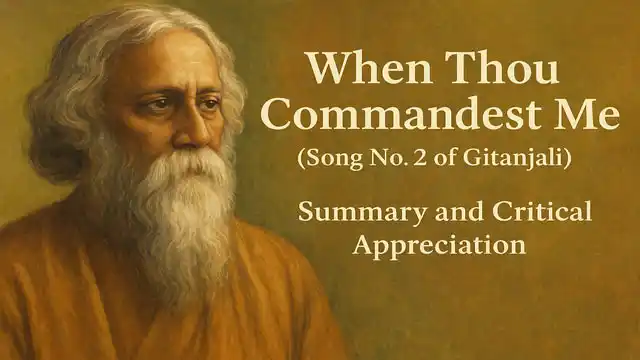
The poem’s tone blends reverence, surrender, and joy, reflecting Tagore’s vision of a personal and intimate relationship with God. As part of Gitanjali, a collection that earned Tagore the Nobel Prize in Literature (1913), Song No. 2 encapsulates the central themes of divine love, spiritual duty, and the transformative power of God’s grace.
Summary of the Song No. 2 in Gitanjali:
Stanza.1:
When thou commandest me to sing it seems that my heart would break with
pride; and I look to thy face, and tears come to my eyes.
All that is harsh and dissonant in my life melts into one sweet harmony—and my
adoration spreads wings like a glad bird on its flight across the sea.
Explanatory Word-Meanings:
1. When thou…to sing = the poet sings when God wills him to do so. 2. Commandest = bids, orders. 3. It seems…pride = under divine inspiration his heart puffs up with joy and pride. 4. Seems=appears. 5. I look…face = in such moments of ecstasy he stands face to face with his maker. 6. Tears…eyes = tears of ecstasy well up in the poet’s eyes. 7. All that…sweet harmony = all the discordant, ugly, evil and wicked forces which envelop human soul transform into the harmony of sweet music. 8. Melts = transforms. 9. Sweet harmony = pleasant and melodious state of affairs. 10. My adoration spreads…the sea = the poet is lost in meditation and prayer and his soul endeavours to reach the infinite like a joyously singing bird which with its outspread wings soars higher in order to cross the vast sea.
Paraphrase:
The poet believes that God has endowed him with the gift of poetry, making his art a form of divine inspiration. He explains that whenever God illumines his mind, song flows naturally from him. In those sacred moments, his voice becomes harmonious, his heart swells with pride and joy, and tears of bliss fill his eyes. Under such inspiration, his spirit feels united with the divine, as though he stands directly before his Creator.
Though the human soul often carries discord, ugliness, and moral corruption, music has the power to cleanse it. Through song, the harsh and jarring elements within are subdued, allowing harmony and peace to settle in. Music elevates the soul, granting it nobility and lifting it closer to the divine.
A sense of mystical joy arises when a person dedicates their gifts to the worship of God. In such inspired moments, the human spirit soars upward, seeking union with its Maker. The poet likens the soul to a bird spreading its wings wide, gliding across the endless sea of eternity in its quest to reach the divine.
Stanza.2:
I know thou takest pleasure in my singing I know that only as a singer I come
before thy presence.
I touch by the edge of the far-spreading wing of my song thy feet which I could
never aspire to reach.
Drunk with the joy of singing I forget myself and call thee friend who art my lord.
Explanatory Word-Meanings:
1.I know…my singing = the poet knows that God is pleased with his songs. 2.I know…presence = it is only through singing that he can realise the divine presence in his life. 3. I touch…my song = the poet feels the presence of divinity in him while singing. The image of the bird is extended here. 4.Thy feet…reach = his songs elevate his soul so as to enable it to come near God and touch His feet 5. Aspire = feel earnest desire. 6. Reach = fulfil the desire to attain his aim. 7. Far-spreading= that which stretches to an inordinately long distance. 8. Drunk…art my lord= the poet is so much overwhelmed by the inspired singing that he forgets that he is only a servant of God and not His equal. 9. Drunk = overwhelmed by the inspired singing.
Paraphrase:
The poet understands that his song delights God, for every melody springs from the blending of clashing notes—and this same principle underlies the very fabric of creation. Just as a musician shapes disorder into harmony, God once brought structure to the swirling chaos of elemental forces. In that act of ordering the universe, God composed His own cosmic music. Hence, it is through music that the human spirit can rise and unite with the divine.
Yet the poet admits, with deep humility, that even in these rare moments of mystical inspiration, he never fully beholds God. At best, he hopes his soul—unfolded like wings—might brush against the divine feet. But carried away by the bliss that surges through him when he sings under heavenly influence, he sometimes forgets his place. Enraptured, he begins to feel not like God’s servant, but almost His companion and equal, though in truth he remains only a devoted worshipper.
Critical Appreciation:
Introduction:
The piece “When Thou Commandest Me” is a lyrical and evocative poem drawn from Tagore’s celebrated collection Gitanjali. In it, the poet appears as a mystic soul yearning to encounter the Divine and dissolve his own self in that sacred presence. The poem conveys his deepest and most heartfelt emotions—joy, reverence, gratitude, pride, and profound humility—capturing the spiritual rapture that defines his devotion.
Thought-Content:
The poet says that he sings only because it is God’s will. His voice rises out of a sacred impulse, and only divine influence unlocks his song. When this heavenly inspiration touches him, his heart overflows with joy and a deep sense of honour, and tears gather in his eyes. In such moments, everything harsh or violent, every trace of conflict and dissonance, melts away into the gentle rhythm of music.
His lower, self-centered impulses are transformed into pure love and devotion. He becomes a devoted worshipper, a lover of the Divine. His reverence unfurls like a joyous bird spreading its wings to cross the sea. Through his songs, he seeks a path to God. The human soul itself is likened to a bird, winged and soaring over the ocean of eternity, striving to reach the divine presence.
The poet understands that his songs bring joy to God, and that through his singing alone he can sense the divine presence in his life. Lifted on the wings of his own music, he feels able to reach the sacred feet he could never approach in any other way. When the Divinity stirs within his heart, a wave of bliss overtakes him. In that moment of rapture, he forgets his role as a mere servant and addresses God as a friend, though God is truly his lord and master.
His Lyricism:
Tagore’s lyrics have supreme beauty. They shine like smile. Some of them glisten like tears, some blush like the cheeks of a pride and some flash like lightning in the darkness of soul. Sarojini Naidu’s dictum that his songs are the Lyre of Heaven is a true summary of Tagore’s lyricism. Tagore as a supreme lyricist prays:
All that is harsh and dissonant in my life melts into one sweet harmony-and my adoration spreads wings like a glad bird on its flight across the sea. I know thou takest pleasure in my singing. I know that only as a singer I come before thy presence.
Drunk with the joy of singing. I forget myself and call thee friend who art my lord.
The Use of Images:
The poet expresses his visions, emotions and experiences through metaphor, simile, and personification and mythological or legendry images:
“All that is harsh and dissonant in my life melts into one sweet harmony-and my adoration spreads wings like a glad bird on its flight across the sea.”
The poet reveals himself through images in which the tenors and vehicles reciprocate. For instance, the poet and God appear to be singers. Both are related to music imagery:
“I know thou takest pleasure in my singing I know that only as a singer I come before thy presence.
I touch by the edge of the far-spreading wing of my song thy feet which I could never aspire to reach. Drunk with the joy of singing I forget myself and call thee friend who art my lord.”
Poet’s Emotions:
In utter humility and gratitude the poet confesses that he sings because of God’s inspiration. This singular honour of divine inspiration makes the poet full of gratitude and he feels that his heart is incapable of harbouring such immense joy and may burst. Such feelings bring tears and joy to his eyes.