Introduction:
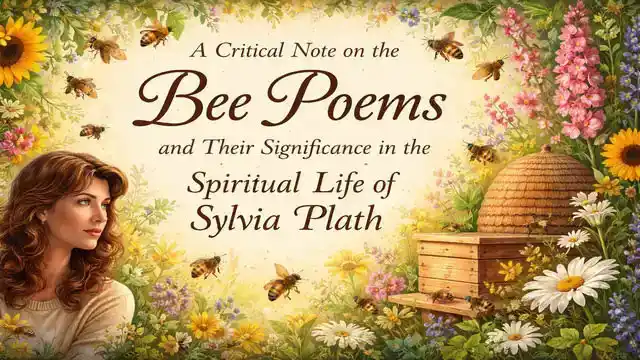
The bee poems were composed by Sylvia Plath just a few months before she committed suicide. The sequence of the bee poems consists of five poems— The Bee Meeting, The Arrival of the Bee Box, The Stings, The Swarm and Wintering. These poems are called the bee sequence. A noted critic says about these poems, “Thus, the Bee sequence shows a distinct advance in the mood of the past; It is a prelude to her where aggression becomes the important strain though the undercurrent of fear is always present. The aggression in these poems is mainly directed against husband, mother, father, and men and women in general who were source of terror to her during the poem of the Colossus and Crossing the Water.”
The Autobiographical Element in Bee Poems:
Besides the two children the bees were her other important companions here to face the sufferings in tortures of life which she came across her son and daughter in their infancy. The bees were her happy companions in those trouble times. The bee poems are the interior part of the last phase of her life. The bee poems are remarkable of positive progress in her death bond consciousness created by her failure in marriage in a break in her poetic creation.
The bee poems also remind us of Sylvia’s father Otto Plath, who was famous and learned etymologist, bee keeper also. The bee poems Stings have some reference to Plath’s father then in the same poems there is another reference to her husband Ted Hughes who was stung by bees. This stinging event has been described by Sylvia in her late mother but most important incident is her own personal search and effort or perfection in poetry. Just as the bees give us honey the best part of her creation similarly the poetry the main mission of Sylvia Plath is her search of the true self. Sylvia Plath has written a large number of poems. Sylvia herself is the queen bee in the bee poems. Just as the queen bee flies away similarly the soul of Sylvia Plath wants to fly into heaven after this worldly existence. It is after a long hard battle with her torture self. Sylvia Plath seems to be reconscious with herself in the bee poems.
I am in control
Here is my honey-machine (Stings)
Significance of the bee poems:
Honey is the most important product of the bees. Sylvia used the symbol honey for her poetic creation which signifies the triumph or art in the long run.
I have whirled the midwife’s extractor
I have my honey
Six jars of it. (Wintering)
By strange incident her important poems and prose work are also six in number – Colossus, Winter Tree, Ariel, Crossing the Water, the prose selection Johnny Pannic and The Bible of Dreams and the novel The Bell Jar.
The Conquest of Fear through the Bee Poems:
The undercurrent of the bee poems is fear which she has expressed in many other poems but in these poems, “She neither wants to evade nor escape it but faces it courageously: I could not run without having to run forever”. There is an uncanny expectancy interweaved into bee poems in such a way that her old dread of hostile people, social stigmas and choking encapsulation takes a different dimension, altogether. To face it all, she declares “I am the magician’s girl who does not flinch” in pursuit of that great flight to release. Nor is she put off any more by the incoherent mass of destructive chaos that constantly moves round her box of consciousness.
Wider Application of Torture and Suffering:
In the Bee poems there is not only personal reflection of the incidents of the life of Sylvia but she has described the torture and suffering in humanity in wider contents. For example, in the poem The Swarm Sylvia Plath refers to Napolean and his power-hungry armies. We can understand that Sylvia was quite aware of the suffering caused by a wider Nazi to the general people. In this reference she forgets her own self and its narrow boundaries and began to think the adverse role of suffering and torture from the collective point of view. The black ball of bees becomes the symbol of the suffering innocent people because the victorious Hitler wants to fulfil his own personal ambition. This description of Napolean shattered the vision of peace and calm of whole universe. This poem The Swarm is full of suiting sounds when Napolean is taking a prisoner a new type of life begins which Sylvia Plath calls a process of receding.
The Idea of Rebirth in the Poems:
All the bee poems end on a note of rebirth of life and art after the experience of ritual death. There is a sense of new courage and spirit of endurance developed out of the reaper and wiser consciousness that after death there is rebirth. This is the belief of Sylvia Plath in the Bee poems.
Conclusion:
The box imagery continues in the poem “The Arrival of the Bee Box”. Now the speaker becomes the beekeeper with a box full of restless bee. The box becomes epitome of a dangerous encloser.
The box is locked, it is dangerous
I have to live with it overnight
And I can’t keep away from it
There are no windows, so I can’t see what is in there
There is only a little grid, no exit.
Thus, we find that the difference shows a clear advance in the mood of the poet. Really this sequence of the poems consists of five poems. It is a prelude to her last poems where aggressive mood gives place to peaceful state of mind born out of Sylvia’s faith in rebirth or resurrection.
