Introduction:
“A Far Cry from Africa” is a powerful and thought-provoking poem by Derek Walcott that explores the themes of colonialism, violence, identity, and inner conflict. Set against the backdrop of the Mau Mau Uprising in Kenya, the poem reflects on the brutal clash between the native Africans and British colonial forces. Walcott, who has both African and European heritage, expresses his deep personal struggle in choosing between these two conflicting cultures. Through vivid imagery and emotional intensity, the poem highlights the horrors of war and questions the moral complexities of loyalty, justice, and cultural identity.
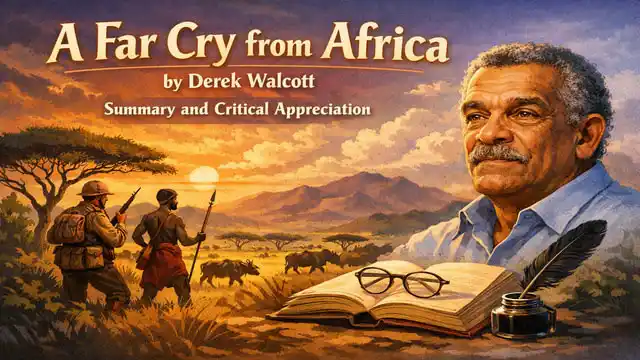
Summary of the Poem A Far Cry from Africa
The poet talks of the unrest spreading all through the country and the tawny-coloured people are passing their life in great misery. The people of the African tribe known as the mau fighters are being killed mercilessly. They are very fast and quick in hunting. They are so poor that they do not get food enough and live on only what they hunt because they are savages. They live in the open country which is neither a forest nor cultivable. Their dead bodies are spread all around. The Britishers consider them no better than the worms and humiliate them. They declare that these savage Africans should not be treated sympathetically and mercifully. They believe that any sympathy will simply be wasted because they do not deserve it. The policy of the colonizers shows that there is no justice. Their life has no value even for a child. They consider that they are no more than the savages and can be compared to the Jews.
The poet is very well conscious of his double personality, the blood of the black Africans and that of the white. He considers it miserable for himself and feels humiliated. In his opinion, this blood in his veins is no less than poison because he cannot take anyone stand firmly. Everywhere he feels himself divided. This is just the greatest curse of his life which can never be removed. He has to choose between the two languages African or English but he cannot help himself and thus he is deceiving both of them. He cannot even pay for what they have given and perhaps will never be free. He suspects that in the midst of this wide spread bloodshed in the country, he cannot control himself. In this condition, it is difficult to forget his country. Even if he tries to turn away, he cannot think of living alive. The pain of the poet is felt when he suddenly turns to himself and expresses his personal dilemma between Europe and Africa.
Critical Appreciation of the Poem A Far Cry from Africa:
Introduction:
Derek Walcott’s A Far Cry from Africa, published in 1962, is a painful and jarring depiction of ethnic conflict and divided loyalties. The opening images of the poem are drawn from accounts of the Mau Mau Uprising, an extended and bloody battle during the 1950s between European settlers and the native Kikuyu tribe in what is now the republic of Kenya. In the early twentieth century, the first white settlers arrived in the region, forcing the Kikuyu people off of their tribal lands. European took control of farmland and the government, relegating the Kikuyu to a subservient position. One faction of the Kikuyu people formed Mau Mau, a terrorist organization intent on purging all European influence from the country, but less strident Kikuyus attempted either to remain neutral or to help the British defeat Mau Mau.
The ongoings in Kenya magnified an internal strife within the poet concerning his own mixed heritage. Walcott has both African and European roots; his grandmothers were both black, and both grandfathers were white. In addition, at the time the poem was written, the poet’s country of birth, the island of St. Lucia, was still a colony of Great Britain. While Walcott opposes colonialism and would therefore seem to be sympathetic to a revolution with an anticolonial cause, he has passionate reservations about Mau Mau: they are, or are reported to be, extremely violent—to animals, whites and Kikuyu perceived as traitors to the Mau Mau cause. As Walcott is divided in two, so too is the poem. The first two stanzas refer to the Kenyan conflict, while the second two address the war within the poet-as-outsider/insider, between his roles as blood insider but geographical outsider to the Mau Mau Uprising. The Mau Mau Uprising, which began in 1952, was put down—some say in 1953, 1956, or 1960—without a treaty, yet the British did leave Kenya in 1963. Just as the Uprising was never cleanly resolved, Walcott, at least within the poem, never resolves his conflict about whose side to take.
Thought-content:
The very first stanza mainly talks about the problems that arose after the Africa was colonized by British. He starts the poem with the scenario how the disaster came like hurricane and destroyed everything as quick as possible. People were being killed and their dead bodies were scattered like. cattle on the beautiful land of Africa. Also, he adds that the colonel of carrion, the worm, which symbolises the British, had no sympathy towards the dead people. Therefore, people were victimized by the colonizer and even killed when their purpose were not fulfilled. Again, in the same stanza, he talks about the nature of the colonizer and their traits. The British were the materials like who were composed out of complex machine and they possessed beast like quality. From the second stanza, he talks more about the Diaspora sentiment, which means love for the nation and nationality. He tried to clarify that he only wanted to be an African but he loved the English tongue as well which he could not disseminate from him. Then, he presented the British as a superman, most powerful country of that time and the African as a gorilla who is one of the most powerful animals, and even though, the African tried to fight with the British, their practice for their own existence went to vain. Later on, he tells that things had been changed. The cultural transmission could not be avoided. Even in him, there is an amalgamation of blood and culture which could not be discarded.
Theme of the Poem:
A Far Cry from Africa by Derek Walcott deals with the theme of split identity and anxiety caused by it in the face of the struggle in which the poet could side with neither party. It is, in short, about the ambivalent feelings towards the Kenyan terrorists and the Counter-terrorist white colonial government, both of which were inhuman, during the independence struggle of the country in the 1950s. The persona, probably the poet himself, can take favour of none of them since both bloods circulate along his veins.
Form and Structure of Poem:
The poem contains four stanzas of mostly iambic tetrameter. Actually, the poem starts off in iambic pentameter, the prevalent form of poetry written in English, but it soon veers off course metrically—a change that reflects the changing scene and perspective in the poem—with lines of varying length and number of stresses. A point of consistency is Walcott’s use of masculine endings (lines ending with accented syllables) and masculine rhymes (one syllable rhymes). Rhyme is as irregular as meter. The rhyme scheme of the first stanza might be rendered ababbcdecd or ababbaccad. On the other hand, both of these schemes leave out the related sounds in ‘Jews’, ‘flies’, ‘seize’ and ‘policy’ that give this stanza two basic end sounds upon which lesser or greater variation occurs. The second stanza has its fourth and seventh lines rhyming and also lines five, ten and eleven.
The Use of Imagery:
Imagery plays a large part in developing the theme for the poem. The narrator’s words produce images in the reader’s mind that shows the harshness of colonialism. For example, the narrator says, “Batten upon the blood streams of the veldt. /Corpses are scattered through a paradise.” This creates the image of a beautiful country ruined from the brutality of the colonialists. Dead bodies are seen across the land because no compassion is shown towards them. The narrator then says that statistics and scholars say that colonialism is good for those being taken over. He questions this statement by stating, “What is that to the white child hacked in bed?” The image created from his question is that of a young child killed in his sleep one night. This child is of the colonialist’s own kind, yet he is still killed; stressing the point that no one is safe from colonialism. In relation to the theme, these images show that colonialism uses the pressure of violence in order to make entire country conform to their ideas and beliefs.
Tragic Element:
Behind this poem lies the tragedy of both external and internal conflict. The historical backdrop of the poem is the civil uprising of the Mau Mau against British colonialists in Kenya. In the late 1800s British colonies began to settle throughout a territory that native Kikuyu called home. As British colonies began to spread so did the injustices: natives were thrown off of their own land and impoverished by poor work and poor wages. The subjugation and mistreatment of the Kikuyu only got brutally worse as time progressed. In the 1950s Mau Mau could no longer hold on to empty promises of reparation and economic equality, nor could they tolerate any more passive complaints—they rebelled violently. As a result, British military forces rapidly expanded and, along with African loyalists, pursued and eventually put to death eleven thousands of the rebel force. Although it served as the catalysis for the independence of the Kikuyu and greater Kenya, the conflicts of the Mau Mau Uprising were savage, bloody and cruel (both ways). Bitter memories and no doubt latent hostilities followed the bloodshed.
