Introduction:
The poem A Far Cry from Africa by Derek Walcott is a powerful exploration of cultural conflict and crisis of identity arising from colonial history. Set against the backdrop of the Mau Mau Uprising in Kenya, the poem reflects the brutal violence between the British colonizers and the native Africans. However, beyond its political context, the poem becomes deeply personal, revealing the poet’s inner turmoil as a man of mixed heritage—African and European.
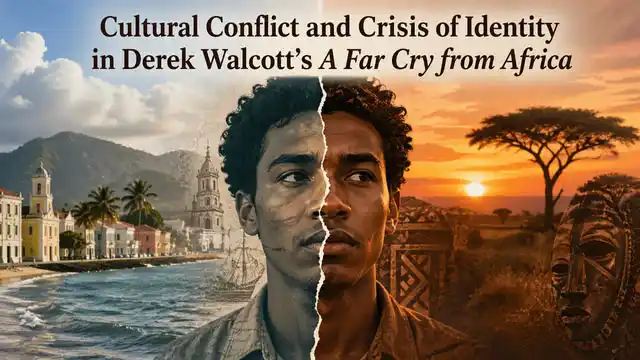
Walcott finds himself emotionally divided between the two cultures: he is drawn to the African side by ancestry and sympathy for the oppressed, yet he is also connected to the English language and literary tradition. This duality creates a profound sense of alienation and confusion, as he struggles to reconcile his loyalties. The poem thus becomes a poignant expression of the psychological conflict experienced by individuals caught between cultures, highlighting the pain of not fully belonging to either.
Through vivid imagery and a conflicted tone, Walcott captures the complexities of identity in a colonized world. The poem ultimately presents cultural conflict not just as an external clash of nations, but as an internal struggle within the self, making it a timeless reflection on identity, heritage, and belonging.
Conflict of Identity and Cultural Duality:
Derek Walcott’s A Far Cry from Africa, is not only a brilliant exposition of the imbalance relationship between the colonizer and the colonized but also a depiction of the pain of a man who stands in-between two cultures. The poem exposes the conflict of the identity he goes through due to his state of in- betweenness. Throughout the poem he continues his quest to get an identity of his own, but at the end, his endeavour remains futile as he finally confesses his love for the English language as well as for his origin. In other words, the idea that pervades the entire poem is the conflict of culture and identity, from where the poet finds no way out.
While dealing with the identity of his own Walcott writes— “I am a kind of split writer; I have one tradition inside me going in one way, and another going another. The mimetic, the narrative and dance element is strong on one side, and the literary, the classical tradition is strong on the other. Like other Anglophone Caribbean poets his poetry registers this socio-cultural plurality, ambivalence and quest for a legitimate identity, but at the same time there is an attempt to resolve the contradictions and bridge the cultural distances. The purpose of Walcott in A Far Cry from Africa is to explore his desire to harmonise the discord between his African and European cultural inheritance and his endeavour to build a bridge between two cultural traditions.”
Significance of the Title and Sense of Alienation:
The title A Far Cry from Africa is very significant in the sense as it indicates, despite his concentration on African themes, Walcott’s cultural instability as well as his alienation from Africa. His negative view of his hybridism: “I who am poisoned with the blood of both, /where shall I turn, divided to the vein?” points out the consequences of displacement-isolation. It seems that Walcott feels. foreign in both cultures due to his lack of ‘pure’ blood. As he writes “An individual’s sense of identity arises from cultural influences which define his or her character according to a particular society’s standards.” The poet’s hybrid heritage prevents him from identifying directly with one culture and creates a feeling of isolation. The poem provides a textual version of the poet’s mental dissertation on the vices and virtues which differentiate each culture.
Cultural Conflict Reflected Through Contradictory Imagery:
Walcott depicts the struggle with cultural and ancestral divisions. He begins the poem with images of the Mau Mau Uprising and moves on to address his internal dilemma that tears Walcott because of his mixed race. That is why the poet continuously uses contradictory statements to determine his state between two cultures. He first describes the Kikuyu natives as ‘quick as flies,/Batten upon the bloodstreams of the veldt’ not only to uphold the perspectives of the British towards the native Kikuyus but also to justify the beneficial nature of the British rule in Africa. But at the very next line he contradicts the image of the British, as the principal cause of the suffering of the natives in equally ugly terms, Only the worm, colonel of carrion, cries: “Waste no compassion on these separate dead!” These contradictory statements become more intense as the poem progresses unit towards the end of the poem Walcott finally compares Africans as a primitive beast, and the British as a fictitious, yet mighty, super-hero:
“A waste of our compassion, as with Spain,
The gorilla wrestles with the superman.”
Use of Metaphor, Irony, and Hybridity:
A Far Cry from Africa uses metaphors, such as ‘colonel of carrion’, and ironic statements, such as ‘corpses are scattered through a paradise’, to criticise the inhumane and destructive nature of both cultures. Being a man of in- betweenness, Walcott uses the advantage of his own hybridity to dissect the inherent intention of Africa and Europe. He has tried to express the idea what Fanon has written in his Wretched of the Earth that it is the desire of the every colonized to be in the positions of the colonizer. In other words, Walcott uses his genetic hybridity and cultural hybridity to express the extremity of his unhomliness.
The Complex Journey of Identity Search:
The poem is actually a journey of Walcott to determine his own identity. But as the poem progresses, we find that his search becomes more complicated as he himself falls in an ambiguous state from where there is no way out. That is why, the last stanza of the poem contains so many lines where we see that poet himself complicates his search for a legitimate identity. Despite making numerous contradictory statements he cannot turn his head away from facing the question, “How choose/between this Africa and the English tongue I love?” the answer of which he himself does not know. Apart from that, the quoted lines clearly indicate the poet’s admiration of the aspect of both cultures. As Heather M. Bradley writes: “He remains partial to the African terrain and way of life, while he prefers the English language and literary tradition. The poet grapples with his affinity for progress and technology contained within the British culture and his nostalgia for the rich cultural heritage of Africa. The magnetism that each culture holds for Walcott causes a tension which arguments as the poem continues.”
Moral Dilemma and Divided Loyalties:
Walcott’s divided loyalties engender in him a sense for not being able to adopt the culture of his origin. Though he accepts the civilised aspects of British culture, he cannot acknowledge the justification of the immoral treatment done by British towards the Africans in the name of civilizing them. In other words, A Far cry from Africa does not provide the poet the way to resolve the paradox of his hybrid inheritance:
“How can I face such slaughter and be cool?
How can I turn from Africa and live?”
Sense of Guilt, Displacement, and Isolation:
Throughout the poem, Walcott continues his quests to know about the true identity of him. He has used words like ‘poison’ to uphold the fact that how dual identity haunts him and create in him a sense of guilt for not being able to trace out his origin. It creates in him a sense of displacement and isolation. He, despite his love for the English language, cannot embrace the culture of the colonizer and the same time cannot fit himself to the culture of the ‘darkness’ and as a result he tries to conclude the tussle within himself by blaming his state of in-betweenness.
“I who am poisoned with the blood of both,
Where shall I turn, divided to the vein?”
This sad ending upholds the fact that Walcott considers himself as a foreigner due to his mixed blood.
Hybrid Identity and Critical View of Both Cultures:
Cultural influences play a vital role in formulating the identity of an individual by defining one’s character according to a particular society’s standards. Walcott, due to his sharing of mixed blood, is unable to identify his own culture. The result of which is the poet’s indecisive state of mind regarding his own identity. In other words, the poet’s hybrid heritage is not enabling him to identity his own culture and thereby putting him in state of isolation. Walcott’s sceptic look towards both cultures provides him the scope to acknowledge Africa and Britain in the standard roles of the vanquished and the conqueror. It is true that he criticises the cruel imperialistic exploits of the British but at the same time does not even try to draw sympathy for the African tribesmen. This suggests the fact that Walcott tries to uphold the fault of both cultures without showing any kind biasness either towards Africa or towards British. For instance in the following quoted lines he blames the British for their imperialistic design to grasp the culture of the native but without creating sympathy for the colonized:
“Only the worm, colonel of carrion, cries:
Waste no compassion on these separate dead!”
Ambiguity and Multiple Meanings of the Title:
The title of the poem is very ambiguous in nature. The title involves an idiom ‘a far cry’ which does contain two meanings. At one hand the phrase ‘A Far Cry’ suggests the poet’s futile attempt to write about Africa from distance for the poet himself feels the difficulty of writing about a culture from where he is literally and metaphorically far away. At the other hand, ‘A Far Cry’ may also have another meaning that the real state of the African ‘paradise’ is a far cry from Africa that we have read about in descriptions of gorgeous fauna and flora and interesting village customs. A third level of meaning to the title is the idea that the poet, despite the distance, is able to hear the cry of the Africa natives due to their loss of their cultural identity. He hears the cry coming to him on the wind and making him feel nostalgic towards his origin. In short by using the phrase ‘A Far Cry’ in the title the poet not only exposes his anti-colonial outlook but has tried to justify the fact despite sharing the culture of the civilized, he cannot discard his past, his origin.
Animal Imagery and Expression of Colonial Pain:
In the poem A Far Cry from Africa, the poet has used ample animal imagery to criticise the savage aspects of both cultures. His hybrid existence provides him the scope to dismantle the evil side of both the colonizer and the colonized. Another problem that Walcott faces in the poem is the problem how to express this painful experience, because it is always difficult to depict Blackman’s agony in Whiteman’s words. Due to his long detachment from his origin, the poet himself falls in doubt whether he will be upholding the pain of his native Africans in the language of the colonizer. As Ramazani in this context comments: “His name taken from the culture of colonizer and slaver, yet his wounded black body allegorizing their cruelty, Philoctete recalls the divided speaker of A. Far Cry from Africa, cursing the brutality of the colonizers yet cursing them in the language they have given him.”
