Introduction:
Matthew Arnold’s essay The Study of Poetry stands as one of the most influential works of Victorian literary criticism, in which he attempts to establish clear standards for judging poetic excellence. In this critical framework, Arnold evaluates the greatness of earlier poets, including Geoffrey Chaucer, often regarded as the “Father of English Poetry.”
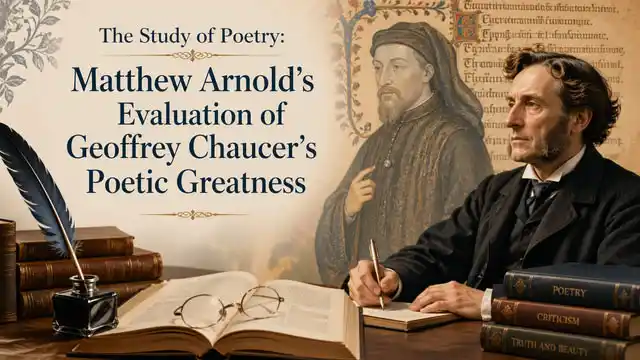
While acknowledging Chaucer’s historical importance, narrative skill, and vivid portrayal of medieval life, Arnold applies his famous criteria of “high seriousness” and poetic truth to assess his work. He argues that although Chaucer possesses charm, clarity, and human insight, his poetry does not consistently reach the highest level of moral depth and emotional intensity that Arnold finds in the greatest poets. Thus, Arnold’s evaluation presents a balanced yet critical view, placing Chaucer as a significant but not supreme figure in the hierarchy of poetic greatness.
Matthew Arnold in ‘The Study of Poetry’ pleads for real estimate of poets and their poetry. He warns against prejudices whether positive or negative. He does not approve historical or personal estimate. Unfortunately, Chaucer’s greatness is based more on historical estimate than the real onc. Arnold comments that historical estimate is full of errors. It leads to undeserving praise to one poet. It attempts at presenting a man as a god. It obstructs in critical analysis of the process of artistic creation. It attracts blind admiration. For proper criticism it is required that a poet’s environment, the traditions and precedents of his times should be examined. A poet ought to be evaluated as a man rather than a god. If a work is really great, its proper analysis would give us great pleasure.
Chaucer: The Father of English Poetry:
Arnold does not wish to ignore Chaucer’s greatness. He praises the qualities of his poetry as well as its historical value when he refers to the background of English poetry. A particular sort of poetry was popular in France in 12th and 13th century but now that poetry has no importance. Historical estimate is imperfect in the way that whatever was thought to be very high at that time, stands nowhere now. But in the 14th century Chaucer contributed truly excellent poetry. Its popularity is permanent. Its greatness is not historical but real. This poetry is superior to romantic poetry in the substance of poetry as well as in the style of poetry. Superiority of substance is given by Chaucer’s large, free, simple, clear yet kindly view to human life. His poetry is a survey of the world from a central, a truly human point of view. Regarding Chaucer’s ‘The Canterbury Tales’, Dryden’s comment is significant that it has limitless variety and the poem is a perpetual fountain of good sense. It is a high criticism of life that is truth of substance.
If we ask ourselves wherein consists the immense superiority of Chaucer’s poetry over the romance poetry— why it is that in passing from this to Chaucer we suddenly feel ourselves to be in another world, we shall find that his superiority is both in the substance of his poetry and in the style of his poetry. His superiority in substance is given by his large, free, simple, clear yet kindly view of human life, — so unlike the total want, in the romance-poets, of all intelligent command of it. Chaucer has not their helplessness; he has gained the power to survey the world from a central, a truly human point of view. We have only to call to mind the Prologue to The Canterbury Tales. The right comment upon it is Dryden’s: “It is sufficient to say, according to the proverb, that here is God’s plenty.” And again: “He is a perpetual fountain of good sense.” It is by a large free, sound representation of things, that poetry, this high criticism of life, has truth of substance; and Chaucer’s poetry has truth of substance.
Chaucer’s Style and Manner:
Arnold praises Chaucer’s style and manner. To understand Chaucer’s style and manner, if we study romantic poetry, Chaucer’s rare smooth flow is exposed. Arnold justifies Dryden’s appreciation of Chaucer’s poetry. According to him Dr. Johnson’s criticism of Dryden’s viewpoint is not just. Arnold favours Chaucer’s contemporary Gower also for his refined style. Chaucer is the father of English poetry. The lovely charm of his diction and the lovely charm of his movement establish a tradition in itself. The tradition of liquid diction is followed by Spenser, Shakespeare, Milton and Keats. They followed Chaucer’s smooth flow of movement so well that their poetry is noted for substance as well as style. Still the romantic poetry lacks true virtue of Chaucer’s poetry. Even Wordsworth fails in producing that charming effect for it is not possible for him to enjoy Chaucer like liberty with language. Burns does not have this liberty. Shakespeare and Keats have that talent. Arnold observes:
Of his style and manner, if we think first of the romance poetry and then of Chaucer’s divine liquidness of diction, his divine fluidity of moment, it is difficult to speak temperately. They are irresistible, and justify all the rapture with which his successors speak of his “god dew-drops of speech.” Johnson misses the point entirely when he finds fault with Dryden for ascribing to Chaucer the first refinement of our numbers, and says that Gower also can show smooth numbers and easy rhymes. The refinement of our numbers means something far more than this. A nation may have versifiers with smooth numbers and easy rhymes, and yet may have no real poetry at all. Chaucer is the father of our splendid English poetry, he is our “well of English undefiled,” because by the lovely charm of his diction, the lovely charm of his movement, he makes an epoch and founds a tradition. In Spenser, Shakespeare, Milton, Keats, we can follow the tradition of the liquid diction, the fluid movement, of Chaucer; at one time it is his liquid diction of which in these poets we feel the virtue, and at another time it is his fluid movement. And the virtue is irresistible.
Chaucer’s Greatness:
Arnold regards Chaucer as the father of English poetry. He claims that Chaucer’s poetry has a rare force. It has a virtue of manner and movement such as we shall not find in all the verse of romance-poetry; —but this is saying nothing. The virtue is such as we shall not find, perhaps, in all English poetry, outside the poets whom I have named as the special inheritors of Chaucer’s tradition. A single line, however, is too little if we have not the strain of Chaucer’s verse well in our memory; let us take a stanza. It is from The Prioress’s Tale, the story of the Christian child murdered in a Jewry—
“My throte is cut unto my nekke-bone
Saide this child, and as by way of kinde
I should have deyd, yea, longe time agone;
But Jesu Christ, as ye in bookes finde,
Will that his glory last and be in minde,
And for the worship of his mother dere
Yet may I sing O Alma loud and clere.”
The lines have been translated by many poets but the force of Chaucer’s poetry disappears in the translation. For example, Wordsworth’s translation of these lines looks dull and uninteresting.
Wordsworth has modernised this Tale, and to feel how delicate and evanescent is the charm of verse, we have only to read Wordsworth’s first three lines of this stanza after Chaucer’s—
“My throat is cut unto the bone, I trow,
Said this young child, and by the law of kind
I should have died, yea, many hours ago.”
Arnold rightly comments that in the above-mentioned translation the charm is departed. It is often said that the power of liquidness and fluidity in Chaucer’s verse was dependent upon a free, a licentious dealing with language, such as is now impossible; upon a liberty, such as Burns too enjoyed, of making words like neck, bird, into a dissyllable by adding to them, and words like cause, rhyme, into a dissyllable by sounding the e mute. It is true that Chaucer’s fluidity is conjoined with this liberty, and is admirably served by it; but we ought not to say that it was dependent soon it. It was dependent upon his talent. Other poets with a like liberty do not attain to the fluidity of Chaucer; Burns himself does not attain to it. Poets, again, who have a talent akin to Chaucer’s, such as Shakespeare or Keats, have known how to attain to his fluidity without the like liberty.
Chaucer’s Weakness: Lack of High Seriousness:
Arnold evaluates Chaucer’s poetry and concludes that Chaucer lacks high seriousness of the great classics, therefore he should not be praised in superlatives. He should be praised for poetic truth of substance. With him is born our real poetry. Arnold has no wish to speak much on Elizabethan poetry or on the continuation and close of this poetry in Milton. Shakespeare and Milton are poetical classics. This real estimate is approved by all. But the estimate of the next age of poetry is difficult. The historical estimate has established itself. It is believed the age has produced poetical classics of its own. They have made advances beyond their predecessors. Addison compares Dryden with Chaucer. Arnold doubts if Pope and Dryden are real poetical classics. He does not approve historical estimate. Wordsworth and Coleridge denied this place to Dryden and Pope, but they belonged to the younger generation. Arnold wishes to make their real estimate.
Regarding Chaucer it is his real estimate that Chaucer is not one of the great classics. His poetry transcends and effaces, easily and without effort, all the romance-poetry of Catholic Christendom; it transcends and effects all the English poetry subsequent to it down to the age of Elizabeth. Of such avail is poetic truth of substance, in its natural and necessary union with poetic truth of style. And yet, I say, Chaucer is not one of the great classics. He has not their accent. What is wanting to him is suggested by the mere mention of the name of the first great classic of Christendom, the immortal poet who died eighty years before Chaucer, —Dante. The accent of such verse as
“In la sua volontade e nostra pace ….”
is altogether beyond Chaucer’s reach; we praise him, but we feel that this accent is out of the question for him. It may be said that it was necessarily out of the reach of any poet in the England of that stage of growth. Possibly; but we are to adopt a real, not a historic, estimate of poetry. However, we may account for its absence, something is wanting, then, to the poetry of Chaucer, which poetry must have before it can be placed in the glorious. class of the best. And there is no doubt what that something is. It is the high and excellent seriousness, which Aristotle assigns as one of the grand virtues of poetry. The substance of Chaucer’s poetry, his view of things and his criticism of life, has largeness, freedom, shrewdness, benignity; but it has not this high seriousness. Homer’s criticism of life has it, Dante’s has it, Shakespeare’s has it. It is this chiefly which gives to our spirits what they can rest upon; and with the increasing demands of our modern ages upon poetry, this virtue of giving us what we can rest upon will be more and more highly esteemed. A voice from the slums of Paris, fifty or sixty years after Chaucer, the voice of poor Villon out of his life of riot and crime, has at its happy moments as, for instance, in the last stanza of (La Bella Heaulmiere) more of this important poetic virtue of seriousness than all the productions of Chaucer. But its apparition in Villon, and in men like Villon, is fitful; the greatness of the great poets, the power of their criticism of life, is that their virtue is sustained.
Conclusion:
According to Arnold to our praise, therefore, of Chaucer as a poct there must be this limitation; he lacks the high seriousness of the great classics, and therewith an important part of their virtue. Still, the main fact for us to bear in mind about Chaucer is his sterling value according to that real estimate which we firmly adopt for all poets. He has poetic truth of substance, though he has not high poetic seriousness, and corresponding to his truth of substance he has an exquisite virtue of style and manner. With him is born our real poetry. Arnold accounts for Chaucer’s poetry while dealing with Burns’ poetry also. According to him Chaucer’s view is large, free, shrewd, benignant, —truly poetic, therefore; and his manner of rendering what he sees is to match. But we must note, at the same time, his great difference from Chaucer. The freedom of Chaucer is heightened, in Burns, by a fiery, reckless energy; the benignity of Chaucer deepens, in Burns, into an overwhelming sense of the pathos of things; —of the pathos of human nature, the pathos, also, of non-human nature. Instead of the fluidity of Chaucer’s manner, the manner of Burns has spring, bounding swiftness. Burns is by far the greater force, though he has perhaps less charm. The world of Chaucer is fairer, richer, more significant than that of Burns. It is his real estimate of Chauce
