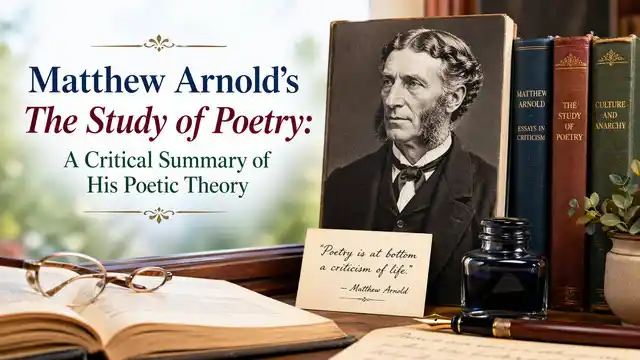
Matthew Arnold’s The Study of Poetry: Poetry as a Timeless Criticism of Life:
Matthew Arnold’s ‘The Study of Poetry’ is a critical essay of great importance. Pater’s essay on ‘Style’ is placed with this essay. Here Arnold contributes his theory of touchstone method and criticism of life. He firmly believes in the bright future of poetry. He opens this essay with this strong claim. He declares that the future of poetry is great. Traditional beliefs based on mere faith have been shaken. All those faiths decay that are not based on facts of life. Religion too is growing more more rational. Poetry depends on ideas related to facts of human life. It makes it definite and durable. The rest is a world of illusion. Only poetry is timeless. It never grows outdated.
“The future of poetry is immense, because in poetry, where it is worthy of its high destinies, our race, as time goes on, will find an ever surer and surer stay. There is not an accredited dogma which is not shown to be questionable, not a received tradition which does not threaten to dissolve. Our religion has materialised itself in the fact, in the supposed fact; it has attached its emotion to the fact, and now the fact is failing it. But for poetry the idea is everything; the rest is a world of illusion, of divine illusion. Poetry aches its emotion to the idea; the idea is the fact. The strongest part of our religion to-day is its unconscious poetry.”
Arnold has written this critical essay with a definite aim. The purpose behind the essay is to discover the stream of English poetry. Arnold advises to recognize the great purpose of poetry. Poetry interprets life for us. It teaches how to live. In this sense it has power to replace religion and philosophy. Science too aims at making life as happy as possible. In this sense poetry becomes the breath and finer spirit of all knowledge. Without it, science too is incomplete. Poetry deals with truth of life. Without it, religion and philosophy look hollow. He has no doubt that they are but the shadows and dreams and false shows of knowledge? The day will come when we shall wonder at ourselves for having trusted to them, for having taken them seriously; and the more we perceive their hollowness, the more we shall prize “the breath and finer spirit of knowledge” offered to us by poetry.
Poetry has high order of excellence. It is possible only by following strict norms of criticism. Boastful pretenders have no place in it. Poetry is thought and art in one. It has glory and eternal honour. In poetry it is of the greatest importance that clear distinction is made between excellent and inferior, sound and unsound or only half sound, true and untrue or only half- true. Poetry is a criticism of life under the conditions fixed for such a criticism by the laws of poetic truth and poetic beauty.
“And the criticism of life will be of power in proportion as the poetry conveying it is excellent rather than inferior, sound rather than unsound or half-sound, true rather than untrue or half-true.”
There is no need to say that all want the best poetry. It should have creativity, strengthening force and ability to delight us. We should save ourselves from negative tendencies that discourage from getting full utility of poetry. We should be firm in keeping in mind the longing for the best poetry.
“The best poetry is what we want; the best will be found to have a power of forming, sustaining, and delighting us, as nothing else can. A clearer, deeper sense of the best in poetry, and of the strength and joy to be drawn from it, is the most precious benefit which we can gather from a poetical collection such as the present.”
We should read the best in poetry. But while deciding the best we should save our judgement from being guided by either historic estimate or personal estimate. Generally historic estimate dominates in the case of poets of the past and personal estimate works in the case of the moderns. In poetry objective judgements based on the objective facts should be honoured.
Estimate: Historical, Personal and Real:
Historical estimate is full of errors. It leads to undeserving praise to one poet. It attempts at presenting a man as a god. It obstructs in critical analysis of the process of artistic creation. It attracts blind admiration. For proper criticism it is required that a poet’s environment, the traditions and precedents of his times should be examined. A poet ought to be evaluated as a man rather than a god. If a work is really great, its proper analysis would give us great pleasure.
If the greatness of a poet is uncertain, he should be revalued and given proper position. A real classic ought to be the very best. To appreciate his quality, we should appreciate the great difference between it and other great works. It is beneficial. It is wrong to read a classic with superstition that it is great. We must know its proper value. If we know its real worth, we enjoy the author in a better way. Otherwise, we are likely to fail in making distinction between what is really true and what seems to be true.
When the historic origins and historical relationships of the poet are discovered, generally those poets are given importance who have exaggerated the poet’s importance and those poets are ignored who had no interest in the poet. It leads to historical estimate or personal estimate. The both are imperfect. We should attempt at the real estimate to get full benefit of truly classic poet and his work.
Historical estimate leads to exaggeration which results in abuse of language. For example, some critics claim that Caedmon’s paraphrases are the direct source of Milton’s ‘Paradise Lost’. It is unjust. So often historical estimate create problem when two ancient works are compared. For example, Turoldus ‘Chanson de Roland’ and Homer’s ‘Iliad’ are ancient works of great merit. It is just to praise them. It is wrong to praise an inferior work.
Touchstone Method:
To determine if a piece of poetry is truly excellent or not, Arnold suggests to apply expressions of great masters as a touchstone to other poetry. It may help in detecting the presence or absence of high quality of poetry as well as the degree of this quality. According to Arnold short passages or even single lines may serve this purpose quite sufficiently. If we have tact only few lines are enough to keep clear and sound our judgements about poetry.
“Indeed, there can be no more useful help for discovering what poetry belongs to the class of the truly excellent, and can therefore do us better, than to have always in one’s mind lines and expressions of the great masters, and to apply them as a touchstone to other poetry. Of course, we are not to require this other poetry to resemble them; it may be very dissimilar. But if we have any tact we shall find them, when we have lodged them well in our minds, an infallible touchstone for detecting the presence or absence of high poetic quality, and also the degree of this quality, in all other poetry which we may place beside them. Short passages, even single lines, will serve our turn quite sufficiently.”
The Greatness of Poetry:
Arnold points out the elements that make poetry great. The high quality of poetry is found in the substance and matter and the style and manner of poetry. The very excellent must be perfect in the both. The matter should have truth and seriousness which should be supported by the superiority of style and manner of that poetry.
Arnold approves Aristotle’s viewpoint that poetry possesses a higher truth and higher seriousness than history. Besides the style and manner of the best poetry should have excellent diction and movement. The superior quality of truth and seriousness in the matter and substance of the best poetry, is inseparable from the superiority of diction and movement that is the mark of style and manner. Poetry suffers from weakness if any part of these is missing or imperfect.
The superior character of truth and seriousness, in the matter and substance of the best poetry, is inseparable from the superiority of diction and movement marking its style and manner. The two superiorities are closely related, and are in steadfast proportion one to the other. So far as high poetic truth and seriousness are wanting to a poet’s matter and substance, so far also, we may be sure, will a high poetic stamp of diction and movement be wanting to his style and manner.
No doubt greatness of poetry depends on these principals but theory does not prove effective until it gets proper application properly in practice. It is therefore, Arnold points out that he has been discussing theoretical generalisation upto now. He wishes that every student of poetry should practice the theory according to his own skill. It will prove very helpful in following the important principles. Arnold assures to discuss it furthermore in the rest of the essay. Arnold refers to the early poetry of France. In the twelfth and thirteenth centuries French poetry, was popular in Europe. It had two main branches: one was popular in the Northern provinces of France and the other in the Southern provinces. Romantic poetry bloomed in the twelfth century. It dominated Europe. Themes were supplied from various quarters but the setting was common.
Evaluation of Chaucer:
Chaucer is rightly called the father of English poetry. A particular sort of poetry was popular in France in 12th and 13th century but now that poetry has no importance. Historical estimate is imperfect in the way that whatever was thought to be very high at that time, stands nowhere now. But in the 14th century Chaucer contributed truly excellent poetry. Its popularity is permanent. Its greatness is not historical but real. This poetry is superior to romantic poetry in the substance of poetry as well as in the style of poetry. Superiority of substance is given by Chaucer’s large, free, simple, clear yet kindly view to human life. His poetry is a survey of the world from a central, a truly human point of view. Regarding Chaucer’s “The Canterbury Tales’, Dryden’s comment is significant that it has limitless variety and the poem is a perpetual fountain of good sense. It is a high criticism of life that is truth of substance.
To understand Chaucer’s style and manner, if we study romantic poetry, Chaucer’s rare smooth flow is exposed. Arnold justifies Dryden’s appreciation of Chaucer’s poetry. According to him Dr. Johnson’s criticism of Dryden’s viewpoint is not just. Arnold favours Chaucer’s contemporary Gower also for his refined style. Chaucer is the father of English poetry. The lovely charm of his diction and the lovely charm of his movement establish a tradition in itself. The tradition of liquid diction is followed by Spenser, Shakespeare, Milton and Keats. They followed Chaucer’s smooth flow of movement so well that their poetry is noted for substance as well as style. Still the romantic poetry lacks true virtue of Chaucer’s poetry. Even Wordsworth fails in producing that charming effect for it is not possible for him to enjoy Chaucer like liberty with language. Burns does not have this liberty. Shakespeare and Keats have that talent. Yet Chaucer is not free from weakness.
It is true Chaucer lacks high seriousness of the great classics; therefore, he should not be praised in superlatives. He should be praised for poetic truth of substance. With him is born our real poetry. Arnold has no wish to speak much on Elizabethan poetry or on the continuation and close of this poetry in Milton. Shakespeare and Milton are poetical classics. This real estimate is approved by all. But the estimate of the next age of poetry is difficult. The historical estimate has established itself. It is believed the age has produced poetical classics of its own. They have made advances beyond their predecessors. Addison compares Dryden with Chaucer. Arnold doubts if Pope and Dryden are real poetical classics. He does not approve historical estimate. Wordsworth and Coleridge denied this place to Dryden and Pope, but they belonged to the younger generation. Arnold wishes to make their real estimate.
Evaluation of Dryden, Pope, Gray and Burns:
Arnold feels he cannot discuss all in detail in this essay. According to him Dryden and Pope are like two men of admirable talent. There is great need for their real estimate. After the Restoration, there was felt need of making a definite improvement in prose. Dryden and Pope surpassed Chapman and Milton in prose. Dryden is the founder of the Age of Prose and Reason. Pope is its true representative. Their poetry consists of qualities of prose. No doubt they are the classics of English prose. Their poetry is devoid of poetic criticism of life. In a certain sense they are masters of the art of versification.
Gray is our poetical classic of that literature and age; the position of Gray is singular, and demands a word of notice here. He has not the volume or the power of poets who, coming in times more favourable, have attained to an independent criticism of life. But he lived with the great poets, he lived, above all, with the Greeks, through perpetually studying and enjoying them; and he caught their poetic point of view of regarding life, caught their poetic manner. His literary output is small but of high quality. Arnold suggests that real beauty of Burns’ poetry is found in his Scotch poetry instead of the English. Burns’ artistic achievement is exposed when he presents ugly reality of life in a beautiful way. Critics believe Burns’ greatness is exposed in songs composed in praise of wine or liberty or morality. In fact, the real greatness is hidden in his criticism of life. His successful application of ideas to life is remarkable.
Criticism of Life and Burns.
According to Arnold mere powerful application of ideas to life is not enough. In fact it must be an application under the conditions fixed by the laws of poetic truth and poetic beauty. Those laws fix as an essential condition, in the poet’s treatment of such matters as are here in question, high seriousness: the high seriousness which comes from absolute sincerity. Arnold claims that high seriousness born of absolute sincerity gives power to criticism of life. In Dante’s poetry this quality is present. Burns lacks in it. He seems preaching. He does not seem speaking from the depth of inmost soul. Like Chaucer, Burns also falls short of the high seriousness of the great classics, and the virtue of matter and manner. At moments he touches it in a profound and passionate melancholy. It is the real estimate of Burns that his work has truth of matter and truth of manner but lack in poetic virtue of the highest masters. His genuine criticism of life is ironic. Like Chaucer his view is large, free, shrewd, gentle and truly poetic. It is the basic difference in the both that freedom of Chaucer is heightened in Burns by a fiery reckless energy; the gentleness of Chaucer deepens in Burns into a deep sense of pathos. Chaucer has fluidity of manner; Burns has spring bounding swiftness. Burns has greater force but less charm. The world of Chaucer is fairer, richer, more significant than the world of Burns. But when largeness and freedom of Burns get full sweep, it becomes stronger and more splendid. It has breadth, truth and power which are only matched by Shakespeare and Aristophanes.
Universal Popularity of Good Poetry:
Arnold claims that genuine Burns is exposed in those poems in which his largeness and freedom serve him admirably or he adds infinite skill, wit and pathos and where his manner is flawless. Arnold warns against personal estimate. The problem becomes serious when we try to evaluate those poets who are near to us for example Shelley, Byron and Wordsworth are to Arnold. Yet the touchstone method should be applied in this caste too. It is generally told that in the new age there is a crowd of readers interested in low sort of literature. Arnold strongly believes that good literature will always be appreciated.
