Introduction:
Matthew Arnold, one of the most influential literary critics of the Victorian age, offers a balanced and insightful evaluation of John Keats, particularly focusing on his intense sensuousness and deep passion for beauty. Arnold acknowledges that Keats stands apart among the Romantic poets for the richness of his sensuous imagery, which appeals vividly to the senses—sight, sound, touch, taste, and smell. At the same time, he emphasizes that Keats’s devotion to beauty is not merely superficial but is deeply rooted in a profound artistic impulse.
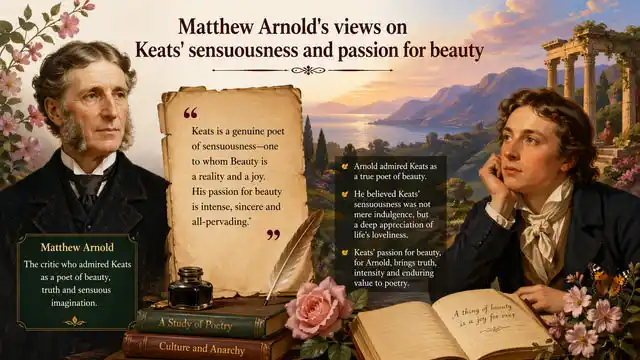
According to Arnold, Keats’s poetry reflects an extraordinary love for the beautiful, which often finds expression in lush descriptions and emotional intensity. However, Arnold also points out certain limitations in Keats’s work, suggesting that his excessive sensuousness sometimes lacks the moral depth and intellectual discipline that Arnold considered essential for the highest poetry. Thus, Arnold’s views present a nuanced assessment, appreciating Keats’s unique poetic genius while also critically examining its limitations.
Arnold’s critical essay ‘John Keats’ is an attempt at evaluating a few qualities of Keats’ poetry and personality. Arnold praises the element of sensuousness and passion for beauty richly present in Keats’ poetry. He points out that sensuousness is an important quality of poetry and it is allied to passion for beauty. It is great that John Keats shows this quality in his poetry more than all romantic poets. Arnold’s ‘John Keats’ was prefixed to the ‘Selection from Keats’ in Ward’s ‘English Poets’ Vol. IV. 1880.
Importance of Sensuousness:
Arnold regards sensuousness as one of the basic qualities of good poetry. In support to his viewpoint, he refers to Milton. Milton observes that poetry should be simple, sensuous and impassioned. Keats’ poetry is rich in the element of sensuousness. As a poet he surpasses all the romantics in sensuousness. Some critics, therefore, begin to ask whether he is anything else? No doubt he is greatly dominated by senses. It seems he desires nothing better. Therefore, at one place in one of his letters he exclaims:
‘O for a life of sensation rather than thoughts.’
Some critics give importance to Keats’ devotion to Beauty. They claim that Keats’ sense of Beauty overcomes every other consideration. It is remarked that Keats had no decision of character; no object upon which to direct his great powers. It is sensuousness that fills poetry with beauty.
“Poetry, according to Milton’s famous saying, should be “simple, sensuous, impassioned.” No one can question the eminency, in Keats’s poetry, of the quality of sensuousness. Keats as a poet is abundantly and enchantingly sensuous; the question with some people will be, whether he is anything else? Many things may be brought forward which seem to show him as under the fascination and sole dominion of sense, and desiring nothing better.”
Keats’ Intellectual and Spiritual Passion for Beauty:
Arnold accounts for Keats’ passion for beauty and comments that it is a rare quality. No doubt Keats’ yearning passion for the Beautiful is in fact an intellectual and spiritual passion. It is ‘connected and made one with the ambition of the intellect’. It is the mighty abstract idea of Beauty in all things. In his last days Keats wrote if he should die, he had left no immortal word behind him to make his friends proud of his memory, but he had loved the principle of beauty in all things, and if he had time, he would have made himself remembered. He is remembered as no merely sensuous poet could be, and he has done it by having loved the principle of beauty in all things.
Beauty as the Master-Passion Beyond Sensuousness:
The truth is that “the yearning passion for the Beautiful,” which was with Keats, as he himself truly says, the master-passion, is not a passion of the sensuous or sentimental man, is not a passion of the sensuous or sentimental poet. It is an intellectual and spiritual passion. It is “connected and made one.” as Keats declares that in his case it was, “with the ambition of the intellect.” It is, as he again says, “the mighty abstract idea of Beauty in all things.” And in his last days Keats wrote: “If I should die, I have left no immortal work behind me-nothing to make my friends proud of my memory: but I have loved the principle of beauty in all things, and if I had had time, I would have made myself remembered.” He has made himself remembered, and remembered as no merely sensuous poet could be; and he has done it by having “loved the principle of beauty in all things.”
Beauty, Truth, and Keats’ Realisation:
To see things in their beauty is to see things in their truth and Keats knew it. He believed that Beauty must be Truth. He claims in ‘Endymion’.
‘A thing of beauty is a joy forever.’
Arnold comments that it is not a small thing to love the principal of beauty combining it with truth and joy. Keats observes that nothing surprises him more than the moment the setting sun will always set him to rights or if a sparrow comes before his window. Unfortunately, he could not live long. He wrote to Reynolds he could last eighty years if he had a free and healthy and lasting organization of heart and strong lungs. The blind force of Fortune was against him.
The Unity of Beauty and Truth in Keats’ Philosophy:
For to see, things in their beauty is to see things in their truth, and Keats in knew it. “What the Imagination seizes as Beauty must be Truth,” he says prose; and in immortal verse he has said the same thing—
“Beauty is truth, truth beauty, —that is all
Ye know on earth, and all ye need to know.”
For Keats Beauty lies in Truth as inseparably as Truth consists of Beauty. Truth is not acceptable if it is ugly and Beauty ought to be given up if it is devoid of truth. When Beauty and Truth are united, true pleasure is attained.
The Relationship of Beauty, Truth, and Joy:
No, it is not all; but it is true, deeply true, and we have deep need to know it. And with beauty goes not only truth, joy goes with her also; and this too Keats saw and said, as in the famous first line of his Endymion it stands written—
“A thing of beauty is a joy forever.”
It is no small thing to have so loved the principle of beauty as to perceive the necessary relation of beauty with truth, and of both with joy.
Keats’ Place Alongside Shakespeare:
By virtue of his feeling for beauty and of his perception of the strong connection of beauty with truth, Keats accomplished so much in poetry that he stands with Shakespeare. No one else in English poetry, save Shakespeare, has in expression quite the attraction of Keats and his perfection of loveliness. He hoped to be among the English poets after his death and he is with Shakespeare.
Keats’ Achievement Despite Limitations:
Nevertheless, let and hindered as he was, and with a short term and imperfect experience, —”young,” as he says of himself, “and writing at random, straining after particles of light in the midst of a great darkness. without knowing the bearing of any one assertion, of any one opinion,”— notwithstanding all this, by virtue of his feeling for beauty and of his perception of the vital connection of beauty with truth, Keats accomplished so much in poetry, that in one of the two great modes by which poetry interprets, in the faculty of naturalistic interpretation, in what we call natural magic, he ranks with Shakespeare.
Keats’s Passion for Beauty and Quest for Great Poetry:
Arnold concludes that Keats’ strong passion for love for sensuousness and the principal of Beauty were inspired by a deep longing for the best poetry. It makes his poetry sublime. But indeed nothing is more remarkable in Keats than his clear-sightedness, his lucidity; and lucidity is in itself akin to character and to high and severe work. In spite, therefore, of his overpowering feeling for beauty, in spite of his sensuousness, in spite of his facility, in spite of his gift of expression, Keats could say resolutely:
“I know nothing, I have read nothing; and I mean to follow Solomon’s directions: ‘Get learning, get understanding.’ There is but one way for me. The road lies through application, study, and thought. I will pursue it.” Keats loved Milton’s poetry like a passionate lover and wished to be an accomplished poet like Milton.
Aspiration for Higher Poetic Excellence:
In his own poetry, too, Keats felt that place must be found for “the ardours rather than the pleasures of song,” although he was aware that he was not yet ripe for it—
“But my flag is not unfurl’d
On the Admiral-staff, and to philosophise
I dare not yet.”
Dedication to the Highest Form of Poetry:
Even in his pursuit of “the pleasures of song,” however, there is that stamp of high work which is akin to character, which is character passing into intellectual production. “The best sort of poetry-that,” he truly says, “is all I care for, all I live for.” It is curious to observe how this severe addiction of his to the best sort of poetry affects him with a certain coldness, as if the addiction had been to mathematics, towards those prime objects of a sensuous and passionate poet’s regard, love and women.
Limitations in Long Poems and Excellence in Shorter Works:
Keats was not ripe or mature for works like ‘Agamemnon’ or ‘Lear’. His ‘Endymion’ is a failure and ‘Hyperion’ is not a success. But in shorter poems he is perfect. Therefore, Arnold has chiefly spoken of Keats the man and of the elements in him which explain the production of such work. Arnold claims that it is Shakespearean work that is not imitative of Shakespeare, but Shakespearean because its expression has perfection and loveliness. Shakespeare is the great master of these qualities. Keats succeeded in attaining these qualities in his poetry.
Shakespearean Perfection in Keats’s Expression:
Shakespearean work it is; not imitative, indeed, of Shakespeare, but Shakespearean, because its expression has that rounded perfection and felicity of loveliness of which Shakespeare is the great master. To show such work is to praise it. Let us now end by delighting ourselves with a fragment of it, too broken to find a place among the pieces which follow, but far too beautiful to be lost. It is a fragment of an ode for May Day, O might I, he cries to May, O might I.
“…… thy smiles
Seek as they once were sought, in Grecian isles,
By bards who died content on pleasant sward,
Leaving great verse unto a little clan!
O, give me their old vigour, and unheard
Save of the quite primrose, and the span
Of heaven, and few years,
Rounded by thee, my song should die away,
Content as theirs,
Rich in the simple worship of a day!”
Misguided Admiration and Overemphasis on Sensuousness:
Arnold rightly observes that there are the admirers whose pawing and fondness does not good but harm to the fame of Keats; who concentrate attention upon what in him is least wholesome and most questionable; who worship him, and would have the world worship him too, as the poet of
“Light feet, dark violet eyes, and parted hair,
Soft dimpled hands, white neck, and creamy breast.”
Beyond Sensuousness: Keats’s Moral and Intellectual Depth:
Keats’ poetry is rich in such lines of sensuous beauty. But this sensuous strain does not show his true talent in it. But he has something more, and something better. We who believe Keats to have been by his promise, at any rate, if not fully by his performance, one of the very greatest of English poets, and who believe also that a merely sensuous man cannot either by promise or by performance by a very great poet, because poetry interprets life, and so large and noble a part of life is outside of such a man’s ken, — we cannot but look for signs in his of something more than sensuousness, for signs of character and virtue. And indeed, the elements of high character Keats undoubtedly has, and the effort to develop them; the effort is frustrated and cut short by misfortune, and disease, and time, but for the due understanding of Keats’s worth the recognition of this effort, and of the elements on which it worked, is necessary.
