Introduction:
Doctor Faustus presents the story of a brilliant scholar whose excessive ambition and unrestrained desire for power lead him toward inevitable destruction. In the tradition of classical tragedy, Dr. Faustus possesses the qualities of a tragic hero: he is a man of extraordinary talent and learning, yet he is ruined by his tragic flaw, namely his pride and overreaching ambition. Like the heroes of ancient Greek tragedy, Faustus struggles between human limitations and limitless desires, and his downfall evokes pity and fear in the audience. Through his rise, moral conflict, and ultimate catastrophe, Christopher Marlowe portrays Faustus as a classical tragic hero whose fate becomes a powerful warning against excessive pride, misuse of knowledge, and defiance of divine order.
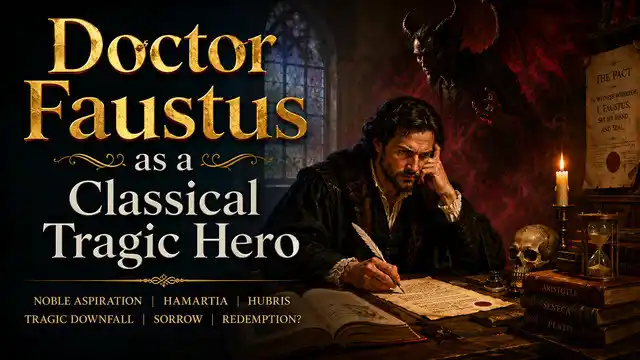
A Victim of Renaissance Ambition:
Dr. Faustus falls a victim to his renaissance ambition. Dr. Faustus has mastered all the branches of learning. Dr. Faustus thinks that now he should settle his studies to one direction in place of reading all the branches of learning. He decides to give up logic for medical science. He is ambitious enough to enjoy himself in super human powers. He wishes to be powerful enough to make men to live eternally, or, being dead, bring them back to life again. But such powers are not given by medical science. Therefore, he gives up medical science. It shows he suffers from over-ambition.
Mental Conflict:
Renaissance ambition of getting more than all other human beings leads Faustus to confusion. He fails to decide what he should study now. Dr. Faustus gives up logic, medical science and law for religion. He takes the German translation of the Bible by Jerome and reads it. According to it the wages of sin is death. The reward of sin is death and that is hard. He reads if we say that we have no sin, we deceive ourselves, and there is no truth in us. It means we must sin, and consequently die. He wishes for an everlasting death. According to this doctrine, what will be shall be. It means human efforts are meaningless. But Faustus is a self-made man. In spite of being born in a very poor family he has become the greatest scholar of his time on account of his own efforts. He can’t approve this sort of pessimistic philosophy. He decides to give up Divinity.
Tragic Conflict:
Faustus suffers from tragic conflict of mind under the impact of renaissance ambition. Lawful branches of learning are blessed by God and do not impart limitless power. He longs for limitless power and feels attraction for magic. He believes a perfect magician is as powerful as a mighty god. Faustus is attracted by metaphysics of magicians. He believes necromantic bocks are heavenly. He takes interest in complex lines, circles, scenes, letters, and characters used by magicians.
Faustus thinks that a world of profit and delight, of power, of honour, and omnipotence, is promised to the studious magician. He hopes if he becomes a perfect magician, all things that exist in the world shall be at his command. In that case he shall be greater than emperors and Kings who are but obeyed in their limited provinces; but Faustus’ dominion shall extend to endless limits. He believes a perfect magician is as powerful as a mighty god. He suffers from Renaissance ambition of attaining limitless power. In his opinion only magic can bless him with this power. Therefore, Faustus is determined to tire his brains to gain this great power through the practice of magic.
Faustus’ Error in Judgement:
Faustus is happy to think that Lucifer may grant him four and twenty years of all worldly pleasures. During the period Mephistophilis should attend him, to give him all. In short, he will have the supreme power. Faustus thinks if he had numberless souls, he would give them all for getting services of Mephistophilis. With his help, Faustus hopes he will be great emperor of the world. He may do miracles like making of a bridge thorough the moving air. It should be strong enough to be used by a band of men to pass the ocean. He has a mind to join the hills of African shore, and make that country a continent to Spain, and both contributory to his crown. He imagines that the emperor or any other authority of Germany shall not live without his permission.
Faustus’ Disappointment:
Faustus gives his soul to Lucifer through a deed of gift in his own blood. Mephistophilis requests Faustus to ask him whatever he wishes. Faustus longs to have a wife but Mephistophilis claims that marriage is but an unimportant ceremony. According to him Faustus should be satisfied with a mistress who will offer all sexual pleasures to him. It makes Faustus think of his error in judgement that magic will make him extremely powerful. He curses Mephistophilis for misguiding him and Mephistophilis claims that heaven is not beautiful. Faustus claims when he looks at the sky, he repents and curses Mephistophilis, because he has deprived him of heavenly blessings. Having written a deed to surrender his soul to Lucifer he has become a devil who does not deserve salvation. Mephistophilis claims it was Faustus’ own decision.
Mephistophilis is absolutely right for he had warned Faustus against the tortures of hell. Unfortunately, Faustus was so blind under the effect of his over- ambition that he over-looked the warning. Still, according to him, heaven is not a glorious thing. It was made for angels and suits only to them. Faustus should know that it is not half so far as the earth. The earth was made for man, then he is excellent on it for it suits him, just as the sky suits the birds and the sea is suitable for fish. These arguments fail in impressing Faustus who declares to give up magic and decides to repent.
Faustus’ Confusion:
Faustus suffers from mental tension when he fails to decide if his decision of practising magic was right or wrong. On the one hand Faustus claims that he is deprived of heavenly blessings. On the other he accounts for rare pleasures attained through magic. Faustus admits that his heart is so hard that he cannot repent. He cannot think of salvation, faith, or heaven. If he tries the instruments of suicide like swords, poisons, halters, and poisoned daggers are laid before him to kill him. Faustus claims that he would have committed suicide if magic had not given him pleasure sweet enough to conquer his deep despair. On account of his magic, he has made blind Homer sing to him his immortal poem. In these poems the story of Alexander’s love and Oenon’s death are narrated. Just to amuse Faustus, Amphion, who built the walls of Thebes with music, played on his harp to make music with my Mephistophilis. These achievements encourage Faustus not to die or basely despair. He is determined not to repent.
Faustus’ Wavering Mind:
Old man feels sorry for Doctor Faustus, and wishes to guide his steps on the right way of life that leads to salvation. Hearing the old man’s words Faustus curses himself for his sinful acts and fears that he is damned. The ruin of Faustus’ hopeless soul is inevitable. Old man’s words console him. Old man sees an Angel that hovers over Faustus’ head with a bottle of divine mercy to pour the same into his soul. Seeing it Mephistophilis rebukes Faustus and calls him a traitor who must be killed. Faustus is frightened and requests Mephistophilis to request his Lord (Lucifer) to pardon his unjust thoughts. Faustus promises write another deed with his blood again to confirm his former vow he made to Lucifer. Mephistophilis asks Faustus to do it then quickly, with true heart. Faustus asks Mephistophilis to torture that old man who asked him to give up Lucifer. Mephistophilis informs that the old man’s faith in God is firm. He can’t be tortured.
Faustus’ Tragic End:
Faustus recognizes his mistake and feels sorry for writing a deed with Lucifer. The period of twenty-four years is almost spent. The clock strikes eleven and only one hour is left in Faustus’ life.
Faustus warns himself that now he has but only one hour to live, and then he must be damned for ever to suffer in hell. He requests the sun and the moon to stand still. They are ever moving planets of heaven. If they do not move, time may stop, and midnight will never come. In this way Faustus’ death will never come. He requests the sun that is fair eye of Nature to rise and rise again to make a permanent day. In this way the night will never come. He requests the Almighty God to extend the duration of this hour to be a year, a month, week or a natural day, so that Faustus may have sufficient time to repent for his sins and save his soul from devils.
With a view to save himself from the heavy wrath of God, Faustus intends to run headlong into the earth. But all this hopeless thought goes in vain for the clock strikes the half-hour. When the clock strikes the half-hour, Faustus becomes hopeless. Faustus is grieved that half the hour is past. It marks only half-hour is left in his life. But it makes him hopeless and he thinks that it will all be past shortly. He requests God, if he will not have mercy on his soul, yet for Christ’s sake, whose blood has paid ransom for all sinners, He should decide some end to his endless pain. Faustus is ready to live in hell for a thousand years, a hundred thousand, and at last be saved. But unfortunately, no end is limited to damned souls.
