Introduction:
Doctor Faustus is not only a tragic drama of ambition, sin, and downfall, but also a play rich in comic elements and humour. Christopher Marlowe skilfully introduces comic scenes to provide relief from the intense seriousness of Faustus’s tragic journey. The humorous episodes involving characters such as Wagner, the Clown, Robin, Rafe, and the Horse-Courser create amusement through wit, foolishness, tricks, and satire. These comic scenes not only entertain the audience but also deepen the central themes of greed, misuse of knowledge, and human weakness. By presenting low comic situations alongside tragic events, Marlowe achieves a balance between seriousness and laughter, making the play more lively, dramatic, and meaningful.
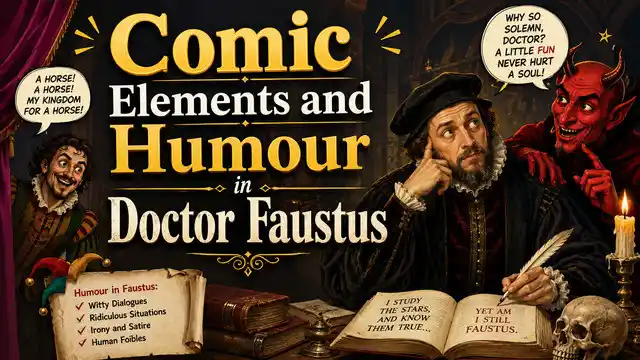
Christopher Marlowe was a popular English playwright and poet. Doctor Faustus is his master-piece. It is regarded as one of the best tragic plays in world literature. The play consists of some comic scenes also. In this reference this fact can’t be ignored that Marlowe’s drawbacks are significant like his qualities. He fails in comic scenes and plot- constructions. His comic scenes are out of reference as well as obstruction to the development of the serious action. Some scholars think that comic scenes are perhaps composed by some other dramatist of lesser skill only to lengthen the action of the play. His scenes seem loosely jointed.
Importance of Comic Scenes:
Comic scenes are included in tragic plays to serve many purposes. The most common of them are:
(i) to parody the main action
(ii) to preach morality
(iii) to satirize imperfection
(iv) to develop the action
(v) to provide comic relief
(vi) to lengthen the action of the play
Parody of the Main Action:
Marlowe shows his dramatic skill in the first comic scene that appears in Act I when Dr. Faustus’ servant Wagner befools a Clown. He asks the clown to sell his soul to the devil for a shoulder of mutton, though it was blood-raw. The Clown puts a condition that the mutton should be well roasted and good sauce to it. Wagner calls two devils to punish the clown. In fact, it is a parody to the main action in which Faustus sells his soul to Lucifer.
Preaching of Morality:
The march of seven deadly sins is made to recreate Faustus’ tense mind. The purpose behind the march is to preach morality. Faustus calls Christ to save his soul. It alarms Lucifer, Beelzebub, and Mephistophilis. They come to change Faustus’ decision. Lucifer claims Christ cannot save his soul, for he is just and has no interest in his foul soul. Lucifer introduces himself and Beelzebub to Faustus who fears they are come to take away his soul. Faustus requests them to pardon him for this, and Faustus vows never to look to heaven. Lucifer and Beelzebub promise Faustus to amuse him by presenting the march the Seven Deadly Sins.
Mephistophilis brings in the Seven Deadly Sins. The first deadly sin is Pride. It disdains to have any parents. It can reap every corner. Anything like a wig, a necklace, a fan of feathers may be the cause of pride. It refuses to stand at the ground which is not perfumed, and covered with carpet.
Faustus asks the second deadly sin to tell about itself. It is Covetousness or greed. It wishes that this house and all should turn to gold so that it might lock them safe into its box. The third deadly sin is Envy. It was begotten of a chimney-sweeper and a fisher-wife. It cannot read, and therefore wishes all books should be burned. It becomes lean seeing others eat. It wishes that there would be a famine over the world strong enough to kill all, and it might live alone. Then it would be fat. Wrath or anger is the next deadly sin. It had neither father nor mother. It leapt out of a lion’s mouth when it was hardly an hour old. Since then, it has been running up and down the world with swords. It wounds itself when it gets none to fight withal. It was born in hell. The fifth deadly sin is Gluttony or over-eating. Its parents are all dead, and they left him poor. He cannot buy more than thirty meals and ten break- fasts a day. Its father was salted thigh of a pig. Its mother was a large flask of wine. Its godfathers were fish and salted beef. Its godmother was beer. The sixth deadly sin is Sloth or laziness. It was begotten on a sunny bank. It does not wish to speak anything. The seventh and last is Lechery or lust. Lucifer asks all to go away to hell. Faustus claims that this sight delights his soul.
Satire on Imperfections:
A good comic scene should always be rich in the element of satire. It must attempt at passing satire on imperfections. In Dr. Faustus there is a sharp satire on imperfect priests who take interest only in eating and drinking. Faustus asks Mephistophilis to visit the monuments of Rome. Mephistophilis suggests that they should see the Pope, and take some part of holy Peter’s feast. Pope comes. The Cardinal of Lorraine attends him. Pope thanks to the Bishop of Milan for his present. Faustus thanks him and snatches the dish. Pope is upset. He asks Lord Archbishop to have a dainty dish which was sent by a cardinal in France. Faustus takes that too. Pope asks for some wine. Faustus snatches the cup. The Pope crosses himself. Faustus strikes the Pope. Friars return with bell, book, and candle, for the dirge. Mephistophilis and Faustus beat them, and fling fire-works among them.
Development of Action:
Some comic scenes help in developing the action by showing a vital change in the fortune of the tragic hero. For example, Dr. Faustus goes from court to court just to entertain kings and princes. He is reduced to the state of a conjurer. For example, Emperor Carolus the Fifth says to doctor Faustus that he has heard strange report of his knowledge in the black art of magic. He is willing to confirm what his ears have heard reported. Emperor swears to him, by the honour of his Imperial crown, that whatever he does, he shall be neither prejudiced nor damaged for his performance. A Knight present there remarks that Faustus looks much like a conjurer.
Emperor requests Doctor Faustus that by skill of his magic he should raise Alexander the great from his grave and bring with him his beautiful mistress, Thais. They should be in their right shapes, gesture, and garments they used to wear during their time of life.
Faustus assures that he is ready to accomplish his request, so far as by art and power of his spirit he is able to perform. The Knight remarks again that it is just nothing at all. Emperor asks him to do that without delay. The Knight reminds Faustus to bring Alexander and his mistress before the emperor. It is as true as Diana turned him to a stag. Faustus remarks when Acteon died, he left the horns for that knight. Faustus presents the spirits. Emperor remarks that these are no spirits, but the true solid bodies of those two dead princes.
Faustus requests to call the knight that was passing remarks on Faustus. The Knight enters with a pair of horns on his head. The knight rebukes Faustus for that but Emperor requests him to release the knight. Faustus asks Mephistophilis to remove the horns. With a bounteous reward Faustus leaves the court.
Comic Relief:
To provide comic relief just before Faustus’ pathetic laments followed by his tragic death, there is included a comic scene in which Faustus befools a Horse- courser. He has brought forty dollars for Faustus’ horse. Faustus charges fifty dollars for the horse and warns not to ride the horse into the water at any cost. Horsecourser rebukes Faustus for cheating. He tried to ride him in-to the deep pond at the town end, he was no sooner in the middle of the pond, but his horse vanished away, and he found himself sitting on a bottle of hey. He was never so near drowning in his life. Horse-courser finds Faustus sleeping. Horse- courser makes a noise and pulls Faustus by the leg which is pulled away. Faustus asks to call police. Horse-courser pays him forty dollars more for not getting him arrested.
Lengthening of Action:
Some comic scenes are included to lengthen the action of the play. For example, there is a comic scene in which Robin the stableman appears with a book in his hand. Robin claims this is an admirable book that he has stolen from the library of doctor Faustus’ conjuring books. Now he will be able to make all the maidens in his parish dance at his pleasure. Just then Ralph appears calling Robin to tell that the mistress has called him to look after horses. Robin warns him to keep distance for he is busy in a roaring piece of work. Now he has a magic book powerful enough to call a devil. Ralph asks if he can conjure with it. Robin claims he can make him drunk with costly wine at any tavern in Europe for nothing. If he has any mind to Nan Spit the kitchen maid, he shall have her. Ralph praises Robin for his magic. Robin suggests to attempt at drinking without payment with the help of magic.
Robin and Ralph enter a shop and drink. When the Vintner asks for payment Robin calls Mephistophilis with the help of magic. Mephistophilis rebukes Robin for calling him unnecessarily. It concludes the comic scene.
Conclusion:
Thus, comic scenes serve an important purpose in this play.
