Introduction: Wit as the Hallmark of Restoration Comedy:
“The Way of the World” is regarded as one of the finest Restoration comedies and a perfect example of a comedy of wit. Written by William Congreve, the play presents the polished manners, fashionable society, and intellectual brilliance of the Restoration age. A comedy of wit mainly depends upon clever dialogue, sparkling conversation, satire, and the intellectual sharpness of its characters rather than on physical action or sentiment.
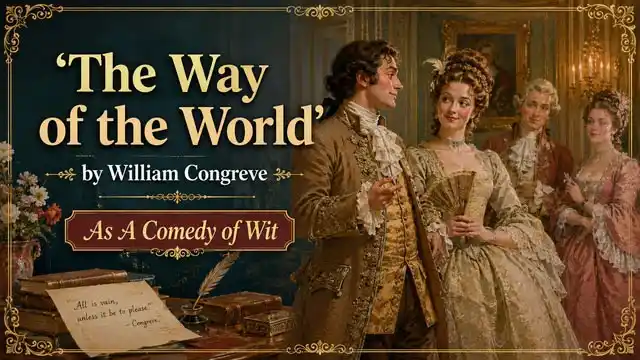
In this play, “The Way of the World” Congreve skilfully portrays the artificiality, hypocrisy, and selfishness of the upper-class society through witty repartees and humorous situations. The characters constantly engage in verbal battles filled with irony, epigrams, and sophisticated humour, which make the play lively and entertaining. The love relationship between Mirabell and Millamant, especially their famous “Proviso Scene,” displays the highest form of wit, intelligence, and mutual understanding. Thus, through its brilliant dialogue, satirical treatment of society, and refined comic spirit, The Way of the World stands as a masterpiece of comedy of wit.
Wit is the most distinguishing feature of the Restoration comedy of manners. Wit is a matter of a clever use of words. It is the saying of the five sparkling things which amuse and delight by their originality and freshness. Its appeal is primarily to the intellect, but both intellect and fancy are important ingredients in it. In the Restoration era, the nature of wit was discussed at length. “Wit was defined as the invention or discovering of similitudes which give pleasure by their vividness and novelty,” Or discovering of similitudes which give pleasure by their vividness and novelty. It is the wit as the invention or use of similitudes that makes Restoration comic dialogue so graphic and striking such similitudes require the play both of fancy (imagination) and intellect. They have been generally used in poetry, but they were used in comic prose dialogue in Restoration comedy, and the comic prose is thus raised to the level of poetry.
Mirabell’s Imaginative Wit and Verbal Brilliance:
Thus, for example, when Mirabell sees Millamant approaching at a distance, he startles and amuses the readers when he spontaneously remarks “Here she comes in faith, full sail, with her fan spread and streamers out, and a shoal of fools for tenders.” Both fancy (imagination) and judgement, as well as spontaneity, characterise this witty remark. Similarly, in the very opening of the play, both Fainall and Mirabell play with words as they would play a game of cards:
Fainall: Not at all: Witwoud grows by the night, like a medlar grafted your mouth, and t’other set your teeth on edge, one is all pulp, and the other all core.
Mirabell: So, one will be rotten before he be ripe, and the other will be rotten without ever being ripe at all.
Critical Appreciation of Congreve’s Wit:
All these words and fancies are independent of time, place and character. They are the deliberate gambollings of mind swift and rich in fancy, tutored by long practice and to ease and felicity of expression.” (Alardyce Nicholl) “Every page (of ‘Way of the World’) says Hazlitt, “presents a shower of brilliant conceits, is a tissue of epigrams in prose, is a new triumph of wait, a new conquest over dullness.” The play shows Congreve’s wit at its best it delights by its aptness and fancy, it surprises by its unexpectedness, and it startles by its boldness. Its keynote is struck at the very outset when Fainall says to Mirabell: “The coldness of a losing gamester lessens the pleasure of the winner. I’d no more play with a man that slighted his ill-fortune, than I’d make love to a woman, who under-valued the loss of her reputation.”
Aptness and Unexpectedness in Comic Dialogue:
Even Petulant’s remarks delight by their aptness and unexpectedness. For example,
Betty: They are gave Sir in great anger.
Petulant: Enough, let’s em trundle. Anger helps complexion, save paint. Mirabell’s description of the old woman’s (Lady Wishfort’s) appetite shows aptness of expression and bloodness of imagery:
……tis the green sickness of a second childhood, and like the faint offer of a later spring, serves but to usher in the fall and withers in an affected bloom.” The boldness of Mirabell’s remark startles by its unexpectedness, and delights by its aptness. Equally apt and bold is the following remark of his:
Beauty is the lover’s gift, tis he who bestows your charms. Your gloss is all cheat.”
Boldness and Fancy in Mirabell’s Wit:
Again, the boldness of fancy in the following sentence (uttered by Mirabell in a soliloquy) is striking.
“A fellow that lives in a windmill has not a more whimsical dwelling than the heart of a man that is lodged in a woman.”
The ‘Proviso Scene’ and Refined Paradoxical Wit:
The ‘proviso’ or bargaining scene is remarkable for its display of the wit both of Mirabell and Millamant. Hence both of them are capable of finely balanced phrases, subtlity of thought and elegence of expression, rather than of striking figurs of speech or similitudes. It is full of paradoxical wit of a superior, refined kind:
Milla: And d’ye hear, I won’t be call’d names after I’m marrid : positively I won’t be call’d names.
Mira: Names?
Milla: Ay, as wife, spouse, my Dear, joy, jewel, love sweetheart, which men and their wives are so fulsomly familiar.
Such wit was employed for the purpose of securing novelty and surprise, and its lends a delightful, playful quality to the comedy. It fully brings out Millamant’s hatred of all can’t and hypocricy, and reveals her prudence and greedness.
True Wit and False Wit in Restoration Comedy:
During the Restoration era it was also usual to distinguish between true wit and false wit true wit was characterised by decorum and had novelty and originality of thought which both surprised and amused. It was also characterised by property i.e.; it was used only sparingly at the right time. True wit degenerated into false wit when it was mere play, twist and turn of words, and was carried to excess. It was indulged in season and out of season. Such false wit, by its very excess, ruined the true comic spirit and became wearisome and monotonous. On the basis the characters in Restoration comedy may be distinguished between truewits and Witwoulds. The truewits have judgement, good sense, and decorum, the false wits or Witwouds lack judgement and taste, and their ideas are also superficial. Thus, in the present play Mirabell and Millamant are truewits, while Witwoud, Petulant and Lady Wishfort are false wits or witwoulds.
Congreve’s Purpose in Creating Witwouds and Truewits:
As Congreve himself tells us in Dedication, for an appreciation of the play it is necessary to distinguish between witwoulds and true wits. He explains that instead of the gross fools currently represented on the stage, he would present some characters who should appear ridiculous because of their false wit. The result is a comedy of wit, embodying the familiar ingredients of witwoulds, who are exposed and ridiculed for their defective wit, and truewits who outwit others and engage in wit combats, and rivals who are outwitted. In fact, says Fujimura, “the situation in the play is the familiar one of true wits outwitting rivals and guardians, exposing witwould, and at the same time conducting a wit combat between themselves.”
Antithesis Between Truewits and Falsewits:
The entire play turns on the antithesis between true wits and falsewits. As a true wit Mirabell is capable of finely balanced phrases, but his remarks are characterised by subtlety of thought and elegance of expression rather than by striking figures of speech. The exchange of repartee, between Mirabell and Fainall, in which the latter tried to sound out Mirabell’s feelings towards Mrs. Marwood, is characteristic of his elegant speech:
Fain: You are a gallant man Mirabell, and tho’ you may have cruelty enough, not to satisfy a Lady’s longing, you have too much generosity, not to be tender of her Hover. Yet you speak with an indifference which seems to be affected, and confesses you are conscious of a negligence.
Mira: You pursue the argument with a distrust that seems to be unaffected and confesses you are conscious of a concern for which the lady is more indebted to you, than is your wife, the reply is beautiful ‘turn’ and shows great judgement, but it lacks the force and concreteness that similitudes alone can give. Mirabell is no longer the plain-dealing truewit instead he is ironical, and lauches insinuations on the sea of conversation. He has become introspective and detached, and he is too elegant to engage in too direct repartee.
Millamant as a Refined and Whimsical Truewit:
Millamant is another truewit with a sensibility extremely refined and a lightness of touch extremely unique. Her wit is fanciful and whimsical. It is her whimsical wit that makes her seem to so airy, and one suspects that this is the becoming affectation of which Mirabell is enamoured she declares that she is pestered with letters-“O ay letters I am persecuted with letters hate letters-nobody knows how to write letters, and get one has’im one does not know how they serve one to pin up one’s hair.” Then she plays with the conceit that only letters in verse are gred for mere prose will not curl her hair. How charming is this mixture of whimsical petulance and femining illogic, of fancy flitting playfully from inconsequential thought to inconsequential thought. When Mirabell accuses her, of lacking judgement in conversing with such fools, she answers with the mixture of sense and whimsicality that is characteristic of her wit:
Milla: I please myself. Besides, sometimes to converse with fools is for my health.
Mira: Your health! Is there a worse disease than the conversation of fools?
Milla: Yes, the vapours, fools are physick for it, next to Assafoetides her whimsical wit is a shield which she holds up against the world, against Marwood and Lady Wishfort, and even against Mirabell.
Millamant’s Decorum and Independence:
Millamant is a truewit with judgement and an awareness of decorum. This side of her is best demonstrated in the famous ‘proviso’ Scene in which she capitulates to Mirabell. In this courtship scene, she tells Mirabell that she will not have any of ‘that hauseous cant’ of affection, such as ‘wife, spouse, my dear, joy, jewel, love, sweet, heart and the rest’, which passes for legal currency between husband and wives in public, she would rather be distant before others, and love each other sincerely in private. As a truewit, she loves good taste, restraint and sincerity above false show and cant. She is also independent enough to demand freedom to live a life of her own, instead of having her whole nature circumscribed in the little of a wife. In short, as Fujimura puts it, “she is a more subtle and profounder creation than any other female truewit i wit comedy but her capacity for deep feeling and her sensitive nature come close to transforming her into a woman of sensibility.”
Witwoud as a Falsewit:
Witwould: The truewits Mirabell and Millamant are well constrasted with the falsewits, Witwould, Petulant and Lady Wishfort. Among the falsewits, Witwould is easily the most amusing, though he is the cause for the familiar charge that Congreve made his coxcombs too witty. The best criticism of Witwould is to be found in the comments off Mirabell.
Fain: He has something of good nature, and does not always want wit.
Mira: Not always, but as often as his memory fails him, and his common place of comparisons. He is a fool with a good memory, and some few scraps of other folks wit. He is one whose conversation can never be approved, yet is now and then to be endur’d.
No doubt, Witwould sometimes says amusing things, but they are forced pell-mell on whatever company may be present. His lack of decorum, which characterises, a truewit, is quite evident on his first appearance:
Milla: Dear Mr. Witwould, true with your similitudes, for I am a sick of ’em.
Wit: As a physician of good air I cannot help it, Madam, tho tis against myself.
Milla: Yet again, Mincing; stand between me and his wit.
Wit: Do, Mrs. Mincing like a skreem before a great fire, I confess I do blaze today, I am for bright.
He is at best a buffoon who will raise a laugh at any price, even and his own expense, because he is deficient in judgemenmt and in this role he is simply a refinement on similar characters by Etherage and Wycherly.
Petulant as a Falsewit:
Petulant is another falsewit. He affects previty and breathes fire. “It throats are to be cut,” he mutters let sworps clash:
Shuy’s the words I shrug and am silent.” He is rebuked, too, by Mirabell for uttering senseless rival dry before ladies, like the boor that he is. The crude, witless raillery of Sir Witful and Petulant is exposed amusingly in an encounter between the too.
Pet: Sir, I presume upon the information of your boots.
Sir Will: Why ’tis like you may, sir, If you are not satisfied with the information of my boots. Sir, if you will step to the stable, you may enquire further of my Horse Sir.
Pet: Your Horse, sir, your horse is an Ass, sir!
Lady Wishfort’s Exaggerated and Comic Wit:
Lady Wishfort: The most amusing of the female falsewits is Lady Wishfort, and she is the victim of the intrigue of the two truewits. She is addicted to extreme forms of metonymy and exaggerated similitudes. To peg, she cries “paint, paint, paint dost thou understand that changeling, dangeling they hands likes Bobines before thee? Why dost thou hot stir puppet? Thou wooden thing upon wires” she uses hyperbole in the manner of Belinda, but without her char: “Let me see the glass-cracks say’st thou? Why I am arrantly flea’d— I look like an old pee’ld wall, thou must repair me, Foible, before Sir Rowland comes.” This violence of language springs from the intemperance of her nature and the result is a sort of bastard wit compounded of striking figures and abused ideas.”
Triumph of the Truewits:
The truewits are more clever and more honest than the falsewits, and they outwit both Lady Wishfort and Fainall a cynical wit and adulterous husband.
Conclusion: The Play as a Brilliant Comedy of Wit:
Thus, the play is a rich delicious feast of wit. The wit is dramatic, the wit of each character differs from that of the others, and has its own peculiar ingredients. There is wit of every shade, variety and flavour. It is one of the most brilliant comedy of wit in English language.
