Introduction:
In The Way of the World, Millamant is one of the most fascinating and memorable female characters created by William Congreve. She represents the wit, elegance, charm, and sophistication of Restoration society. Beautiful, intelligent, fashionable, and independent in spirit, Millamant stands apart from ordinary heroines because of her sharp intellect and her desire for personal freedom even after marriage. Through her lively conversation, refined manners, and playful humour, Congreve presents her as the ideal “woman of wit.” At the same time, she is practical, sensible, and emotionally balanced, especially in her relationship with Mirabell. Her famous role in the Proviso Scene reveals her modern outlook on marriage and individuality. Thus, Millamant is not merely a comic heroine but also the central attraction of the play, embodying both the brilliance of Restoration comedy and the qualities of an ideal cultured woman.
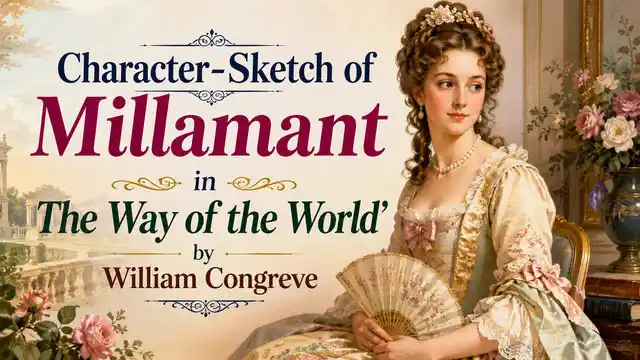
Millamant’s Beauty, Charm and Fascination:
Millamant is a young lady of great charm and fascination. She is beautiful and is conveted and desired by numerous gallants of the day. Countless are the love-letters she receives. A number of gallants always wait upon her and follow her. Her first appearance in the play is described in the most glowing poetic words:
“Here she comes, in faith, full sail, with her fan spread and streamers out, and a shoal of fools for tenders.”
Her physical beauty is the least part of her peculiar fascination. She is also cultured and educated, with refined tastes and polished manners. She augments her natural beauty by dressing up elegantly and tastefully, and by the judicious use of cosmetics. She has also a taste for literature and enjoys reading the poetry of ‘Suckling’ and other poets of the Restoration era. She can quote verses from them and recite from them at length.
Millamant as the Ideal Fine Lady:
Millamant is the perfect model of the accomplished five lady. She is the ideal heroine of the comedy of high life, who arrives at the height of indifference to everything from the height of satisfaction; to whom pleasure is as familiar as the air she draws; elegance worn as a part of her dress; wit the habitual language which she hears and speaks; love a matter of course; and who has nothing to hope or to fear from her own caprice, being the only law to herself, and rule to those about her. Her words seem composed of amorous sighs; her looks are glanced at by prostrate admirers or envious rivals. She refines on her her person, pleasures to satiety; and is almost stifled in the incense that is offered to her wit, her beauty, and her fortune. Secure of triumph, her slaves tremble at her frown; her charms her so irresistible, that her conquests give her neither surprise nor concern. “Beauty the lover’s gift?” She exclaims, in answer to Mirabell, “Dear me, what is a lover that it can give? Why, one makes lovers as fast as one pleases, and they live as long as one pleases, and they die as soon as one pleases; and then if one pleases one makes more.” We are not sorry to see her tamed down at last, from her pride of love and beauty, into a wife. She is good-natured and generous, with all her temptations to the contrary; and her behaviour to Mirabell reconciles us to her treatment of Witwoud and Petulant, and of her country admirer, Sir Wilfull.
Congreve’s Artistic Portrayal of Millamant:
Congreve in Millamant’s character has given us the finest idea of an artificial character of this kind. The springs of nature, passion, or imagination are but feebly touched. The mere fine lady of comedy, compared with the heroine of romance or poetry, when stripped of her decorative ornaments and advantages, is too much like the doll stripped of its finery. In thinking of Millamant, we think almost as much of her dress as of her person; it is not so with respect to Rosalind or Perdita. The poet has painted them themselves. They do not depend upon the drapery of circumstances. Imogen is the same differently. The interest we feel is in themselves; the admiration they excite is for in a lonely cave as in a court; nay more, for she seems something heavenly-a spirit or a vision. Millamant is nothing but fine lady; and all her airs and affection would be blown away with the first breath of misfortune. Enviable in drawing rooms, adorable at her toilette, fashion has thrown its spell around her; but if that spell were broken, her power of fascination would be gone. For that reason, the character is better adapted for the stage; it is more artificial, more theatrical, more meretricious.
Millamant’s Treatment of Other Characters:
The Way of the World is Congreve’s masterpiece, and Millamant his most perfect creation. She first enters escorted by Witwould and at once reveals to the audience her contempt for him: “Dear Mr. Witwoud, twice with your similitudes; for I’m as sick of ’em— Mincing, stand between me and his wit.” She is as hard on Petulant’s ignorance as on Witwould’s affectations: “An illiterate man’s my aversion: I wonder at the impudence of any illiterate man to offer to make love.” Her treatment of Sir Wilful from the country is well-nigh flowless. He has been proposed as a match for the incomparable Millamant, and her object is to discourage him from all thoughts on that subject. She quotes Suckling to him, but of Suckling he has never heard; she tells him that she despises the country and everything pertaining to it, and he imagines that then they may live in town; but Millamant is still beyond him: “Ah, the giddy town! I hate the town too.” He is soon dismissed, without any hard feeling, and at the end of the play he helps get Lady Wishfort’s consent to the marriage of Millamant and Mirabell.
Millamant and Mirabell: Wit and Comic Dialogue:
With Mirabell, Millamant is on exactly the right terms for the finest kind of comic writing. They are in love with each other and know it, but at the time when we first see them they are in the midst of a pretty quarrel over the gay company that Millamant insists on keeping. Mirabell is enraged at her folly and shows no hesitancy about telling her so. But she realizes that he is completely in her power. Consequently, she succeeds in turning the tables on him and in the process establishing an atmosphere of comedy. With all her love of affections and all her social mannerisms, Millamant understands that beneath the surface man is always man and woman still pure woman. Millamant goes on laughing at Mirabell whenever they meet, until in Act IV she decides to take him. She lays down long conditions as to the way they shall live after marriage and then gives him a chance to do the same thing in a milder way. So, each rails at the married habits of the opposite sex in quite the most brilliant and masterly scene in all Congreve’s plays. Their encounters mark the highest point reached in the English Comedy of Manners as far as dialogue is concerned, and yet theirs is not quite dialogue purely for the sake of dialogue: In this ‘proviso scene’, Millamant is at her witty best. Her wit and intelligence are seen to best advantage in the famous bargaining scene in which she lays down conditions which must be accepted before she would consent to be a wife. Her wit sparkles forth but Mirabell is equal to the situation and presses her hard at every instant. Perhaps though he would never have completely subdued her, had not a third party come to join is the peerless Millamant wooed and won.
Millamant’s Individuality and Understanding of Marriage:
Whenever Millamant is upon the stage, Congreve is at his best. The speeches which he puts in her mouth are all delicately turned and finely edged. She is a personage by and of herself. She comes before us visibly and audibly. She is no profile, painted upon paper, and fitted with tags. Her creator has made her in three dimensions; and, as she always differs from those about her, so she is always consistent with herself. Mirabell knows her when he says that “her true vanity is in her power of pleasing.” she is, indeed, a kind of Beatrice, who strives with a willing Benedick. But though she loves her Mirabell, yet she will not submit. She wants to maintain her individuality, her otherness till the end because she knows that otherwise there would come a day when she could feel suffocated and in bondage in her marriage and ultimately would start hating Mirabell. It is obvious that Millamant knows the disillusionment that comes to people after marriage. She has known the unhappy experience of her cousin Mrs. Fainall, and so she wants to be sure that Mirabell would not take her for granted after marriage.
Millamant’s Virtue, Generosity and Moral Superiority:
Millamant might be a coquette, and she might have her faults, but as Mirabell puts one likes her, with all her faults; nay likes her for her faults. Elaborating further he says- her follies are so natural, or so artful, that they become her, and those affectation which in another woman would be odious serve to make her more agreeable. It should also be remembered that she loved Mirabell passionately and yet she did not sacrifice her chastity to Mirabell’s masculine charms as did Mrs. Fainall and Mrs. Marwood living in the midst of sensual and sexual perverts and being pursued by rakes and gallants, she could keep her chastity inviolate. Her virtue alone would have placed her above all others of her group. But she has other accomplishments too. Virtuous, witty, intelligent, beautiful, she is also generous. She smothered her feelings and consented to marry Sir Wilfull even though she regarded him as a boor, just to save her aunt Lady Wishfort’s honour. She is the model whom Mrs. Marwoods and Mrs. Fainalls of fashionable society should emulate, the ideal for which they should aspire.
