Introduction to The Way of the World and the Proviso Scene
The Way of the World is one of the finest comedies of manners in English literature, celebrated for its brilliant wit, refined dialogue, and realistic portrayal of aristocratic society. Among its most remarkable episodes, the Proviso Scene in Act IV stands out as the emotional and intellectual centre of the play. In this scene, Mirabell and Millamant discuss the terms and conditions of their future marriage with playful humour and sharp wit. Their conversation not only provides rich comic entertainment but also presents an ideal vision of harmonious married life based on mutual respect, understanding, freedom, and equality. Unlike the selfish and artificial relationships shown elsewhere in the play, their union reflects sincerity and balance. Thus, the Proviso Scene perfectly combines comic wit with a serious commentary on marriage, making it one of the most memorable and significant scenes in Restoration comedy.
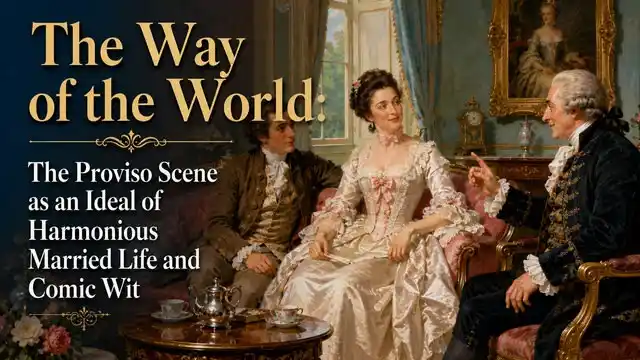
Critical Importance and Dramatic Purpose of the Proviso Scene:
The proviso scene between Mirabell and Millamant has won much critical acclaim. Definitely, the way it has been conceived and handled is praiseworthy. It serves a double purpose: firstly its witty dialogues are highly delightful and entertain the readers but at the same time it also has a serious purpose. It defines the foundation on which a harmonious marriage can be based and how the two partners in marriage can avoid the pitfalls which are strewn in the way so as their marriage can be called successful. Dramatically, this scene marks the culmination of the play, and brings the principal love- affair in the story to a head. Besides another reason for the inclusion of the proviso scene was that in the Restoration use of such a device had become a common practice.
Millamant’s Desire for Liberty and Individuality:
When the scene opens Mirabell accuses Millamant of locking herself up in the room and avoiding him because she wanted that he should not easily search her out or, he asked her, was it a trick employed by her to indicate that his pursuit of her must end there and he must now reap the reward of his efforts because she could flee no further from that room. But Millamant retorted back that she would like to be followed or chased by her lover to the last moment. Even if she were on the point of marrying him, she would expect him to entreat her and continue to seek her favour as if she were not going to marry him but to enter a convent in order to become a nun. She expects that he would press her to say yes to his proposal of marriage and act as if he had an apprehension that she had decided not to marry at all. She expects to be ‘solicited’ by him to the very last, and even afterwards. She told him that she would not like to be freed from the pleasant fatigue which resulted from a wooer’s pleadings and entreaties. They are witty remarks which, at the same time, have a serious meaning. Millamant says that she would hate a lover who can live independently of his mistress even for a moment. An arrogant husband would be intolerable to her. She declares emphatically that she would never get married unless she was sure of her ‘will’ and ‘pleasure’, which meant, until she was first convinced that she would have her own way in every matter, and the pleasure she wanted was made available to her. Mirabell at this wittily asked her if she wanted both her ‘will’ and her ‘pleasure’ before getting married or if she would be satisfied with having her will then, and wait for her pleasure till the marriage ceremony had been completed. Dismissing this good-natured gibe from Mirabell as impertinent, Millamant says even after marriage she cannot give up her liberty, that she could not bid farewell to her ‘solitude’ and ‘contemplation’, her morning thoughts, agreeable wakings, indolent slumbers etc. She told Mirabell emphatically that she would definitely lie in bed in the mornings as long as she pleased to which Mirabell playfully retorted that then he would get up in the mornings as early as he pleased. Mirabell’s reply is as amusing as Millamant’s way of expressing her love of liberty. But Millamant indulges in a witty paradox by saying: “Ah! Idle creature, get up when you will.” She then declares that she would not like him to address her with endearments like ‘wife’, ‘spouse’, ‘my dear’, ‘my joy’, ‘my jewel’, ‘my love’, ‘my sweetheart’, and such other vulgar modes of address which generally husband and wife use for each other. Besides, after marriage they would not make a display of their mutual intimacy or attachment, nor would they act as too familiar with each other before others, nor go to Hyde Park together in a new chariot in order to attract the notice of people for she hated to be the centre of gossips of others. We get another witty paradox from her when she says to him: “Let us be as strange as if we had been married a great while, and as well-bred as if we were not married at all.” What she means is that a certain reserve or a certain distance must always be maintained by a husband and a wife toward each other.
Millamant’s Conditions for Marriage:
When Mirabell asks if she has any other condition she said that her other conditions were very minor like she would like to be free to pay visits to whomsoever she liked and receive visits from whomsoever she pleased; she would be free to write letters and receive letters without being asked any questions by him or any expression of displeasure on his face; she would be free to wear whichever clothes she pleased, and talk on subjects which agreed with her taste; she would be under no compulsion to talk with persons who thought themselves witty but whom she did not like; she would not talk to them just because they were his acquaintances; she would not become intimate with fools just because they happened to be his relations; she would dine in her own room when she would not be in a mood for company and would not expect him to ask her any reasons; she would not like the privacy of her closet to be violated; she would sit alone at her tea- table as if she were a monarch, and he must not take the liberty to come to her without first asking her permission; and finally, wherever she was, he should always knock at the door before she entered. She said that if he was willing to agree to those condition then she would slowly and gradually bring herself to become his wife.
Serious Meaning Beneath the Comic Wit:
All these demands of Millamant are stated in a witty and entertaining manner. But they have a serious purpose at the core, because what Millamant is really asking for, or what Congreve makes her ask for, is non-interference from her husband in her day-to-day routine life. She concludes this speech by saying that, if he abides by these conditions, she may “by degrees dwindle into a wife”. The phrase “dwindling into a wife” is really a very amusing way of saying that a woman, no matter how much freedom she has can no longer be wholly her own mistress after marriage.
Mirabell’s Conditions and Satire on Society Women:
It is now Mirabell’s turn to lay down conditions. What he says is a highly entertaining satire on the habits of the society women not only of Congreve’s day but of all times. Indeed, much in the ‘proviso’ scene has a universal validity. His first condition. is that the persons she associated with would belong to a general category, that she would not associate with anyone who had sworn to keep her confidences, or any woman with whom she was on terms of close intimacy; she would have no female friend who revealed her personal affairs to her, and by doing so lured her into revealing her personal affairs to her; she would have no female friend, who was in her confidence and who coaxed a fop to take her (Millamant), masked to the theatre in great hurry so that she was not detected; that she would continue to like her own face as long as he should like it and would not try to give it a new look by the use of cosmetics etc. He laid down the condition firmly that she would not wear masks either during the day or during the night and would have nothing to do with women who dealt in cosmetics and whose trade it was to sell powders and paints to varnish the face. Mirabell then goes on to denounce the wearing of too tight dresses by pregnant women because such tight dresses could lead to the child’s head being so twisted as to give it the shape of a sugar loaf. Lastly, he said that though he agreed to her sovereignty over the tea-table, but his condition was that she should confine herself to simple, native tea-table drinks, such as tea, chocolate, and coffee. Besides she would confine her conversation to trivial topics like fashions, gossip about acquaintances but under no circumstances would she trespass upon the rights and privileges of males. He said that if those conditions were acceptable to her, then he might in all other things prove a co-operative husband, easy to deal with and willing to agree with her on routine matters.
Comic Entertainment and Satirical Value of the Scene:
The entertainment value of the proviso scene is thus obvious. Mirabell ridicules the female sex of his time for many of its activities, such as a mutual exchange confidences, the use of cosmetics, the wearing dresses which squeeze the body of a pregnant woman too tightly, and indulging in malacious gossip about absent friends Congreve makes Millamant, a woman though she is, ridicule herself and other ladies of her class, the upper section of the society, when she speaks of her indolent slumbers in the morning and her desire to remain in bed till a late hour in the morning. Millamant’s wish to be wooed even after marriage shows a woman’s vanity in wanting to remain object of admiration and worship always.
The Philosophy of Harmonious Married Life:
Coming to the serious purpose of the proviso scene, we find that, while it is necessary for loves to sacrifice some of their ego, harmony in marriage demands that they should not be too suspicious of one another and not poke their noses into one another’s affairs too much. It is necessary for a husband and a wife to respect each other’s privacy as far as possible, to allow one another a certain amount of freedom, but not unlimited freedom, in the choice of friends and acquaintances. In the matter of make-up and cosmetics, a wife must show due consideration for the feelings of her husband. As Millamant is a well-bred and decent lady, she rightly describes Mirabell’s conditions as ‘horried provisos’, because she would not do any of those things even if Miabell had laid down no conditions. However, there is much that Mirabell has to learn from the conditions laid down by Millamant. Millamant would certainly find herself unhappy after marriage if any of her conditions were to be violated by him. And, indeed, apart from the exaggeration which is inevitable in satire, Millamant has said nothing that is impossible or undesirable.
Congreve’s Philosophy of Love and Marriage:
It is in the light of the serious purpose of the core of the proviso scene that this scene is regarded as Congreve’s contribution to the philosophy of love. It would be wrong to think that Millamant in this scene shows herself to be an ‘arrant coquette’. In reality, Millamant shows her awareness of the conflict in marriage, and of the need to maintain her own personality in order to be able to love whole heartedly. Her appeal has all the earnestness of real life about it; it is expressive of all the hopes and fears of lovers when they see the bright face of happiness tarnished with the shadow of possible disillusionment. Each of them has been the rocks which bring most marriages to ruin, and will strive to avoid them. As a woman, Millamant has the valuable power of giving, but she is rightly jealous of herself, and is not to be under-valued. Once convinced of Mirabell’s love, she throws away her defences, and shows a perfect frankness.
Congreve’s Artistic Achievement in the Proviso Scene:
In the proviso scene Congreve preserved many details of similar scenes in earlier plays by other dramatists especially Dryden, Millamant lays down condition to safeguard her ‘dear liberty’. Like Melantha in Dryden’s Marriage a La Mode, she says, “let us never visit together, not go to a play together.” Like Isabelle in Dryden’s The Wild Gallant, she describes most of her conditions as ‘trifles’. She condemns words expressive of mutual affection as emphatically as Celadon and Florimet in Dryden’s Secret Love. Mirabell, like Isabelle’s lover, finds Millamant’s initial conditions reasonable enough but the later ones somewhat alarming. Mirabell’s own conditions, although fairly original, are expressed with all the formality shown in corresponding scenes in Dryden’s Secret Love and Amphitryon. Thus, Congreve borrows much, but he improves on what he borrows. of his prose He achieves the finest of all the proviso scenes in Restoration comedy. The scene has a poetic luminosity. The speeches are all perfect in character, rich in detail, and continuously witty. The lovers show grace both in their evasiveness and in their surrender to each other.
