Introduction:
In The Way of the World, Mirabell appears as the central hero and one of the most intelligent, polished, and admirable characters created by William Congreve. He represents the ideal gentleman of the Restoration age, possessing wit, refinement, wisdom, and emotional balance. Though surrounded by a corrupt and artificial society, Mirabell stands apart because of his sincerity in love and his practical understanding of human nature. His deep love for Millamant, his clever handling of complicated situations, and his skill in overcoming the schemes of enemies reveal both his intellectual superiority and moral strength. Through the character of Mirabell, Congreve presents a perfect blend of wit, charm, diplomacy, and true affection, making him one of the most memorable heroes in Restoration comedy.
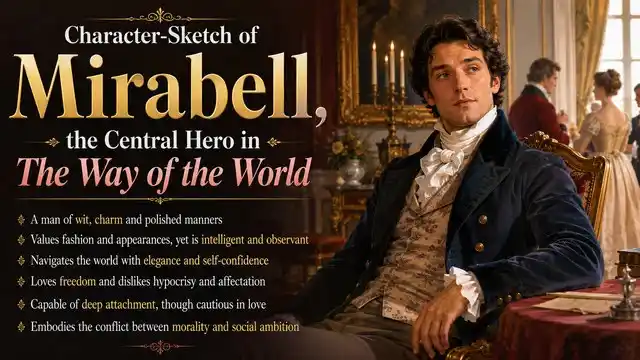
Mirabell as a Charming and Attractive Hero:
Mirabell, the hero of the play, is a young, charming, attractive society. gentleman. He has great physical charms and his handsome personality and charming manners make him a favourite with Lady Wishfort, Mrs. Fainall, and Mrs. Millamant. His great personal charm makes him a centre of attraction for all the women-folk in the comedy.
Mirabell’s Persuasive Power and Deception:
Not only is a charming, attractive person, but he is aiso gifted with a highly persuasive tongue. His persuasive powers enable him to win the hearts of others, and convert them to his own way of thinking. Lady Wishfort knows how persuasive he can be and that is why she is afraid that if Foible has met him, he would certainly succeed in getting out of her the secret of Sir Rowland’s visit to her. It was his physical charm and smooth and attractive talk which made Lady Wishfort fall for him in a big way, and she had ultimately to suffer much pain and humiliation when she discovered that in reality, he loved her niece Millamant, and was simply using her as a screen to conceal his love of her.
Mirabell’s Moral Weaknesses and Genuine Love:
Mirabell is not an ideal hero. He courts Lady Wishfort knowing all the while that he did not intend to marry her. He even becomes sexually involved with Mrs. Fainall and when it was feared that she might be pregnant he coaxed her to get married to Fainall so that Fainall could be claimed as the father of the child. This behaviour does not do him any credit. So far as Lady Wishfort’s deception is concerned, he may be excused on the ground that his ardent and genuine love for Millamant drove him to that trick. Even so he took care that the position of Lady Wishfort was not seriously compromised, and for that purpose got his servant Waitwell to marry Foible beforehand. But his relationship with Mrs. Fainall is inexcusable. There is no reason for that connection except sexual gratification which was a very common past time for the society gentlemen of the Restoration period. However, when the spark of genuine love was kindled in his heart, he gave up that sinful relationship and reformed himself. He behaved in a perfectly gentlemanly manner towards her by seeing to it that her social reputation did not suffer on account of his relationship with her and also by saving her from the conspiracy of her husband and Mrs. Marwood to bring about her economic ruin along with that of her mother Lady Wishfort. His love of Millamant is true and sincere, and it is this love alone which can excuse the trick which he played upon the old lady. Lady Wishfort was hostile to him and there was no other way of securing her permission to their marriage, a permission which was necessary if Millamant was to inherit her share of the family estate. Mirabell sincerely loves Millamant and makes all efforts to win her hand in marriage, and uses every trick in the book to achieve his purpose, is not discouraged by Lady Wishfort’s hostility and in the end is able to bring her round and gets her approval for his union with Mirabell.
Critical Opinions about Mirabell:
Meredith calls Mirabell “the spright best male figure of English comedy”, and Dr. Johnson calls him, “an intellectual gladiator” because of the lively wit-combat which he keeps up with Millamant throughout the comedy. His wit, the fine sparkling things which he says so often, show that he is intelligent and shrewd, and knows how to hold his own. Mirabell may not be Millamant’s equal in playful, witty talk, still his gift for coining sentences, short and sparkling and amusing, as well as imaginative and intelligent, is unique. He describes the advent of Millamant thus:
“Her she comes, i’ faithful sail, with her fan spread and streamers out, and a shoal of fools for tenders.”
In another place he says, “A man may as soon take a friend by his wit: or a fortune by his honesty, as win a woman with plain dealing and sincerity.”
And this may be also taken to be a testimony of his wit: “Matrimony has made you eloquent in love.”
Mirabell’s Wit in the Proviso Scene:
The proviso scene where he also lays down conditions as to what type of conduct, he would expect of Millamant is the water-mark of his wit. The scene reveals both his shrewdness and wit. Both he and she shine out, in the words of a critic, as “the civilized man and the civilised woman, working out move by move and step by step, in the wittiest language and with an appearance of great confidence, the insoluble problem of how to deal with an animal passion in a sophisticated world.
Mirabell as a Truewit:
Mirabell is a Truewit i.e., one who outwits others both guardians and rivals, exposes Witwouds, and engages in wit combats with other truewits. He is, says T. H. Fujimura, “the Resotration rake in the process of being transformed into a wit of the age of sense and sensibility.” His predominant characteristic as a Truewit is his judgement rather than fancy; and he is more addicted to sententiae (use of maxims and proverbial similitudes (use of analogy or figures of speech). When Mirabell is metaphorical, his expressions) observation is just, but not striking, as in his remark on Lady Wishfort: “An old woman’s appetite is deprav’d like that of a birl— ” Tis the Green sickness of a second childhood; and like the faint offer of a latter Spring, serves but to usher in the Fall; and withers in an affected Bloom.” He is capable of finely balanced phrases, but his remarks are characterized by subtlety of thought and elegance of expression rather than by striking figures of speech. The repartee of Mirabell to Fainall, in which the latter tries to sound out Mirabell’s feelings towards Marwood, is characteristic of his elegant speech.
Fain: You are a gallant Man, Mirabell, and tho’you may have cruelty enough not to satisfy a lady’s longing, you have too much generosity, not to be tender of her Honour. Yet you speak with an indifference which seems to be affected; and confesses you are conscious of a negligence.
Mirabell: You pursue the Argument with a distrust that seems to be unaffected, and confesses you are conscious of a Concern for which the Lady is more indebted to you, than is your wife.”
The reply is a beautiful “turn” and shows great judgement, but it lacks the force and concreteness that similitudes alone can give. Mirabell is no longer the plain-dealing Truewit; instead he is ironical, and launches insinuations on the sea of conversation. He has become introspective and detached, and he is too elegant to engage in too direct a repartee.”
Mirabell’s Sound Sense and Modesty:
Mirabell is a man of sound sense as well as shows modesty and decency in his behaviour which is generally not to be found in other Truewits of Restoration comedy. He believes that true wit is not devoid of good nature and that is why when Petulant indulges in senseless and tasteless ribaldry in the presence of ladies, he sharply castigates him:
Mira: But has not thou then Sense enough to know that thou ought’ st to be most asham’d of thy self, when thou has put another out of countenance.
Pet: Not I, by this Hand-I always take Blushing either for a Sign of Guilt, or ill Breeding.
Mira: I confess you ought to think so. You are in the right, that you may plead the Error of your judgement in defence of your practice:
Where Modesty’s ill Manners, its but fit
That Impudence and Malice pass for wit.
This behaviour of Mirabell is based on Congreve’s own sensible and affectionate nature, Congreve in Mirabell’s character has not followed the pattern of other dramatists who showed maliciousness as a key quality of their Trucwits. Mirabell also knows his own weaknesses too well to be carefree and gay. As he says, “As Fellow that lives in a Windmill, has not a more whimsical Dwelling than the Heart of a Man that is lodged in a woman.” The following comment is made in a more graver and sententious tone: “To know this, and yet continue to be in Love, is to be made wise from the Dictates of Reason, and yet preserve to play the Fool by the force of Instinct.”
Mirabell as a Principled Truewit:
Mirabell is not an unprincipled Truewit. No doubt he has had sexual relations with several women but he chooses his mates well. He shows good sense in the choice of his women. He refuses the advances of Mrs. Harwood even though he knows that he stands to gain through that relationship because his love for Mrs. Millamant is genuine and sincere. Though he had expressed love once to Lady Wishfort in an effort to win Mrs. Millamant, yet he does not stoop low to seduce her sexually. Mrs. Fainall, we come to know, had been physicall involved with him in the past before he fell in love with Millamant; and since she was a widow at that time, hence, according to the popular views of widows being very inflammable, he could hardly be blamed for satisfying her sexual appetite, as well as his own. When the play opens we gather that his relationship with Mrs. Fainall has come to an end and he is seriously involved with Millamant with matrimony in mind. In the “Proviso” scene (the bargaining scene) he lays down the condition that she would not be allowed to wear tight dresses for he did not want the head of his son to be deformed or mis-shaped because of her craze for being fashionable. “I denounce against all strait lacking”, he tells Mrs. Millamant, “Squeezing for a shape, till mould my Boy’s Head like a Sugar-loaf; and instead of a Man Child make me father to a Crooked bittel.” Mirabell is probably the first Truewit so sensible as to begin worrying about his offspring at the time he proposes to his mistress. He is prudent enough, too, to make some concessions to reputation; and he is the one who expresses the ostensible moral of the play, “That marriage Friends too oft are paid in kind.” “Sententious Mirabell”, as Mrs. Millamant so aptly calls him is a sober Truewit, in whom the playful flirteousness of other Truewits has been transformed into a concern with sound conduct of life, He is different from other Truewits of other dramatists in the sense that he does not show cynicism as they do, but sobriety which they do not.
Conclusion:
In short, the many qualities of head and heart which Mirabell posseses, elevate him to a higher place in comparison to the other heroes of Restoration dramatists, and entitle him to be the hero of the play.
