Chaucer: The Father of English Poetry
Introduction: Chaucer’s Life and Works:
There is no source to confirm whether Chaucer was born in 1343 or not but it is certain that he belonged to a prosperous family. His father John Chaucer was a wine importer. His mother Agnes was daughter of John de Copton and his birthplace was in Thames Street. John Chaucer arranged for his son and got him appointed as a page boy. Chaucer was brought up in London and found no difficulty in working in the household of King Edward III’s daughter-in-law, Elizabeth of Ulster; and having got such a good start Chaucer enjoyed an uninterrupted favour of royal authorities even in the realms of Edward, Richard II, and Henry IV, as a man of affairs and it helped him in his growth as a poet also.
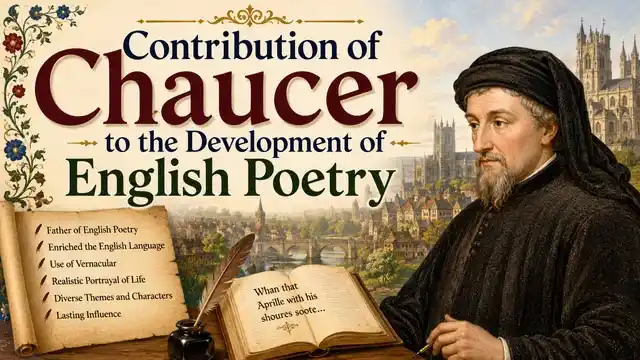
Chaucer was not only a poet but a soldier as well. In 1359-1360, as a soldier he served in France during the Hundred Year’s War. He was married in 1366 to Philippa Roet of Flanders. She was lady-in-waiting to Queen Phillippa at that time. Then after she served Constance who was John of Gaunt’s second wife. It is interesting to know that the sister of Chaucer’s wife became the third wife of John of Gaunt. He was sent abroad frequently for his loyalty was beyond suspicion.
It is said from 1368 to 1387 he visited France and Italy in diplomatic missions atleast for seven times. He had acquired business training at the Inner Temple. During 1374-1385 he acted as a Controller of Customs. In 1385 he became a Justice of the Peace in Kent. In 1386 he became a Member of Parliament.
Chaucer’s wife died in 1387 leaving behind two sons and a daughter. As a Clerk of the Works he served in London with great success during 1389-1391 and then after he became a subforester. It was a set back to him for he was expecting a promotion. It affected him mentally as well as physically, and he could not live long. In 1400 he died and was buried in Westminster Abbey. Chaucer’s literary contribution is divided into three periods;
The French Period 1355-1370
The Italian Period 1371-1385
The English Period 1386-1400
The French Period:
Under the French influence Chaucer wrote two poems of great merit:’ The Romance of the Rose’ and’ The Book of the Duchess’. ‘The Romance of the Rose’ is a symbolical poem in which the rose symbolizes love and its various pleasures. The lover is helped by Welcome, Pity, and Liberty but Reason restrains it. In fact, it was English translation of a French love story ‘The Raoman de la Rose’ composed by Guillaume de Lorris in 1237 but remained incomplete. Chaucer in this way only translated the work into an allegorical poem in English.
‘The Book of The Duchess’ pays the poet’s tribute to John of Gaunt’s first wife, Blanche of Lancaster, who died in November 1369. It is the first original poem of any length by Chaucer. In the prologue he imagines that he has not been able to sleep for the last eight years. Hopeless love had deprived him of health and happiness.
My peyne is this, that what so I desire,
That have I not, ne no thing lyk therto;
And ever set Desire myn herte on fire.
Eek on that other syde where – so I go:
What maner thinge that may enctesr my wo
That have I redy, unsoght, everywhere,
Me ne lakketh but my deth, and than my bere.
Chaucer’s hopeless love might have started in 1361 or 1362, and have lasted when he married the beautiful Philippa.
The Italian Period:
Chaucer’s stay in Italy was short yet significant in the sense that during it he got opportunity to improve his knowledge of Italian. When he returned, he had three books with him: The ‘Divina Commedia of Dante’ and ‘The Teseide’ and ‘Filostrato of Boccaccio’. ‘Troilus and Cressida’ is the best poem of this period. It is a love story that goes back to the Trojan War. If Chaucer had written nothing else, by itself it would entitle him to be honoured among the greatest English poets. ‘The House of Fame’ is a dream poem. The dream begins in a temple of Venus. A great golden eagle takes the dreamer to the house of fame. In fact, it is a marriage poem. “The Parliament of Foules’ is an allegorical dream poem. ‘The Legend of Good Women’ deals with the life of great heroines like Cleopatra, Thisbe, and Dido. It is the first poem in English that is composed in heroic couplet.
The English Period:
Chaucer’s greatest literary contribution is the ‘Canterbury Tales’ for which the credit goes to this period. Chaucer wrote its prologue also that in itself has become a milestone and is regarded as a historical document telling about the life of English people in the second half of the 14th century. Unfortunately, Chaucer died before completing ‘Canterbury Tales’. Chaucer composed a few minor poems also during his later years. Among them a few like ‘The Former Age’, ‘Fortune’, ‘Truth’, ‘Gentilesse’, and ‘Lak of Stedfastnesse’.
Chaucer’s Contribution to English Language and Literature:
Chaucer literary achievements were very great keeping in mind there historical importance as well as their universal appeal. When he began to write the themes of poetry were confined to the adventures of knights and their love making with beautiful ladies. It is Chaucer’s great achievement that he gave new themes to English poetry. No doubt most of them were drawn from Italian literature or Latin or popular folk tales. He drew some themes from English life also. He made poetry realistic and satiric the qualities without which our modern poetry stands nowhere.
Chaucer introduced not only new themes but also new methods of handling them. He introduced two new metres, the seven-line stanza and the ten or eleven syllabled couplet that suited the most to narrative poetry. Thus, he saved English poetry from the monotony of the octosyllabic couplets. Chaucer imparted an extraordinary richness and ease to verse. He introduced a conversational note and humour mixed with mild satire and irony into English poetry. He is the first conscious artist in English verse.
Alfred W. Pollard claims if we could take thirty percent of Goldsmith, fifty of Fielding and twenty of Walter Scott, and vitalise this compound with the spirit of the 14th century, we should get perhaps fairly near to another Chaucer. But it would be a Chaucer whose right hand wrote prose and only his left in verse, and the formula, though it may be useful in suggesting the writers to whom Chaucer is most akin, and how modern he really is, would still be defective, for the charm of his poetry remains personal and individual.
