The Rape of the Lock: A Mock-Heroic Epic
Introduction:
Alexander Pope’s The Rape of the Lock is regarded as one of the finest examples of a mock-heroic epic in English literature. Written in the early eighteenth century, the poem brilliantly combines wit, satire, and elegance to present a trivial social incident in the grand style of classical epics. The poem is based on the cutting of a lock of hair from a young lady named Belinda by Lord Petre, an incident that created tension between two aristocratic families.
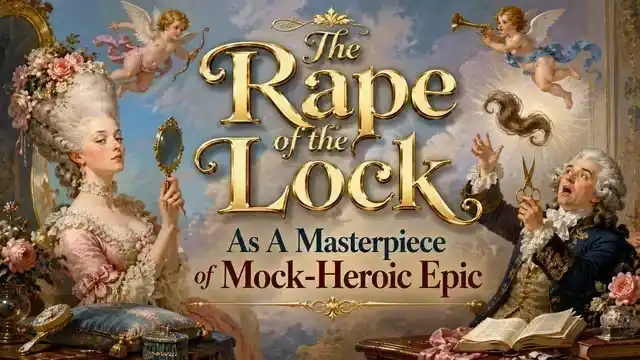
Pope transformed this minor event into a heroic battle by using epic conventions such as invocations, supernatural machinery, grand speeches, battles, and elevated language. Through this artistic treatment, he exposes the vanity, artificiality, and superficiality of fashionable society. The greatness of the poem lies in the poet’s ability to give epic importance to an insignificant matter while maintaining humour and satire throughout. Thus, The Rape of the Lock stands as a masterpiece of mock-heroic poetry that skilfully parodies the epic tradition and at the same time presents a vivid picture of eighteenth-century aristocratic life.
Milton’s Paradise Lost is a great classical epic. Pope follows the tradition of a classical epic with a slight difference that he produces The Rape of the Lock as a mock-heroic epic. In ordinary sense it may be taken to be a parody or comic imitation of a classical epic. It means all the elements of a classical epic like invocation, theme, characters, composition, sensuous description, strong emotions, high imagination and mock-heroic style are present in it. But there is lack of high seriousness. For the motive of The Rape of the Lock is to produce humour.
Invocation:
Following the structure of a classical epic like Milton’s Paradise Lost Pope introduces the theme and invocation in the opening lines. The poet points out the great irony of human life. It is strange that love becomes the cause of terrible incidents and small matters become the cause of serious conflicts. The poet has composed this epic on the suggestion of his friend John Caryl. Belinda is heroine in the epic. The poet hopes that both the persons will appreciate his labour and work. The theme of the verse is ordinary the Muse will bless him and his work shall earn admiration. The poet asks the Muse to guide him in the matter by telling why a refined lord attacked a gentle beautiful lady unlawfully. He does not know why the lady did not accept the proposal of love made by the handsome lord. In such bold matters ordinary people can’t be involved. It too is very strange that a soft-hearted lady becomes so much angry.
Comic Theme:
Milton’s Paradise Lost introduces a noble theme but being a mock-heroic epic, The Rape of the Lock introduces a comic theme. Pope himself admits the fact
Slight is the subject, but not so Praise.
A Baron cuts off a beautiful lock of hair from the head of a beautiful lady. No doubt the act is shameful and is not important in the least-for the mankind. Yet Pope makes it a theme for this epic. For it is a mock-heroic epic in which an important thing is presented as an unimportant thing and likewise a quiet unimportant thing is claimed to be very important.
Comic Characters:
A classical epic consists of inspiring characters as we see in Paradise Lost that even Satan’s character is highly inspiring. But in this mock-heroic epic the characters are lacking in nobility. They are comic characters. For example, the hero is hardly heroic in his action he wants to get possession of the beautiful bright locks hanging behind ivory white neck of fair Belinda. He wants to get it done by fair or foul means. He knows success is important. Nobody thinks if it is got by honest or dishonest means. First of all he attempts at pleasing the gods. For it he gets up before the sun-rise and begins to worship all gods and goddesses. The lord worships all gods yet he prays chiefly the god of love. For that purpose, he builds an altar of love. There he places twelve huge volumes of French Romances for they narrate love stories. Besides, he sets there all those things that his former beloveds left with him from time to time. Among these tokens of his former loves were three garters, one glove and a number of love letters. The lord heaves three long passionate sighs to raise fire. Belinda too lacks in high seriousness. She gives too much importance to her beautiful locks and makes efforts to get back the lost one. Though she knows that it is quite useless after being cut off. During the mock-heroic battle among the characters, their foolishness comes to light. On the grassy bank of the river Meander lies a young man dying like a swan singing his last sweet song. Courageous Sir Plume succeeds in defeating Clarissa but by the time Chlow comes there. Chlow frowns at him and he dies. When she smiles seeing him dead, seeing her attractive smile Sir Plume is alive again.
Composition:
Pope divides the whole action in five cantos. Canto Ⅰ introduces the characters as well as Arial’s warning that a misfortune may fall in Belinda’s life that day. The action is limited to one day. It tells about the supernatural machinery and Belinda’s make up. Belinda looks very beautiful when the makeup is over. In Canto II the points out that Belinda with other youths in a boat in the middle of the river Thames. There are a number of well-dressed youths but all eyes are fixed only on Belinda. Belinda is already so beautiful yet she has grown two beautiful ringlets of her hair. The Baron decides to possess a lock Arial posts his sylphs to protect Belinda. In Canto III the poet tells about the majestic beauty of Hampton Court. Belinda plays the game of Ombre and defeats the Baron. She shouts in joy. At this time, she is very happy without knowing that just a few moments after she has to suffer miserably. Her pride of getting victory shall be removed. She will remember this day for a sorrowful experience. The game of cards is over. It is time to take coffee. Coffee affects the Baron also. His brain becomes sharp enough to make a plan for possessing Belinda’s bright lock. The poet warns the Baron not to act like a thoughtless hasty youth. The poet points out a deep irony that a man determined to do an evil act finds the means of doing it without difficulty. The Baron marks that Clarissa, one of Belinda’s friends has a pair of scissors. Baron cuts off the lock and claims that he is the greatest victor. In Canto IV Belinda shows her grief. Ariel decides to leave Belinda when he sees the image of an earthly lover in her heart. With a heavy heart he departs. Umbriel, a gnome visits the cave of Spleen. Spleen is the goddess of melancholy. The cave of Spleen shows strange sights. It is super that men imagine that they are pregnant. There are girls who claim to be bottles. They shout to be corked. The goddess of Spleen gives a bag and a bottle filled with quarrelling force of women, the force of their lungs, sighs, laments and anger. Then she fills a bottle with fears that faint, soft sorrows that melt the heart and grief that flow tears from eyes. Umbriel opens the bag and breaks the bottle among Belinda and those present there. In Canto V they all fights like warriors with extra ordinary weapons like pins and snuff boxes, smiles too work as weapons. Belinda succeeds in defeating the Baron. By that time the lock of her hair is seen mounting to the moon. Now the lock illumines others like a star.
Sensuous Descriptions:
Pope is a sensuous artist. His descriptions are lively and sensuous. For example, he accounts for Belinda’s make up. Belinda looks very beautiful when the makeup is over. Still, she attempts at looking more beautiful by improving her smiles and increasing her grace. She exposes blushing on her face and a bright shine fills her eyes with a lively excitement. It seems as if she were a warrior and the charms of her face are her weapons. Following classical traditions Pope describes weapons of great warriors along with their past history. Angry Belinda asks the Baron to face his tragic fate. She draws out a horrible hair pin from one side of her head. The pin has been a piece of decoration since ancient times. Her great great grandfather used to wear it round his neck. It was turned into three seal rings. After his death, it was melted. There was made a buckle with it for his widow. It was turned into a whistle when Belinda’s grandmother was a child. It was her beloved toy to play. It was turned into a hairpin for Belinda’s mother. Belinda’s mother wore it for a long time and now it is worn by Belinda.
Strong Emotions:
The epic is full of strong emotions. When the lock is cut off Belinda’s eyes produce flames of fire. She shouts horribly. The whole sky echoes with horror. None has ever shouted louder than this to melt the heart of Divine Powers. Belinda expresses her grief in pathetic words. It arouses such pity in the hearts of the listeners that they begin to weep. But the Baron does not hear anything for his ears are stopped by Jove and Fate.
She said: the pitying audience melt in Tears,
But Fate and Jove had stopp’d the Baron’s Ears.
The Baron shows strong emotions of joy when he succeeds in possessing the lock. He claims that he should be crowned with the garlands of victory for he has done a glorious act. He hopes that his name shall be remembered with great admiration and honour till the streams are full of fish, sky of singing birds, beautiful ladies travel in coaches driven by six horses, people read ‘The New Atlantic’, ladies’ beds have small pillows, people visit Church on holy days and illumine the place with wax-candles, beautiful girls accept invitations and give appointments for meeting.
Let Wreaths of Triumph now my Temples twine.
(The Victor cried) the glorious Prize is mine!
High Imagination:
Pope shows his high imagination in the introduction of the new type of super natural machinery. Pope points out how these strange creatures called sylphs perform wonderful activities. Some sylphs perform higher duties and regulate the movement of planets. Some inferior sylphs move heavenly bodies in night in the sky. Some sylphs refine the mist of lower regions by sucking its poison while some sylphs dip their wings in the rainbow. Ariel points out that sylphs perform great activities like the raising of terrible tempests in the ocean or causing gentle rains in fields and farms. Some sylphs dominate human activities by watching their behaviour and guiding their actions. They guard the nations and their greatest worry is to guard the British crown. Having discussed the important duties performed by sylphs, Ariel tells about their less important duties. One of them is to look after beautiful girls. This duty is very amusing but it is not important. When the winds are rude, sylphs control them to save powder on the faces of beautiful girls. Pope shows how in the cave of Spleen people imagine strangely that their bodies are changed to different shapes. One person claims to be an earthen pot while the other claims to be a stool with three legs and walks strangely. Homer, the great epic poet refers to such things in ‘Iliad’. A person imagines to be a jar and takes a long sigh of grief. One imagines to be a 10asted bird and talks like that. It is super that men imagine that they are pregnant. It all happens under illusion based on strong imagination. There are girls who claim to be bottles. They shout to be corked.
Mock Heroic Style:
In The Rape of the Lock Pope uses the mock-heroic style. In this style, the great is placed with the small as well as the important with the unimportant. For example, Pope has used ‘mighty contests’ with ‘trivial things’ in the following lines:
What dire offence from amorous Causes springs,
What mighty Contests rise form trivial Things,
But the best example of mock-heroic style appears when Ariel thinks over probable misfortunes that may trouble Belinda. She may lose her virginity or her beloved decorative piece of China clay may get a hard shock or fall on the ground. She may spoil her respect or a new silk dress. She may neglect her religious duties or forget to attend a programme of entertainment. She may fall in love with someone or lose a costly necklace. Ariel fears that a greater loss may be in form of an injury to her pet dog named Shock. It suggests that for a girl the breaking of a China jar is as important as the loss of her chastity. Another example of this style appears when the poet accounts for the importance of a hair. Belinda’s beautiful locks of hair are like a labyrinth, a complex arrangement. It is difficult to come out of it. The passion of love succeeds in enslaving the young men by winning their hearts with the help of the beloved’s beautiful hair. Great warriors are imprisoned in bright hair of a beautiful girl. Sharp eyed birds are betrayed by a net Woven of thin hair. The clever fish are caught in a hook attached to a thin hair. Beautiful hair enslave kings and emperors. It is the attraction of a lady’s beautiful hair that men follow her.
Use of Mythological References:
The epic is full of mythological references. poet warns the Baron not to act like a thoughtless hasty youth. He should check his foul action before it is too late. He should not think of cutting off Belinda’s lock for it is a very serious matter. Before doing the act, he should think about the Eternal Justice of God. He should think about Sculla’s fate. She had cut a hair from her father Nisus’s head and for that crime she was punished heavily. She was turned into a sea bird and sent to fly in air. Pope refers to gods and goddesses taking part in the battle. Against Pallas the goddess of wisdom, Mars, the god of war; and against Latona, Jupiter’s wife; Hermes, the messenger of gods take arms.
Moral:
The moral of the epic appears in Clarissa’s speech. Clarissa points out that physical beauty is temporary and weak enough to decay one day or the other. In fact, it is not important if the hair is curly or attractive. In old age the locks are bound to be gray. It is important not to be bitter in their attitude It is beauty of conduct that counts more than beauty of body. Clarissa asks them to have faith in her advice. It is good humour or sweet behaviour that wins the heart of everybody. Display of pride, affectation, ill nature and rebuking language fail in impressing a person for a long time. Seeing a beautiful face all men’s eyes are attracted. But this attraction is limited to eyes only for the heart is won permanently by good behaviour and true virtues.
