Introduction to “Neutral Tones” by Thomas Hardy:
“Neutral Tones” is one of Thomas Hardy’s most poignant and restrained lyric poems, first published in 1898 in his collection Wessex Poems. The poem reflects Hardy’s characteristic pessimism and emotional realism, focusing on the quiet disintegration of a love relationship rather than its dramatic end. Set in a bleak winter landscape, the poem uses muted, colourless imagery to mirror the emotional emptiness and disillusionment experienced by the speaker.
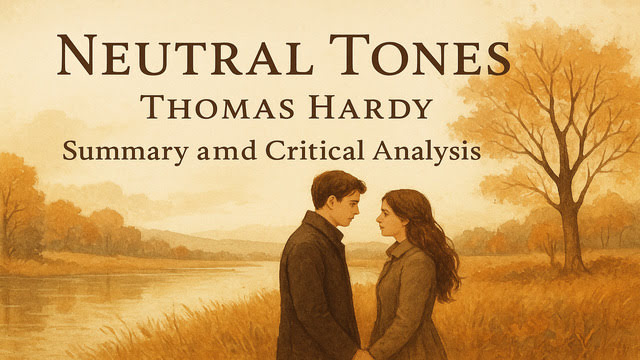
Hardy presents love not as a source of warmth or fulfilment but as something that has withered under the weight of indifference and misunderstanding. The “neutral” tones of the setting—grey leaves, pale sun, and stagnant water—symbolise emotional stagnation and the absence of passion.
Through simple language and subtle irony, Hardy explores themes of loss, memory, betrayal, and the enduring pain of failed love, making the poem a powerful study of emotional desolation and the lasting scars of past relationships.
The poem entitled Neutral Tones is very neutral in tone. Its melancholic note has been created by the poet reflecting on the termination of a relationship. The poem expresses the bitter sweetness of the memory of a love which was the greatest source of joy in the past, but which, later on loses its joyousness and its pleasure.
This poem has not been addressed to his wife, but most probably, the woman who is addressed here, is Hardy’s cousin, Tryphena Sparks with whom he had an unsuccessful love – affair.
This poem is a kind of lament over a love which has died. It is a retrospective and reminiscent poem in which an experience of the past has been depicted most effectively with great feeling. In it there is a considerable psychological interest. It is difficult to understand and explore the mind of a woman; the poet seems to be saying as he recalls that experience of the past. Of course, the poem is a warning to all future lovers.
In the poem Hardy uses a natural background to support the mood of the poem. The relationship between the lovers is reinforced by the sombre natural scene which is depicted here as the background of that relationship. The ash tree is generally a symbol of happiness, but the happiness of love has passed away and the few remaining leaves of the ash tree have turned gray. The poet uses a variety of techniques to highlight sadness and emotions in the speaker.
Summary of the Poem “Neutral Tones”:
Stanza 1:
We stood by a pond that winter day,
And the sun was white, as though chidden of God,
And a few leaves lay on the starving sod;
—They had fallen from an ash, and were gray.
Explanatory Word – Meanings:
1. We = it has been used for the poet and his beloved. Most probably the poet’s beloved was his cousin, Tryphena Sparks with whom he had an intense and passionate relationship. But the poet’s love affair with her was absolutely failure. 2. By a pond = near the pool of water. 3. The Sun was white= due to being a wintry day; the light of the Sun was dim. 4. White = dim: not bright. 5. As … God = it appeared as if the Sun had been scolded by God, so it was not in joyous mood. 6. Chidden = (pp. of chide), scolded, rebuked. 7. And a few … sod= a few gray leaves lay scattered on the drying turf. 8. Starving= drying. 9. Sod = a grassy plot; a layer of matted earth formed by grass and plant roots. 10. Ash = familiar timber tree.
Paraphrase:
The poet conveys the mixed pain and pleasure associated with remembering his love affair. In the past, this relationship was his greatest source of happiness, but with the passage of time it has lost its warmth and delight. He recollects a cold winter day when he and his beloved stood together beside a pond, sharing deep feelings for one another. The sun did not shine brightly, as it was the winter season, a time when sunlight appears weak and dull, especially in European countries.
However, the poet imaginatively suggests that the sun’s dimness was due to God’s rebuke, as if the sun, having been scolded, had become sorrowful. Around them, a few grey leaves were scattered across the drying grass, having fallen from an ash tree, adding to the bleak and reflective atmosphere.
Stanza 2:
Your eyes on me were an eyes that rove
Over tedious riddles of years ago;
And some words played between us to and fro
On which lost the more by our love.
Explanatory Word – Meanings:
1. Rove= to wander aimlessly, to roam. 2. Tedious = difficult; tiresome; wearying. 3. Riddle = an enigma or puzzle, a mysterious question. 4. Years ago= for many years or for a long time. 5. Your eyes … me = the poet observed that his beloved’s eyes were wandering over him with great dullness. 6. Over … ago = it seemed as if the beloved’s eyes tried to solve those difficult and puzzling matters which were left unsolved for a long time. 7. And some …fro = they spoke a few words with each other. 8. On which … love= the words seemed to have lost their meaning or significance because of their misunderstanding in love.
Paraphrase:
Standing by the water’s edge, the poet sensed that his beloved was weighed down by a grave and distant mood. She remained silent, and he noticed that, at the very moment they met, both of them appeared strangely detached from one another. Her eyes moved over him without warmth or excitement; they were dull and lifeless, as though searching for answers to long-standing mysteries that had slowly drained love of its charm and meaning.
To her, the poet had always been an enigma, someone she continually tried to understand. Questions about his character, temperament, and intentions lingered in her mind without resolution. She repeatedly wondered whether he truly loved her, whether he could rise to her social standing, and whether he was a suitable partner for her.
Only a few words passed between them, revealing a deep gap in communication. Those words felt empty and insignificant, stripped of their true sense by misunderstandings that had arisen long ago. Through this, the poet points to the emotional distance and alienation that had grown between the lovers as a result of those unresolved conflicts.
Stanza 3:
The smile on your mouth was the deadest thing
Alive enough to have strength to die;
And a grin of bitterness swept thereby
Like an ominous bird a – wing…….
Explanatory Word – Meanings:
1. The smile … thing = the smile hanging on her tender lips seemed to be the most lifeless thing in the world. 2. Deadest thing = the thing which was more dead than any other dead thing. 3. On your mouth = on her lips. 4. Alive … to die = her smile looked as though she was prepared to die. 5. Strength to die = her smile could express the desire of death. 6. And a grin … a – wing = her lifeless and dim smile expressing the bitterness fled from the lips. It was gone like a bird of ill-omen.7. Grin = smile. 8. Ominous portending=portending evil or harm; threatening, foreboding.
Paraphrase:
The poet remembers that it was during a cold winter day that he first sensed a change in his beloved’s feelings toward him. Her smile that day was harsh and strained, lacking any warmth or vitality. It seemed utterly lifeless, as if all emotion had drained from it. That weak, fading smile suggested her deep dissatisfaction and weariness with the poet’s presence. It also reflected her unhappiness with the bond they shared.
Though empty of joy, the smile clearly signaled her withdrawal from his life. It hinted at her desire to escape the dullness of their repetitive love. She appeared unwilling to continue in a relationship that felt bleak and uninspiring. Thus, the pale and bitter smile on her lips vanished forever, departing like an ominous bird in flight. With that moment, the poet’s love story came to an end.
Stanza 4:
Since then, keen lessons that love deceives,
And wrong with wrong, have shaped to me
Your face, and the God – crust Sun, and a tree,
And a pond edged with grayish leaves.
Explanatory Word – Meanings:
1. Since then= from that wintry day when the poet’s beloved broke a long time relationship with him and filled his lap with sorrow and pain. 2. Keen … deceives= the poet has derived great lesson ( moral ) from the failure of his love that love can deceive a man and it can fill his life with utter sorrow, anguish and pain. 3. Keen lessons = painful lessons. 4. And wrings … wrong = the other lesson which the poet has learnt is that the injustice done by the beloved to man can bring great pain to the victim of love. 5. Have … me = lessons learnt by the poet remind him that wintry day when she left à him mercilessly. 6. Your face= the poet recalls the expressions of his beloved’s face when she was about to say good bye to his love. 7. The God – curst Sun= he recalls the Sun scolded by God. On that wintry day when the poet met his beloved, the Sun was also in melancholic mood. 8. And a tree = the poet recalls an ash tree stood at the bank of the pool of water. 10 And a pond leaves= whenever the poet recalls his former love affair and the lessons derived from it, he thinks of the sight and atmosphere of the pond. On the banks of the pond there lay scattered the dry and dead leaves.
Paraphrase:
From that moment onward, the poet draws certain lessons from a love that once bound them together but later lost all significance. The understanding he gains from the collapse of this relationship is deeply distressing. The abrupt and unforeseen separation from his beloved plunges him into sorrow and disillusionment. It compels him to reflect that a woman’s mind is difficult to comprehend and fathom. He feels that a man cannot place complete trust in love, as it has the power to betray and burden him with a painful sense of injustice.
Whenever the poet remembers that cold winter day when they met, the image of his beloved vividly appears before him. He recalls the expressions on her face, especially her grave and solemn look, which he is unable to forget. The faint, subdued light of that winter day also returns to his memory. At the time of their meeting, the sun failed to shine brightly; it appeared as though it had been rebuked by God. This painful lesson of love evokes in his mind the image of the ash tree standing beside the pond, with its dry, lifeless leaves scattered along the pond’s edge.
Critical Appreciation of the Poem “Neutral Tones”:
Introduction:
Neutral Tones is a reflective and nostalgic poem that looks back on a past emotional experience rendered with deep sensitivity. It conveys the mixed pain and faint sweetness of remembering a love that was once comforting and joyful but has since lost its warmth and delight. The poem focuses on the sadness and collapse of love, its illusions and betrayals, and the tension and irony that arise when romantic ideals confront reality. Since the poem was written as early as 1867, it cannot be connected to Hardy’s wife. It is more likely inspired by his relationship with his cousin, Tryphena Sparks, with whom he shared a deeply passionate bond that ultimately dissolved into strain and bitterness.
Thought – Content:
On a cold winter day, the poet stood beside a pond with the woman he loved. The Sun appeared dull and pale, as though it had been reprimanded by God and had sunk into sadness. Dry ground lay around them, strewn with a few grey, fallen leaves. She gazed at him steadily, her eyes seeming to wander slowly through memories of long ago—memories that had once been puzzling and unresolved. They spoke only now and then. Her smile carried a strange stillness, as if she were ready to face death; it felt almost entirely lifeless. Yet a faint trace of vitality lingered in it, gradually fading until nothing remained.
From that moment, the poet learned certain bitter truths from the love they had once shared—a love that had later lost all significance. Chief among these lessons was the realization that love can be deceptive. What remains with him now is only the aching memory of the woman and the quiet landscape surrounding the pond where they once stood together.
A Reminiscent Poem:
In the poem, Hardy recalls a bitter – sweet experience. It was a day in winter when he had met the lady in question, and when certain words had been spoken by both of them to express their sense of disillusionment. The lady had felt particularly bitter on that occasion because she had felt frustrated in her relations with the poet. There had been a smile on her mouth, but this smile was “the deadest thing, alive enough to have strength to die.” From that experience, Hardy had drawn an inference. He had come to the conclusion that love can deceive a lover , and that the beloved can do the greatest possible injustice to a lover.
Elegiac Note:
The poem is steeped in sorrow and emotional gloom, creating a deeply melancholic impact on the reader. It portrays the fading and eventual loss of the love that once bound the poet and his beloved. Although memories of a love that has ended are often painful, they also carry a quiet tenderness. This poem gives voice to that bittersweet quality of love. The poet’s state of mind is dominated by hopelessness, a feeling commonly found in many of Hardy’s works. The tone is distinctly elegiac, and the poem reads as a mournful reflection on a love that has passed away.
Nature Imagery as a Background for Depicting Human Feelings:
Hardy offers only fleeting glimpses of the natural world, using it chiefly as a backdrop against which human emotions are projected. The central concern of the poem is the emotional breach that developed between Hardy and a woman he loved, generally believed to be his cousin, Tryphena Sparks.
Yet the poem opens not with personal feeling, but with a concise description of a natural scene. The lovers are shown standing beside a pond on a winter day, beneath a pale sun described as though reproved by God. Scattered on the barren ground lie a few fallen leaves, grey in colour, shed from an ash tree.
The poem closes by returning, in shortened form, to this same imagery: the cursed sun, the tree, and the pond bordered with grey leaves. In this way, a strained human relationship is enclosed within a bleak natural setting, and the desolate mood of the landscape perfectly mirrors the bitterness and decay of a love that has faded.
Style and Language:
This love lyric is composed in a dull, dismal and dreary mood. With a special rhyming scheme, the poem consisting of sixteen lines with four tetrastiches can be divided into two parts: the first three stanzas about a moment in the past, and the fourth about the “lessons”, the speaker learns from what happened between the speaker and the woman, which offers a fusion of the images of the lover’s face with those of the scenery.
And the poem predominantly rhymes abba, cddc, effe and ghhg. The first line and the last line of each stanza are rhymed, so are the second and the third of each stanza. The poem goes as a smoothly flowing stream running from the very beginning of the poem till the end of the poem in good order:
aa (day, gray); bb (God, Sod); cc (rove, love); dd (ago, fro); ee (thing, wing): ff (die, thereby) ; gg (deceives, leaves); hh (me, tree).
In the poem, there no instances of typographic foregrounding and no significant departures from the typographic norms of English poetry, except that the last lines of each stanza are significantly shorter and meaningfully in the indented style. The layout of the poem is nothing unusual, and the entire poem is in declarative mood. The poem excellently exemplifies the poet’s semi – dark period, which expresses a gloomier tone with assonance used in it.
There is a most appropriate simile in the grin of bitterness being compared to an ominous bird in flight. There is alliteration in the phrases: “Wrings with wrong”; and “God – curst Sun.”
