Historical Opening and the Narrator’s Curiosity:
There is well-knitted plot structure of the novel Heat and Dust. After reading Heat and Dust, it becomes clear that the novel essentially traces the life and personality of Olivia and her husband Douglas. For this reason, the opening of the novel unfolds in the manner of a historical record.
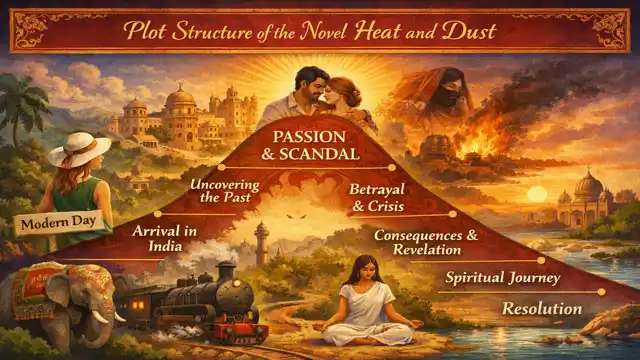
Just as a historian is keen to uncover the secrets of the past, the narrator too is deeply inquisitive about Olivia, her grandmother Tessie, and her grandaunt Beth, both of whom chose to remain silent about Olivia. They believed that time itself would eventually reveal the truth. As the text suggests, “They shied away from her memory as from something dark and terrible.”
Search for Olivia’s Past through Letters and Travel:
However, the Narrator realises that her parents did not share the same interest. Although they were aware of their grandfather’s first wife, they made no effort to explore her life. It is only in the third generation that genuine curiosity emerges, with the Narrator wanting to know more about Olivia. This curiosity leads her to travel to India, where Olivia had spent a significant period of her life with her husband, Douglas.
The Narrator also gathers valuable details from a collection of letters that Harry had handed over to two elderly women connected with Olivia and Douglas. These letters, written by Olivia to her sister Marcia, provide further insight into Olivia’s life in India and in other places as well.
Social Purpose of the Novelist and Role of the Narrator:
It should be noted that the novelist deliberately aimed to draw public attention to the social evils prevalent in contemporary society, with the intention of reforming it. In order to fulfill this objective, she shaped the character of the Narrator as her own reflection. The Narrator arrived in India from Europe carrying a clear vision of a modern and healthy social order. Her journey took her to Bombay, Satipur, Khatam, and a hill town.
During her stay, she interacted closely with local people, including those belonging to the lowest strata of society, to gain a genuine understanding of their lived realities. She resolved to record all these firsthand experiences carefully in her diary.
Realistic Picture of Poverty and Social Conditions:
The novelist was fully acquainted with all the essential details. She also places the Narrator at a window from where the street scene could be observed directly. From there, the Narrator sees people purchasing food from hawkers, eating it on the spot, while others search through the gutters for discarded items. This scene presents a stark and realistic portrayal of the people’s poverty.
Observations of Indian Life at Satipur:
The narrator arrived in Satipur, where she found an opportunity to observe closely the life of Indarlal, a man belonging to the upper social class. She came into contact with his wife and mother as well, both of whom were illiterate and led monotonous, uneventful lives. During her stay, she visited a roadside tailor to have an Indian outfit stitched for herself. The tailor, cautious and respectful, took her measurements in the open street, carefully avoiding any physical contact.
Consequently, the garment he produced was rather loose-fitting. Although these experiences were gathered at various locations and on different dates, together they contributed to a coherent and unified narrative. The narrator faithfully recorded all these observations in her diary.
Contrast between Olivia and the Narrator:
A close and thoughtful reading of Heat and Dust reveals a sharp contrast between the life and personality of Olivia and those of the Narrator. Through the Narrator’s perspective, the novel presents an authentic picture of the social conditions that prevailed in 1923, while at the same time offering a comparison between two phases of life in India—the period of her grandparents and her own contemporary experience.
Douglas, the Narrator’s grandfather, served as an Assistant Collector and remained so deeply involved in his official duties that he had little time for his wife, Olivia. As a result of this neglect, Olivia suffered from intense loneliness and emotional distress. This contrast between Olivia and the Narrator highlights the differing outlooks and attitudes of two generations. Olivia arrived in India without any definite purpose, whereas the Narrator came with a clear sense of direction.
Her stay in India was driven by a desire to understand Olivia’s life as Douglas’s wife. In addition, she carefully observed the social evils prevalent in Indian society and felt a responsibility to work towards social awareness and reform. Had Olivia possessed a similar sense of purpose, like that of the Narrator, she might not have experienced such isolation while her husband devoted himself entirely to public affairs.
Olivia’s Desire for Motherhood and Moral Conflict:
Olivia longed deeply for motherhood. At first, she hoped to have a child with her husband, but her inability to conceive caused her growing anxiety. She wished to seek medical advice to understand the reason for her childlessness, yet her husband showed no concern or desire for parenthood. Eventually, Olivia became involved with the Nawab, grew emotionally and physically close to him, and through this relationship she became pregnant. Later, fear overtook her—she worried that the child’s complexion might resemble the Nawab’s, exposing her illicit affair. Because of this fear, she asked Harry to assist her in ending the pregnancy.
In contrast, the narrator is portrayed as a confident and independent young woman with a modern outlook. When she conceived through her open and voluntary relationship with Indarlal, she remained unconcerned about social judgement and faced the situation without hesitation or guilt.
The Narrator’s Modern Attitude towards Relationships:
If Olivia had her prudery, the narrator did not have any permissiveness because she was a bold young lady with her modern attitude and progressive ideas. With this reason she made her relations with Child and Indarlal without any fear and worry. The narrator had gone to the shrine of Baba Firdaus along with Indarlal to spend nice time there. She found that place very romantic and she also found Indarlal young and healthy.
With this reason she tried to make the best use of that opportunity to enjoy in the pleasant and sexual manner saying. “And yet at the same time he was a healthy young man his wife was away we were alone in a romantic spot (getting more romantic every moment as the Sun began to set). Although the next few moves were upto me, once, I had made them he was not slow to respond. Afterwards he made the same joke the Nawab had made about what had happened here on the original Husband’s Wedding Day to make the barren wife pregnant.”
Generational Difference in Moral Outlook:
The two situations emerge from entirely different historical periods and generational outlooks. The narrator, a young woman with modern and progressive views, felt no hesitation in conceiving a child with an Indian man like Indarlal, even though he was not her husband. Moreover, the idea of abortion never crossed her mind. Instead, she chose to spend the months leading up to her childbirth in a town where she could live peacefully and happily.
In contrast, Olivia’s experience was marked by anxiety and fear after she became pregnant through her relationship with the Nawab. Disturbed by the possibility that the child might inherit the Nawab’s physical features, she decided to end her pregnancy.
Sub-Plot of Karim and Kitty:
A careful reading of the novel reveals a secondary plot centered on the lives and actions of Karim and Kitty. Since the Nawab had no children, he declared his nephew Karim as the successor to his estate. Kitty, Karim’s wife, also came from a royal lineage. Karim is described as “very slender with delicate features and curly hair,” which sets him apart physically. His appearance, particularly his hair and build, highlights the contrast between two generations. While the Nawab’s generation reflected a hard and rugged way of life, Karim and Kitty appear refined, graceful, and closely associated with the ease and comforts of a modern lifestyle.
Modern Lifestyle versus Traditional Values:
When the Narrator went to their room, she found that the floor was covered with cushions. There “Kitty was curled up on a red and gold sofa which had once been a swing and was fixed to the ceiling by long golden chains.” The modern generation liked good living but the people of the old generations liked to possess land.
Migration and Rejection of Ancestral Past:
Karim and Kitty abandoned the comforts and valuables of the Khatam palace, fearing that remaining there would lead to their downfall. They resolved instead to move to London and establish a ready-made garments business. This decision reflects a broader trend of modern Indians migrating abroad in pursuit of improved prospects and a higher standard of living. Both Karim and Kitty avoided any discussion of their family lineage. Karim, in particular, mocked his uncle, the Nawab, by referring to him as a mischievous boy in his youth, and he expressed open criticism of his other forebears as well.
Optimistic Vision of the Future:
The novelist presents a vivid portrayal of the social evils prevailing in Indian society through the voice of the Narrator, who serves as her representative. At the same time, she remains hopeful and optimistic about a promising future for the Indian people, provided that essential reforms and significant improvements take place. The writer seeks to inspire her readers with the vision of a brighter tomorrow and improved living conditions.
For instance, towards the end of the narrative, the Narrator chooses to live in the mountains, where life appears entirely different and renewed. Acting as the novelist’s mouthpiece, the Narrator observes: “I keep looking up all the time, but everything remains hidden. Unable to see, I imagine mountain peaks higher than any I have ever dreamed of; the snow on them is whiter than all other snow, so white that it is luminous and shines against a sky deeper blue than any I have known. That is what I expect to see.”
At this stage, the Narrator is also awaiting the birth of her child, symbolising hope for the next generation. Despite the bleak social realities depicted earlier, she looks forward to a better life and envisions a hopeful and radiant future for all.