Introduction:
The poetry of Margaret Atwood offers a profound and multifaceted exploration of theme identity, making it one of the most compelling themes in her literary work. Atwood examines identity not as a fixed or stable concept, but as a fluid and evolving construct shaped by personal experience, gender roles, cultural expectations, and historical forces.
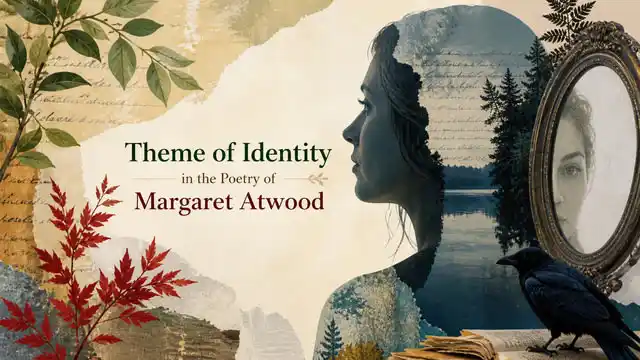
Through her vivid imagery, symbolic language, and sharp intellectual insight, she delves into the complexities of selfhood, often portraying individuals—especially women—struggling to define themselves within oppressive social structures. Her poems frequently question notions of power, autonomy, and authenticity, revealing how identity is influenced by both internal conflicts and external pressures. Thus, the theme of identity in Atwood’s poetry emerges as a dynamic and critical inquiry into what it means to exist, to belong, and to assert one’s sense of self in a rapidly changing world.
Ecological Consciousness and Environmental Concerns in Atwood’s Poetry:
A great number of Margaret Atwood’s poems deal with different environmental issues. She focuses on ecology as well as on a depiction of animals or on a very specific Canadian nature. ‘Atwood’s concern for the natural world— tenuous in the hands of humans— can be traced to her upbringing. Her poems throughout her career have consistently addressed the delicate balance of nature’. Nevertheless, the purpose of such descriptions of environment has much deeper implications by which Atwood tries to point to some environmental problems: ‘Environmentalism in the works of Atwood and the biologists becomes a concern with the urgent preservation of a human place in a natural world in which term “human” does not imply “superior”, or “alone”, and in which what is fabricated or artificial is less satisfying than what has originally occurred.’ In other words, Margaret Atwood has always been interested in the environment and throughout her poems she wants to promote its protection. Moreover, she is conscious of the fact that people are responsible for its destruction, but still, it is nature which should predominate.
Nature as Reflection of Inner Landscapes:
Nonetheless, there is no one collection of poetry, in which Margaret Atwood deals only with environmental issues and does not touch anything else. Her poems are more complicated and, in many cases, she clearly connects her own view of the world with nature:
“Poems which contain descriptions of landscapes and natural objects are often dismissed as being mere Nature poetry. But Nature poetry is seldom just about Nature; it is usually about the poet’s attitude towards the external natural universe. That is, landscapes in poems are often interior landscapes, they are maps of a state of mind.”
Human Intrusion and Failure in ‘Progressive Insanities of a Pioneer’:
Regarding the individual poems, there are therefore chosen from different collections of poetry. The first one is called Progressive Insanities of a Pioneer that was published in Atwood’s second collection The Animals in That Country (1968):
“The house pitched
the plot staked
in the middle of nowhere.
At night the mind
inside, in the middle of nowhere.
The idea of an animal
patters across the roof.
In the darkness the fields
defend themselves with fences
in vain:
everything
is getting in.”
The Settler’s Illusion of Control Over Nature:
In this short extract the settler built the house and staked the plot ‘in the middle of nowhere’ indicating that he eagerly seized a part of nature which originally belonged to nobody to himself. However, later he recognised that it was totally unnecessary to do it because ‘everything/is getting in’ and no obstacle can avoid it: “The settler makes a division between himself with his straight-line house and fence and the Nature on which he is trying to impose his own ideas of order. He fails, and in the end his head is invaded by the Nature which he has identified as chaos, refusing to recognise that it has its own kind of order’. He simply cannot outsmart nature, because it has greater power and authority.
Negative Portrayal of Wild Nature and Lost Opportunity:
Additionally, the wild nature is also portrayed in other parts of this quite a long poem, nevertheless, as in the previous example its depiction is rather negative:
“If he had known unstructured
space is a deluge
and stocked his log house-
boat with all the animals
even the wolves
he might have floated.”
Although the harsh Canadian ‘unstructured’ nature is described as ‘a deluge’, there still was a flicker of hope for the settler that ‘he might have floated’. However, as the settler did not understand it he was unable to escape and finally was captured by nature forever: “The settler and his descendants at best merely float on top of the unseen forces of the wilderness’. ‘If had known’, the results might have been completely different.
Madness and Ultimate Defeat by Nature:
A total failure of the settler along with the signs of madness graduates in the very last stanza of the poem in which ‘the green/vision, the unnamed/whale invaded’. According to these last lines as well as the title of the poem it is apparent that ‘he is insane by the end of the poem’. “The green’ Canadian nature ruthlessly devoured him and like in many other cases it has won.
Nature and Hidden Human Tragedy in “This Is a Photograph of Me”:
Very similar depiction of nature is connected with another famous poem “This Is a Photograph of Me”, which belongs to the first collection of poetry called The Circle Game (1966):
“then, as you scan
it, you see in the left-hand corner
a thing that is like a branch: part of a tree
(balsam or spruce) emerging
and, to the right, halfway up
what ought to be a gentle
slope, a small frame house
In the background there is a lake,
beyond that, some low hills.
The photograph was taken
the day after I drowned.”
From this extract it is obvious that a great tragedy took place in the wild nature with ‘some low hills’, ‘a tree/ (balsam or spruce)’ and ‘a lake’: “The serene natural setting presents a startling contrast to the human tragedy it masks. Atwood uses the subject “I” to show the presence of the speaker in the photograph and offers the picture of the speaker “drowned” in the “lake”. Interestingly, also in this example the nature is viewed in rather negative way, because it has caused the death of a person by drowning in the lake. Nevertheless, according to Margaret Atwood’s Survival discussed above, this is a very important and recurring theme of Canadian literature.
Harsh Winter and Strained Human Relationships:
A harsh Canadian winter is depicted in the poem ‘Midwinter, Presolstice‘ from the collection Procedures for Underground (1970):
“The cold rises around
our house, the wind
drives through the wall in
splinters, on the inside
of the window, behind
the blanket we have hung
a white mould thickers.”
The icy coldness is overt in this extract ‘in which two lovers had been snowed in together by a Canadian winter’. The weather is really awful—’the cold rises around’ and ‘the wind/drives through the wall’. Moreover, such weather does not strengthen the relationship among two lovers at all, which is underlined by wife’s statement ‘I dream of departures, meetings’ later in the poem. She would like to escape in order to enjoy her life again, but she cannot. The reason for that confession is probably the strange behaviour of the husband towards her:
“All night my gentle husband
sits alone in the corner
of a grey arena, guarding
a paper bag
which holds
turnips and apples and my
head, the eyes closed.”
This is definitely not an example of the peaceful coexistence, which is additionally emphasised by a severe winter thwarting the couple to simply depart. Furthermore, the wife is largely neglected by her husband who ‘sits alone in the corner’ and treats her the same way as ‘turnips and apples’: ‘Their relation had not ended in an embrace for the “gentle husband” had put his wife’s head in a bag along with his other necessities’.
Human Superiority and Environmental Context:
Except for the description of the inhospitable Canadian winter outside, there is also evident a significant feature of man’s superiority. Nevertheless, this is discussed in the following section in detail.
The Poem “Interlunar” and the Motif of the Lake:
The last poem describing the unpredictable Canadian bush is called ‘Interlunar’ from the volume Interlunar (1984), which belongs to the Selected Poems II:
“The lake, vast and dimensionless,
doubles everything, the stars,
the boulders, itself, even the darkness
that you can walk so long in
it becomes light.”
Ambiguity and Contrasting Motifs in “Interlunar”:
Also, in this extract Margaret Atwood used the motif of the lake, however, its description is contextually ambiguous, because the lake is ‘vast, and dimensionless’ at the same time. Another contrasting motif occurs with ‘the darkness’ which finally ‘becomes light’ or ‘the lake’ in contrast with ‘the boulders’. All in all, by this poem Margaret Atwood wants to point to the fact that everything has the two opposite sides, which can be applied to both the relationships and the wilderness.
Animals and Environment in Atwood’s Poetry:
Dealing with the environment, it inherently includes the portrayal of animals. The example of it can be the poem ‘The Animals in That Country’ which belongs to the collection of the same names:
“In that country the animals
have the faces of people
the ceremonial
cats possessing the streets
the fox run
politely to earth, the huntsmen
standing around him, fixed
in their tapestry of manners
the bull, embroidered
with blood and given
an elegant death, trumpets, his name
stamped on him, heraldic brand
because
(when he rolled
on the sand, sword in his heart, the teeth
in his blue mouth were human)
he is really a man
even the wolves, holding resonant
conversations in their
forests thickered with legend.”
Optimistic Portrayal of Animals as Human-like Figures:
This is the first and more optimistic part of the poem focusing on a treatment of the animals by people in different countries and which address the “ceremonial” and mythic through fox hunts, bull-fights, and legends of werewolves. Although the animals die in that country, they die like human beings because they have the faces of people. For example, the bull that has ‘given/an elegant death, trumpets, his name/stamped on him, heraldic brand’. He is treated as human individual, ‘he is really a man’. Nonetheless, the poem continues in a quite different manner:
“In this country the animals
have the faces of
animals.
Their eyes
flash once in car headlights
and are gone.”
Negative Treatment and Dehumanization of Animals:
As Margaret Atwood argues in her Survival, animal stories are hardly ever positive in Canadian literature, which is also the case of the second part of the poem: In this country, animals die in the headlights of careless cars. They have the faces of animals and if they die, they are gone and nobody will pity them. The animals in this country are treated as inanimate objects. Moreover, negative description is intensified by the last three lines of the poem which state that “Their deaths are not elegant. /They have the faces of/no one. They are nobody’.
Animals Regaining Power in “You Are Happy”:
Interestingly, there is quite a different interpretation on animals depicted in Atwood’s later collection called You Are Happy (1974), or more precisely in Songs of the Transformed, the second section, in which animals take back their power. As the representative sample of this can be the poem ‘Song of Worms’:
“We have been underground too long,
we have done our work
we are many and one,
we remember when we were human
we have lived among roots and stones,
we have sung but no one has listened,
we come into the open air
at night only to love
which disgusts the soles of boots,
their leather strict religion.”
Rebellion and Hidden Power of Worms:
According to this short example, the worms stayed out of sight ‘too long’ so they decided to ‘come into the open air’. Moreover, they ‘reveal that their underground existence will lead to the true heroic’, but the people to whom they want to come probably would not be happy about their presence at all. In addition, this assumption is underlined by the last stanza in which the worms declare: “When we say Attack/you will hear nothing/at first’. As people do not expect such enemies, they will be probably very surprised at their presence. Nevertheless, it will be too late then.
