Introduction:
The poetry of Sylvia Plath and W. B. Yeats offers a rich field for the study of imagery and symbolism, revealing two distinct yet equally powerful poetic sensibilities. Plath’s work is marked by intense, vivid, and often disturbing imagery drawn from personal experience, psychological conflict, and the realities of modern life. Her symbols are deeply subjective, frequently reflecting themes of identity, death, rebirth, and inner turmoil, and are expressed through sharp, concrete images that evoke strong emotional responses.
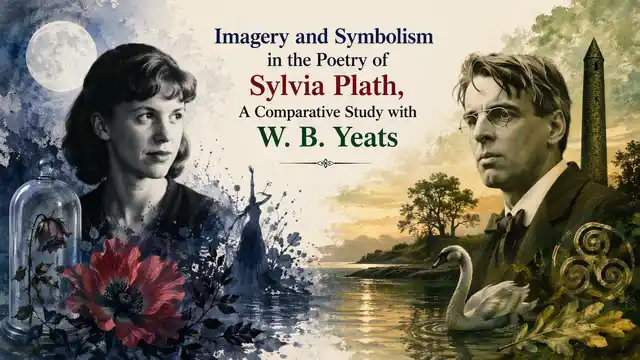
In contrast, Yeats’s symbolism is more structured, philosophical, and rooted in myth, history, and mysticism. His imagery often draws upon Irish folklore, spiritual traditions, and universal patterns, creating a symbolic system that seeks to explain human existence and the passage of time. While Plath’s symbols tend to be immediate and personal, Yeats’s are expansive and universal, aiming to connect individual experience with a larger cosmic order.
A comparative study of their imagery and symbolism thus highlights the shift from the modernist and confessional intensity of Plath to the symbolic and visionary tradition of Yeats. It not only underscores their differing poetic techniques but also reflects broader changes in literary thought, where personal expression and psychological depth intersect with mythic and philosophical exploration.
Sylvia Plath is one of the greatest symbolists of America. Her poetry is full of occult and mystic symbols with which she has been able to paint the inner picture of her emotional and intellectual life. Specially she has been able to express her abstract concept and mystic ideas through symbolic worlds. The word symbolism is the presentation of ideas, objects and life through the means of imagery, metaphor and symbols. Goethe has defined symbolism in the following words:
“Symbolism transforms the phenomenon into idea and the idea into image, in the image the idea remains infinitely effective and unattainable and even when expressed in all languages remains inexpressible.” Symbol is a natural begging of discovery and realisation. Symbols present an objective visible meaning behind which an invisible profounder meaning is hidden.
The Use of Symbols in the Poems of Sylvia Plath:
Sylvia Plath has used many symbols in her poetry which expressed her abstract ideas about death, women’s helplessness and motherhood. She has also used simile and metaphor for making abstract concept visible and tangible. The following statement of a critic illustrate this point fairly well:
Through figurative language employing simile and metaphor, a collective harrowing experience (of the Holocaust) is brought into contact with the literal one of the “I”, who does “it/One year in every ten”. Technically, this is a vast improvement on the parallels drawn between the public and the private lives in Plath’s other poems, e.g., “Cut” and “Mary’s Song”. The abrupt intrusion of the totally unexpected word “Jew” here creates, what Alvarez suggests, is a “shock” effect that is totally unsettling, Surreal, and yet objective and accurate :
Consider how the penultimate line-ending is cannily used to create a pause before the epithet “Jew”. The effect is two-fold: first shock and then an odd detachment. The image is unspeakable, yet the poet’s use of it is calm, almost elegant. And this, perhaps, is the only way to handle such despair: objectively, accurately, and with a certain contempt.”
This unexpected juxtaposition of the loaded word “Jew” with “linen” (a kind of cloth woven from flax yarns) is succeeded by the word “napkin” (a small towel of linen or cotton cloth “for wiping lips and finger”), these “cloth” images gliding into each other to provide a smooth “transition” from the Holocaust back to the hospital. The succeeding scene takes place, probably, in a hospital operation theatre, where the would-be suicide is “fixed” or “mended” by doctors and napkins are used by nurses to tamp the flow of blood. If the napkin is removed or “peeled” (this image anticipates other kinds of “peeling” later in the poem, i.e., “stripping off” or “peeling” clothing to reveal the flesh below) by the doctors and nurses off the body of the wannabe-suicide what would they see? Perhaps a deathshead or a semi-dead person who, in spite of immense blood loss, survives more as a revenant, or spectre, from the past and less as a healthy human being, perhaps to terrify, by her spectral presence, her persecutors, the doctors trying to restore her to life. (Here, the words “terrify” and “enemy” look forward to the ending of the poem, where a red-haired woman threatens male extinction and, by implication, possibly “terrifies” her “enemies” too.)
Suicide in January 1963 was very depressing. A noted critic has described depressing weather in the following words: The unspeakable and unbearable cold that nagged on and on after Christmas and around the New Year was enough to depress the most heartily cheerful person. The entire social and domestic life stood still, freezed up. There was the perennial power cut, the water pipes froze solid, the gas failed, the candles became invisible, and to top it all, there was her irritating sinus problem which seemed to have taken a permanent hold. The fair girl was taking eternity to arrive making her life more gruesome. Yet the lure to live on was immense. Near the end of January 1963, she consulted a doctor who tried to find a hospital bed for her but could not. The fierce rage against the world, against the husband, against all the wrong doors was turning its thorny and she was in total panic with not a single soul to turn to.
On the date she committed suicide, she was very careful about the welfare of her children. She was working in the kitchen. Then she went to the room, to place tea and breakfast for her children. Meticulous as ever, she had laid down breakfast neatly for the babies in case they wake up. She had taken every care to seal up the doors and windows of the kitchen with towels and had put her head calmly in the gas ring after opening the oven.
Thus finished the life of a most promising eloken end therein point of the sentence. For the suicide her husband was mostly responsible because if he had continued to live with her as husband, she would not have felt so much depressed
The Influence of W.B. Yeats on Sylvia Plath:
The most formative influence on Sylvia Plath was the impact of the poetry and philosophy of W. B. Yeats. In the very beginning Keya Majumdar has pointed out: As far as her writing is concerned, she was back on the track conducting herself to the writing grind with a religious persistence rewriting and improving hunting Thesaurus and schooling herself by reading ardently the works of Auden, Yeats, Stevens, Thomas, Dickenson, Moore, Lawrence, Roethke etc. She was training herself vigorously to excel in outward polish and glazing of rhyme achievement for her poetry is full of autobiographical symbol which have been clearly stated by an eminent critic:
Her poetry is a fever-chart of her over-strung mind. Her poetry too is highly autobiographical. A close study of images and symbols in many of her individual poems has revealed that her obsessions and compulsions impinge on her art. The poems provide keen insight into the sick mind of Sylvia Plath. In her poems, she deals with her internal conflict. Her narcissistic fixation can be seen when we know her utter dependence on others for her survival as evidenced in many of her poems. Her phallic fixation becomes clear and shows her excessive sexual imagery and concern with sex in her poems. Her poems are compulsive creations.
Thus, we find that Sylvia Plath has used symbols for the high purpose of showing death is not the end of life but it opens the door for resurrection and in mortality.
The Unfortunate Suicide End of Sylvia Plath’s Life:
The most painful event in the life of Sylvia Plath has been her suicide in February 1963.
The most potent factor was the separation and her desertion by her husband Ted Hughes who became attracted and associated to another German woman. This gave her great pain.
Belief in Rebirth and Resurrection:
Sylvia Plath has deep faith in the philosophy of rebirth and resurrection. In many of her poems she has expressed the idea of resurrection. As for example – She has said in her well-known poem Lady Lazarus. The idea of rebirth:
Out of the ash
I rise with my red hair.
About this idea of resurrection an eminent critic observes:
Finding her source of analogy in Yeatsian version of Eastern occult and Eastern understanding of renewal. She accomplishes in this poem her eternal wish to transcend the earthly sins through fire of regret, repentance and punishment to reach the haven of soaring delight,
I think I am going up
I think I may rise
The beads of hot metal fly, and I, love, I
Am a pure acetylene Virgin
Attended by roses,
By kisses by cherubim,
By whatever these pink things mean
Not you nor him
Not him nor him.
(my selves dissolving, Old whore petticoats)
To paradise
This is what lies at the base of Eastern, especially, Hindu religion that insists on “Know Thyself”, that asks for this same selfless, wantless state of being to achieve Nirvana” or “Moksha”— the ultimate state of non-being. As Barnett Guttenberg says, “In the late poems Plath also considers renewal through transcendence or Nirvana, the escape from the round of reincarnation that occurs, in Hindu and Buddhist belief through a process of self-renunciation that results in enlightenment.”
