Introduction:
The poem “Bee Meeting” by Sylvia Plath is a striking and symbolic exploration of fear, identity, and vulnerability. Written during the final phase of her poetic career and included in her celebrated collection Ariel, the poem reflects Plath’s deep psychological insight and her ability to transform personal experience into powerful imagery. On the surface, “Bee Meeting” describes a seemingly ordinary rural gathering of beekeepers, but beneath this setting lies a haunting portrayal of the speaker’s anxiety and sense of exposure.
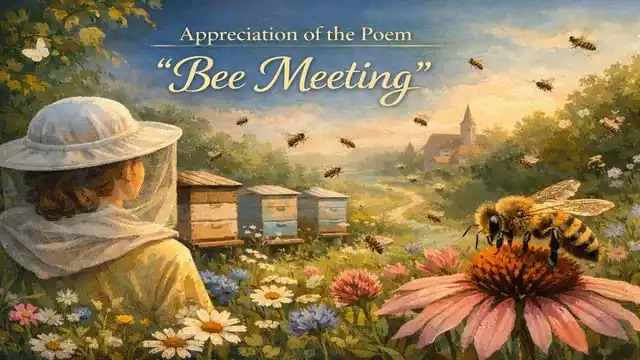
Plath uses vivid, often unsettling imagery to create an atmosphere of tension and alienation, where the speaker feels both observed and threatened by the surrounding figures and environment. The bees themselves become symbolic of both danger and transformation, while the meeting takes on ritualistic and almost oppressive overtones. Through this layered narrative, the poem reveals themes of control, identity crisis, and the individual’s struggle within a conformist society. Thus, “Bee Meeting” stands as a powerful example of Plath’s confessional style, blending personal emotion with rich symbolism to evoke a deeply affecting poetic experience.
In the last phase of her life before five months of her suicide Sylvia Plath wrote four poems on the life of bees. These poems are called bee poems. These poems are “The Bee Meeting”, “The Arrival of the Bee Box” “The Stings”, “The Swarm” and “Wintering”. In these poems, she describes her father, experiences of experiments in the art of bee keeping. Otto Plath was a great biologist of world fame. He was the professor of Boston University and was deeply interested in Bee Keeping. Thus, these four poems have autobiological touches. Besides the evident presence of the beekeeper father in the poem “Stings”, there is a passing remark to the husband getting stung by the bees which actually happened as she had described to her mother in her letter (Letters Home). But neither the bee myth, nor any particular incident of her life becomes more important in her poems than her own organic view of creation (honey = poetry) and the eternal search of the true self (Self=Queen bee) that superseding all boundaries of atrocities, assume the ‘uplight of the murderers into a heaven that loves her’. After a long strenuous battle with the tortuous self, she seems to come to terms with herself at last in these poems,
I am in control
Here is my honey-machine (The Stings)
The Occult and the Mystic in these Poems:
There are some misconceptions about Sylvia Plath’s philosophy and outlook on life. She is considered the confessional poet or a poet of death and pessimism. But these are misconceptions. Really, she is a mystic and oculist who has tried to observe hidden aspects of reality leading to the realization that the hidden part of life comes after death which she calls resurrection. In many of her poems, the idea has been explained through symbolism and metaphor. For instance, in the poem, Lady Lazarus, the last lines are:
Out of the ash,
I rise with my red hair.
The symbol of phoenix is the symbol of resurrection and immortality.
The Significance of the Poem ‘Bee Meeting’:
Bee Meeting is one of the most important poems of the Bee sequence. It gives us organic view of creative. It has occult hidden moving of resurrection and some very enlightening idea on death. The following industrial of a famous critic tells us about the importance of bees that Plath attacked to them.
Besides children, the bees were her other important prop to face the atrocities of life meted out to her. As the children were the hopeful gestures of a solid future, the bees were the happy reminders of a happy careless past. The bees, therefore, become constant reminders of a sound dream broken to pieces. The bee-poems come out apparently as the psychological necessity she felt to cling on to something hopeful in the threateningly menacing physical and mental cosmos she was in at that time. Written in October of 1962, the period of her greatest poetic achievement, the bee poems—”The Bee Meeting,” “The Arrival of the Bee Box,” “The Stings,” “The Swarm” and “Wintering” — chart a positive progress in her death-bound consciousness, that is a serious alignment of art with self and life’s substantial fruitfulness in the face of physically destructive death.” These poems have the autobiographical touches. Besides the evident presence of the bee-keeper father in the poem “Stings,” there is a passing remark to the husband getting stung by the bees which actually happened as she had described to her mother in her letter (Letters Home, 57). But neither the bee-myth nor any particular incident of Plath’s.
The Mystic Interpretation of Bee-Poems:
The Bee-poems represent a positive view of life as explained by Sylvia Plath. Through Symbolism of Honey, Plath has expounded the theory of preservation and creation which is clear from the following extract of an eminent critic.
Plath’s life becomes more important in her poems, than her own organic view of creation (honey = poetry) and the eternal search of the True Self (Self = Queen bee) that superseding all boundaries of atrocities, assume the ‘upflight of the murderess into a heaven that loves her.’ After a long strenuous battle with the tortuous self, she seems to come to terms with herself at last in these poems,
I am in control.
Here is my honey-machine —(Stings)
Honey is the natural analogy of her creative procreation, which signifies the triumph of Art in the long run,
I have whirled the midwife’s extractor,
I have my honey,
Six jars of it. —Wintering
It is courageous note of personal enduration in the Bee-poems which is clearly expressed in the ensuing extract.
The terrible undertone of fear that eddies within the poem, “The Bec-Meeting,” is characteristic of her unnamed fear, expressed in many other poems (e.g., “Purdah,”! “A Birthday Present”). This time she neither wants to evade nor escape it but faces it courageously: “I could not run without having to run forever.” There is an uncanny expectancy interweaved into the bee poems in such a way that her old dread of hostile people, social stigmas and choking encapsulation takes a different dimension altogether. To face it all, she declares: “I am the magician’s girl who does not flinch” in pursuit of that great flight to release. Nor is she put off any more by the incoherent mass of destructive chaos that constantly moves round her box of consciousness.
