Introduction:
The relationship between Ted Hughes and Sylvia Plath remains one of the most compelling and complex literary partnerships of the twentieth century. Their meeting in 1956 marked not only the beginning of an intense romantic bond but also the convergence of two powerful poetic voices whose influence on each other was both profound and transformative. Hughes played a significant role in shaping Plath’s creative confidence, encouraging her to explore deeper emotional and imaginative territories, while Plath’s intellectual intensity and ambition equally stimulated Hughes’s artistic growth.
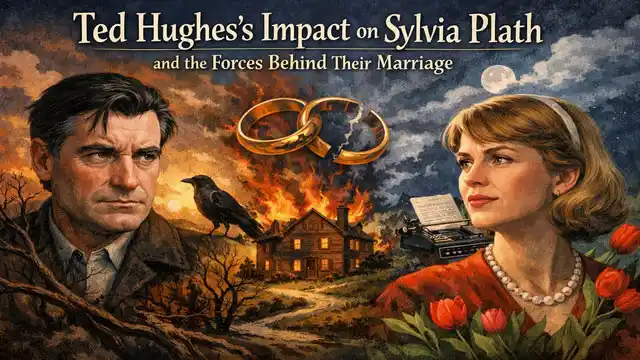
However, their marriage was not sustained by artistic harmony alone; it was also shaped by personal vulnerabilities, psychological tensions, and external pressures. Factors such as Plath’s emotional sensitivity, her desire for stability and recognition, Hughes’s charismatic personality, and the passionate yet volatile nature of their relationship all contributed to their union. This introduction seeks to explore how Hughes’s presence impacted Plath’s poetic development and to examine the complex emotional, psychological, and social forces that led to their marriage, setting the stage for both their creative brilliance and personal turmoil.
Academic Achievement and Meeting with Ted Hughes:
In June 1955, Sylvia Plath had graduated from Smith College with the prospect of winning Fullbright Scholarship. She succeeded in being awarded Fullbright award the same years. With this help she went England and got admission to Newnham College King University. There she met Ted Hughes. He was also a student of literature, at the same university. This meeting was very fruitful because she liked the strong and attractive personality of Ted Hughes. She was deeply inspired by her meeting with Ted. On account of his poetic talent, she and Ted had so many things in common to share and communicate. Ted had no money and had come to Cambridge only on a scholarship. Their association grew into an intimate friendship.
Transformation of Poetic Sensibility under Hughes’s Influence:
About their literary intimacy Keya Majumdar has rightly observed:
“She was so deeply inspired by Hughes’s poetic personality that she took to reading and enjoying myths and different folklores according to his choice; and her volitant imagination took flights to new directions. Alongwith her personality, her poetic sensibility also underwent a great change. Her self-apprenticeship under the influence of Auden and Stevens was finished now. She was fond of Dylan Thomas in her teens also, but now Thomas being Hughes’ favourite too, she took deep plunge in the passionate vortest of Thomas’ volubility. Poetry now began to come more spontaneously. The volte face that her life had taken now, allowed her to take a sure and powerful shot in the direction of the unknown and uncanny. Her poetry became more and more powerful with startling imagery of woods and animals and smell of country life, virulent and strong in effect. She was learning how to sweat out the poem from the throes of lazy emotional blows and thus to come out from her self-built fort of lonely terrors. She had company now, no doubt, of her own choice.”
Marriage of Sylvia Plath and Ted Hughes: Emotional and Psychological Dimensions:
Sylvia and Ted were married on June 16, 1956 in London at the Church of St. George the Martyr where Mrs. Aurelia Plath, her mother was present to bless her. About the marriage of Sylvia a scholar says in her thesis that a wilful golden world was taken away was the hunting hawk. Finally, however, the sense of insecurity, both physical and emotional, triumphed over her assertive ego. Sylvia had been in constant search for a substitute father, for Goliath of a man with a matching mind. This desire, coupled with the ever-present pressure of a belligerent society, made Plath to accept eventually the placid bliss of a married life.
She was completely swept out of her wits when she met Ted Hughes who combined in his bohemian personality all the romantic Aurelia Plath desired in a husband. The wilful golden bird was thus carried away by the predatory hawk, and their new bond was soleminized within weeks by the ringing of nupital bells—Plath Christening it “a marriage of true mind”.
As she perceived a blood-tie between literary and biological creativities, marrying and having many children was part of her plan for a life of complete fulfilment: “I will write until I begin to speak of my deep self, and then have children and speak still deeper. The life of the creative mind first, then the creative body. For the latter is nothing to me without the first, and the first thrives on the rich earth roots of the latter.”
The delightful Company of Ted Hughes:
Sylvia Plath was a young girl full of spirits and loving energy. After this marriage she was happy at never before. An eminent critic says:
“On Sylvia, the effect of marriage and happy commitment of herself to Ted seemed to be an impressive new self-assurance and a new range of emotional honesty.”
Both of them enjoyed their journey of honeymoon in a fishing village in Benidorm in Southern pain. There she was writing poems and prose thesis. She being interested in painting had painted fine pictures of boats and fishes. Their marital life was also full of charming social activities and people called them a brilliant couple like the nineteenth century Brownings. Her spirit was gay and happy in the company of Ted Hughes.
Their Visit to America:
From England both of them came to America and Ted and Sylvia took up teaching jobs at different Universities but they decided to quit the teaching jobs in favour of exclusive writings.
In the winter of 1559, they moved to Boston and took a rented apartment in Boston Hill where they began full time writing. She had learnt the art of writing. In her Journals she noted, “I justified the mess I made of life by saying I’d give it order, form, beauty, writing about it. I justified my writing by saying it would be published, give me life (and prestige to life). Now, you have to begin somewhat, and it might as well be with life, a belief in me, with my limitations, and a strong punchy determination to fight to overcome one by one……to build each solid. To build all solid.”
Conclusion:
The last phase of Ted Hughes and Sylvia Plath is very dark and unfortunate. Ted married another woman after the birth of his son and the daughter by Sylvia Plath. It was during this period that she became quite perfect and mature in her poetic arts. An eminent critic has described her poetic creation in the following words:
“Her poems now describe as never before, her life and consciousness vis-a-vis death and ultimate nothingness. Raw and scathing as she had taken her wounds, she was going to give them back to her readers, shocking and disturbing them all the way. But she had also mastered the art which she had been exercising so long, of bounding the rawest emotions within tight prim presentation wrap. We can only wonder why she did not exercise this astounding control in her personal life also to mould and shape it into a profitable longer life.”
Related Questions on the same Topic:
1. Write a short note on the marriage of Sylvia Plath with Ted Hughes. Why did they separate? What factors are responsible for her suicide?
Or
2. Write a short note on the close association of Ted Hughes which Sylvia Plath in England and America?
