Introduction:
In his celebrated essay The Study of Poetry, Arnold proposes the “Touchstone Method” as a means of evaluating poetic excellence by comparing passages from lesser works with selected lines from acknowledged masterpieces. According to him, these “touchstones” — drawn from poets like Homer, Dante, and Shakespeare — embody the highest qualities of poetic truth and seriousness, serving as reliable standards against which other poetry can be measured.
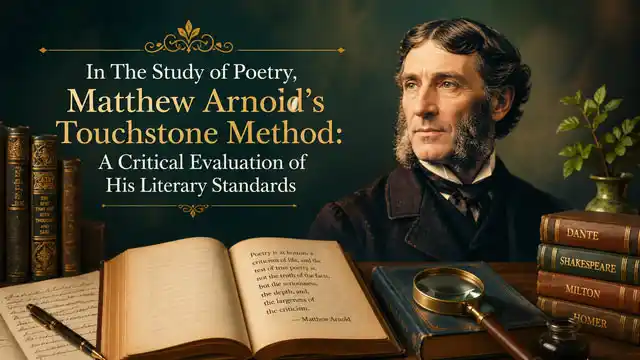
Arnold’s method reflects his broader aim to preserve “the best that has been thought and said” in literature and to guard criticism against personal bias and fleeting trends. However, while the Touchstone Method seeks to establish an objective criterion for literary judgement, it has also been the subject of debate among critics, who question its practicality and its tendency to overlook the diversity and evolving nature of poetic expression. Thus, a critical evaluation of Arnold’s literary standards not only highlights his contribution to the discipline of criticism but also reveals the limitations inherent in applying fixed benchmarks to a dynamic and subjective art like poetry.
Arnold’s Touchstone Method of Judging Poetry:
In order to judge the true excellence of poetry, Arnold recommends the “touchstone” method. In ‘The Study of Poetry’ he writes:
“Indeed, there can be no more useful help for discovering what poetry belongs to the class of the truly excellent, and therefore do us best, than to have always in one’s mind lines and expressions of the great masters, and to apply them as a touchstone to other poetry. Of course, we are not to require this other poetry to resemble them; it may be very dissimilar. But if we have any fact we shall find them, when we have lodged them well in our minds, an infallible touchstone for detecting the presence or absence of high poetic quality, and also the degree of this quality, in all other poetry which may place beside them”
Preference for Concrete Examples over Abstract Criticism:
Arnold advocated this method, because he was against abstract criticism. He said: critics give themselves great labour to draw out what in the abstract constitutes the character of a high quality of poetry. It is much better simply to have recourse to concrete examples; —to take specimens of poetry of the high, the very highest quality, and to say: The characters of a high quality of poetry are what is expressed there. They are far better recognized by being felt in the verse of the master, than by being perused in the prose of the critics. “It is”, he said, “much better simply to have recourse to concrete examples”. But where from these concrete examples are to be picked up? From the established classics, from the poetry of the great masters—from Dante, from Shakespeare, from Milton.
Use of Great Masters as Standards of Excellence:
In ‘The Study of Poetry’, he quotes certain lines from Homer, Dante, Shakespeare and Milton and argues that “these few lines, if we have tact and can use them, are enough even of themselves to keep clear and sound our judgements about poetry, to save us from fallacious estimate of it, to conduct us to a real estimate”. Short passages or even single lines from these great masters, he assures us, serve our purpose admirably well. The lines or passages that he picks up differ from one another widely, he acknowledges; but he points out that they have in common one thing. The possession of the very highest poetical quality.
Application of the Method: Exclusion of Certain Poets:
This is the method which he uses to dispose of Chaucer. He refuses to acknowledge Chaucer as a great poetic classic, the accent of such verse as:
In la sua volontade e nostra pace.
Dryden and Pope are excluded from the list of great classics because their poetry has not the accent of Shakespeare or Dante or Milton, Arnold quotes certain lines from these poets and then points out that they have not the accent of:
“Absent thee from felicity awhile”.
or of
“And what is else not to be overcome”.
or of
“O martyr sounded in virginitee!”
—neither can they ever it. That is why they are excluded from the list of the great poetical classics.
Earlier Influences: Longinus and Addison:
This method of literary judgement is not a new one. Longinus had recommended the same method to determine sublimity in literature. “In general,” he said, “those examples of sublimity which always please and please all are truly beautiful and sublime. For, men, who differ in their habits, and have different tastes, pursuits and aspirations and are of different ages, hold the same view about the same writings, then this unanimous verdict of such discordant judges, gives irresistible authority to their favourable verdict”. In England, this method was first suggested by Addison, with whom Arnold has many affinities. Addison said, “If a man would know whether he is possessed of this faculty (sound taste) I would have him read over the celebrated works of antiquity, which have stood the test of many different ages and countries, or those works among the moderns which have the sanction of the politer part of our contemporaries. upon the persual of such writings he does not find himself delighted in an extraordinary manner or if, upon reading the admired passages in such author he finds a coldness and indifference in his thoughts, he ought to conclude not (as it too usual among tasteless readers) that the author wants those perfections which have been admired in him but that he himself wants the faculty of discovering them”.
Limitations and Historical Fallacy in Arnold’s Method:
Arnold’s method is a modified version of the methods suggested by Longinus and Addison. But as a critical method it is not very safe. It involves a historical fallacy. Tillotson moves the point very admirably when he says, Arnold lacked an adequate sense of the placed originally occupied by old things in foreign lands. He would group together lines from Homer, Chaucer, Milton because they had in common a capacity to make a singular impression on Matthew Arnold in the 19th Century.
Criticism by Professor Garrod:
Professor Garrod also takes Arnold to task as far as the latter’s touchstone method is concerned. He says that this method consists in selling poetry by the pound. “This method may be seen in its most elaborate employment in his essay upon “The study of Poetry’. There he takes a line of Dante, a line of Chaucer, and—rather unfairly, but not meaning to be unfair—two lines of Milton. He likes Chaucer’s line (as you knew he would) the best of all-that might proceed from the circumstances that he misquotes it. But no! that you may not doubt his perfect impartiality, he misquotes all these authors”. Prof. Garrod is an Arnoldian and that is why he spares him after only smiling at him. But another critic would have said stronger things about it.
Mark Van Doren’s Objection to Limited Range of Touchstones:
And then as Mark Van Doren points out, the range of the touchstones. chosen by Arnold is somewhat limited, limited from a definite point of view. “Arnold’s touchstone, “says Doren, “if not sentimental, did deal in pain, sad old memories, and death…………….” Doren examines the method with respect to Dryden and says, “If there were to be no touchstones ringing with malice, disdain or merriment, Dryden would lay no claim to a soul. He had written to please hard-headed men of the world, he had laboured to satisfy critics of poetry, not critics of soul. He had written genuine poetry but he was not a Dante”.
Further Objections to the Touchstone Method:
These very limitations of the touchstones chosen by Matthew Arnold is responsible for the fact that he excludes not only Dryden and Pope but also Chaucer from the list of English poetical classics. A further objection can be bought against this method. It is always dangerous to study a line of poetry apart from its context. This may lead to fantastic results.
Conclusion: An Unsatisfactory Critical Method:
Thus, we see that Arnold’s touchstone method is far from being safe. It is a method which it may be dangerous to rely upon.
