Introduction:
Derek Walcott stands as one of the most significant poetic voices to emerge from the Caribbean, whose works vividly explore the complexities of cultural tensions and hybrid identities in a postcolonial world. Born in Saint Lucia, Walcott inherited a rich yet conflicted legacy shaped by African, European, and indigenous influences. This cultural plurality becomes a central concern in his poetry, where he grapples with questions of belonging, language, and self-definition.
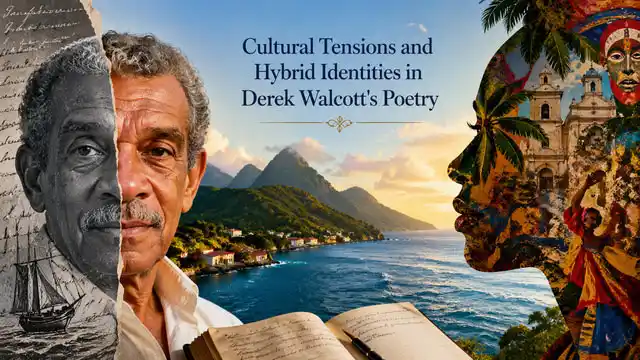
Walcott’s poetry reflects the struggle of reconciling colonial history with native heritage, often portraying a divided consciousness that arises from living between two worlds. His use of the English language—infused with Caribbean rhythms and imagery—symbolizes this duality, as it both connects him to and distances him from his roots. Through his evocative landscapes, historical reflections, and personal introspection, Walcott transforms cultural conflict into a creative force, giving voice to a uniquely hybrid identity that resists singular definition. Thus, his poetry not only examines the tensions of postcolonial identity but also celebrates the richness and resilience born out of cultural fusion.
Fragmented Identity and Early Poetic Vision of Derek Walcott:
In his Nobel Lecture, Derek Walcott described the experience of watching a Ramleela performance in a village in Trinidad, remarking: “…… Two different religions, two different continents, both filling the heart with pain that is joy.” The pain that fills Walcott’s heart is the pain of a fragmented identity. This pain is also joy of a hybrid existence. Walcott published his first collection of poetry at the age of fourteen, in which he described the beautiful and rich landscapes of the Caribbean Islands. As Walcott understood his surroundings, he realised that his identity was fraught with racial and colonial tensions. In his early poems, Walcott confronts the conflicts of his European and African ancestry. However, in these poems, the paradoxes of his identity remain largely unresolved.
In Walcott’s later poems, one observes a heightened historical and political awareness. This analysis discusses an early poem, A Far Cry of Africa (In a Green Nigh: Poems, 1948-60, 1962), and two later poems, Names (Sea Grapes, 1976) and The Sea is History (The Star-Apple Kingdom, 1979), in order to highlight the ways in which the poems present a search for a Caribbean history while exploring the racial, colonial and cultural tensions inherent in Caribbean identity. Moreover, this analysis reveals Walcott’s celebration of the hybridity and cosmopolitanism or Caribbean culture.
Historical Context and Formation of Caribbean Hybrid Culture:
Walcott attempts to rewrite the history of the Caribbean people from a subaltern perspective. He celebrates the hybridity and cosmopolitanism of Caribbean culture, but he never loses sight of its colonial past and remains critical of the forces shaping its future. It is first important to understand the historical and political context in which Walcott wrote these poems. The Caribbean Islands, which served as Walcott’s subject and inspiration, are a group of scattered islands between the North and South America that were occupied by the Caribs or the American-Indian tribe before the arrival of Columbus in 1492.
The different islands were colonized by the British, the French and the Dutch. The colonizers brought in slaves from parts of Africa to work on the land. When slavery was abolished by the Emancipation Act of 1863, the colonizers began ‘importing’ labour-force from India and China. An imaginative reconstruction of the situation of the first generation of people who were brought to the Islands is attempted by a number of Caribbean writers and poets.
When Columbus discovered the islands, he assumed that the native population did not exist. While the natives were denied human existence, the position of the slaves and the indentured labourers was hardly any better. They were displaced from their homeland brought to an entirely unfamiliar environment and forced to work. They could hardly communicate with one another. Over the years the different Diasporas developed a language of communication (Pidgin and Creole), and the intermixing of cultures (Native American, African, Indian, French British and Dutch) resulted in a hybrid culture.
Cultural Schizophrenia and Identity Crisis in A Far Cry from Africa:
The later generation inherited this hybrid culture. Though the later generations did not experience displacement or colonisation first-hand, the inheritance of an identity informed by such complexities resulted in a form of cultural schizophrenia. Walcott’s poem A Far Cry from Africa explores this psychological condition. The central question asked in the poem, “I who am poisoned with the blood of both/where shall I turn, divided to the vein?” Walcott evokes the Mau Mau rebellion of Kenya and holds both the Europeans and the Kenyans responsible for the bloodshed. He is critical of the colonial discourses based on statistics and laws that justify the killing of the Kenyan people. However, he can neither turn away from his English identity, nor from his African ancestry.
In A Far Cry from Africa, therefore, Walcott confronts this psychological conflict but the paradoxes in his identity remain unresolved because the central question is never answered.
Collective Identity and Historical Consciousness in Names and The Sea is History:
In his later poems, such as Names and The Sea is History, there is a more mature and historical understanding of the racial, colonial and cultural tensions in the collective Caribbean identity. Both Names and The Sea is History trace the beginnings of the Caribbean race (referring to the social concept but also meaning journey).
In the first part of Names, Walcott describes how his race began with no nouns, no horizon, no memory and no future. The shift from ‘my race’ and ‘I began’ to ‘Our souls’ and ‘our names’ is significant as it marks the growth from an individual to a collective sensibility. Walcott writes that his race began as the sea began.
The reference is to how African slaves were brought to the Caribbean islands via the sea. They had to leave behind their homeland and the memory of their native culture was lost. Walcott uses the image of an osprey’s cry to describe the condition of these people—”and my race began like the osprey/with that cry, /that terrible vowel, /that I!” This cry is the agonizing cry of the displaced people in an effort to define and identity.
Loss of History and Critique of Colonial Discourse:
While tracing the beginnings of the Caribbean race, Walcott is searching for a particular moment in history when “the mind was halved by a horizon”. By this phrase, Walcott means the introduction and the internalisation of the binary opposition between the black and the white. Walcott is unable to find the moment when this opposition between the black and the white. Walcott is unable to find the moment when this opposition was placed into the mind because the history of the Caribbean Islands remains, largely, the history documented by the European colonizers. This history is governed by the discourse of orientalism.
In Orientalism, Edward discusses the various institutional apparatuses that promoted certain statements about the ‘orient’: about its homogeneity, mystical appeal, and barbarity. These statements validated the truth about the ‘orient’ and formed the discourse of orientalism.
Language Evolution: From Adoption to Subversion in Names:
The African slaves and the Indian indentured labourers who were brought to the Caribbean islands spoke different languages and dialects. They were forced to learn the colonizers’ language (what may be called the adapt phase). As they attempted to learn the language, they altered it with pronunciations and mispronunciations (the adapt phase). Over time, they mastered the colonizer’s language and began using it in a manner to write back to the empire (the adept phase). Walcott explores these three phases in Names.
The second part of the poem describes how the colonizers named everything on the Caribbean islands after places and structures in Europe. This naming process was important to the colonizers for both nomination and domination. The poem describes how the Africans first agreed to the names (adopt), repeated them (adapt) and then changed them(adept). Repetition of names also suggests mimicry—repeating the words or actions of the colonizers in a comic manner in order to subvert them.
Creation of a New Language and Symbolic Resistance:
Therefore, in Names, mimicry of the French words spoken by the teacher is not enough, the words must be spoken in ‘fresh green voices’ to forge a new language. The creation of a new lexicon is represented by the description of the stars in the last line of the poem—the student sees the stars as “fireflies caught in molasses” as opposed to the constellations of Orion or Betelgeuse. The metaphor stands for the condition of the African slaves who are like fireflies capable of emanating light but caught in the colonizer’s physical and ideological trap. Walcott’s task, as a poet, is to aid the forging of this new language.
Historically, in the Caribbean islands the fusion of the different languages produced Pidgin and Creole. However, Walcott writes mostly in English and sometimes in French. There remains a debate between the relative importance of Creole and English in encapsulating the diversity of Caribbean culture. What is important to note, in this regard, is that Walcott appropriates the colonizer’s language to challenge the colonizer’s discourse and to rewrite the history of the Caribbean people.
The Sea is History is a suitable example. The poem, in an odyssey-like fashion, traces the events in the history of the African slaves and compares them to the mythical events in the Bible. For example, in the first part of the poem, the arrival of the African slaves on the islands is described by drawing a parallel with the events in the Genesis. Walcott not only uses Biblical allusions; he also extensively uses the sea as a metaphor. The history of Caribbean people lies in the ‘grey vault’ of the sea. There is the only witness to the suffering of the African slaves brought to the islands, many of whom died on the way and have turned into corals lying in the sea-bed. In the poem, the expansive nature of the sea stands for the complexity of Caribbean history which cannot be understood by the colonizer’s markers of history—monuments, battles, martyrs, etc.
Rewriting Caribbean History from a Subaltern Perspective:
The poems A Far Cry from Africa, The Sea is History and Names can, therefore, be effectively seen as presenting an understanding of the complexities inherent in Caribbean history and identity. These poems are also attempts on the part of the poet to rewrite the history of the Caribbean people from a subaltern perspective. However, Walcott’s poems not only uncover the many oppressions that the Caribbean people have been subjected to in the past, but also present a celebration of the hybridity and cosmopolitanism of Caribbean culture.
Celebration of Hybrid Language through Metaphor:
As already mentioned, Walcott advocates the creation of a language which is an “electric fusion of the old and the new”. This fusion or hybrid formation is celebrated in Walcott’s poetry. Firstly, it is celebrated through metaphors. Though these metaphors are in English, they capture the natural landscape of the Caribbean islands in an extremely vivid manner. The layered metaphor of the threshing of grains and the appearance of the dust as ibises in A Far Cry from Africa is an apt example— “Threshed out by beaters, the long rushes break/in a whit dust of ibises…” Other examples include the metaphor of the osprey’s cry in Names and the metaphors of the sea in The Sea is History.
This creation of the hybrid language and culture is seen in Walcott’s poems as empowering. In Names, the palms of Caribbean islands are seen as greater than Versailles since no man has made them and no man shall destroy them, “except the worm, who has no helmet, /but always the emperor”. The comparison of the Caribbean people to worms is significant for it represents the power of supposedly trivial beings.
Polyphony, Critical Awareness, and Postcolonial Realities:
Another way in which hybridity is celebrated in Walcott’s poems is through polyphony. As one is aware, Walcott is a well-known dramatist besides being a poet. A number of his poems are very dramatic in their use of imagery and voice. In Names, for example, besides the voice of the poetic persona, there is the voice of the French teacher. Similarly, in The Sea is History, there is the voice of the unnamed colonizers who asks the questions—”Where are your monuments, your battles, martyrs?” and “but where is your Renaissance?”
It must also be noted that while Walcott celebrates the hybridity and cosmopolitanism of Caribbean culture, it is in no way an uncritical stance. In the celebration of hybridity, it is possible that the imbalances of power relations may be either neglected or negated. Walcott, however, never loses sight of the colonial past of the Caribbean islands. In an interview recorded in Conversations with Derek Walcott, Walcott says:
“The whole idea of America, and the whole idea of everything on this side of the world……is imported; we’re all imported—black or Spanish……The difficult part is the realization that one is part of the whole idea of colonization……the rare thing is the resolution of being where one is and doing something positive about that reality.”
Furthermore, Walcott is not blind to the shortcomings of the culture and politics of the newly independent states in the Caribbean islands. In the second part of The Sea is History, for example, he is critical of the social and political institutions of the new independent states—the council of priests is compared to flies, the bureaucrats are herons which can’t fly high, and the politicians are like bullfrogs bellowing for votes. The implication is that the new states are still nascent in their culture and politics; there is still a long way to go for the ‘rumour’ of ‘History, really beginning” in these states to echo throughout the world.
