Chaucer: Realism:
Introduction:
The Canterbury Tales is one of the greatest literary works of English literature, and its “Prologue” stands out for its vivid and realistic portrayal of medieval society. In “Realism in Chaucer’s Prologue to The Canterbury Tales,” Geoffrey Chaucer presents a true picture of life by describing people from different social classes with remarkable accuracy and detail. Unlike many medieval writers who focused mainly on idealism and religious themes, Chaucer observed human nature closely and portrayed his characters as real human beings with their virtues, weaknesses, habits, and emotions.
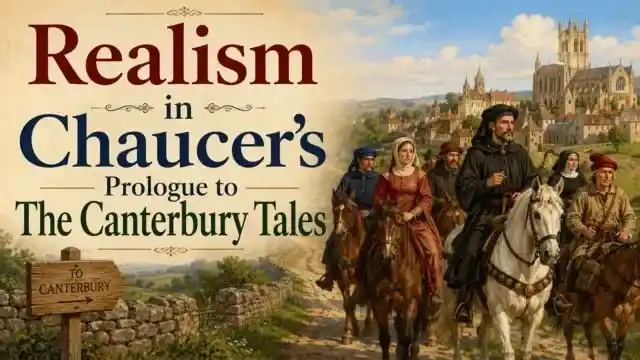
The “Prologue” becomes a living panorama of fourteenth-century England where knights, monks, merchants, doctors, and common people appear as representatives of contemporary society. Chaucer’s realistic approach, sharp observation, humour, and natural descriptions make the “Prologue” a timeless masterpiece and a mirror of medieval life.
Chaucer is a great realist in the sense that he presents people as they are without an attempt to glorify or idealise them. He does not seem to believe in the theory that the real world is made of brass but the poet has to present a world of gold. He is a true artist who sees what is and paints it as he sees it. Chaucer’s ‘Prologue’ is a realistic account of contemporary society. Chaucer points it out why a particular activity takes place at that time for example he tells about the period of pilgrimage as well as the way in which the pilgrims used to proceed to a holy place.
Chaucer’s realism is impartial for he accounts for imperfections as truly as perfections. For example, he points out that the Wife of Bath was not attractive at all. Her face was bold and dark. Her mouth was gap-toothed. She was hard of hearing and her hips were heavy yet so many people were mad after her. It is so for she is an earning lady and her frank behaviour wins their hearts. It is true that she was gap-toothed. She sat comfortably upon a slow-moving horse. She wore a fair wimple or veil and a wide hat shaped like a shield. Her outer skirt covered her large hips. She wore a pair of light shoes. In company she talked freely and cut jokes. She knew all the remedies of love for she had gone through that game so often and so long. Her charms are hidden in her being a lady of self-earning and frank nature. These qualities are rare in a lady of a traditional society.
Realistic Descriptions of Comprehensive Nature:
Chaucer’s realism is revealed in his minute descriptions of comprehensive nature. For example, in the opening lines of the ‘Prologue’ the poet tells about the month suitable for pilgrimage. It marks the turning of weather from rough to pleasant. The heat of March disappears when in April showers of rain bless the dry earth. It is the time when flowers bloom and the atmosphere becomes suitable to travel. Now the west wind blows a gentle breeze and affects all the places whether forests or moors; plants and flowers burst everywhere. It is the season of spring when the sun is young. It has covered half of its annual course in the Ram.
Changes in nature affect feelings of birds and provoke them to sing the whole night. In this way he throws light on a common practice of pilgrimage popular in those days. Chaucer makes a critical study of everything. Here he points out why people go on pilgrimage in that particular season, because in pleasant weather travelling becomes easy. It is the comprehensive nature of his description that the poet tells how in that pleasant weather people plan for pilgrimages. It is the most suitable period when people desire to visit holy places. Some carry a branch of palm and wander from one place to the other.
The branch of palm becomes the mark of their holy motive and people help them throughout the way of the journey. They visit unknown distant places. Mostly pilgrims wish to visit Canterbury to pay their respect to the holy martyr Thomas a Becket who sacrificed his life for the cause of public welfare. These pilgrims come from every district of England. They believe the pilgrimage to Canterbury makes them free from their sickness. It shows their firm faith in Canterbury. Thomas a Becket was an English priest who opposed King Henry II’s anti-people policy. The King got the priest killed in 1170 in his Canterbury Cathedral. Since then, it became a major centre of pilgrimage.
Realistic Descriptions of Individual Nature:
Chaucer’s realism is exposed in his description of the character’s individual qualities. For example, he tells about the Squire whose hair was curly as if it were kept under pressure. The poet guesses the squire was twenty years old. His height was moderate. He was very strong and active. He had been in cavalry force at Flanders, Artois and Picardy. He had become an expert rider in a short period just to impress his beloved. There were embroidered white and red flowers on his gown that looked like a meadow of fresh flowers. He passed his whole day in singing and fluting. By nature, he was joyful like the month of May. His gown was short with long and wide sleeves. He knew well how to sit on a horse and ride it properly. He composed songs. He was expert in combats and dances also. He was skilled in drawing and writing. He was a passionate lover who used to sing like a nightingale at night. He was courteous, polite and helping in serving his father at dining table. He tells about Madam Eglantine. Her smile was sweet and simple. Her greatest oath was by St. Loy but it is a great irony that St. Loy was against taking oaths. She sang prayer in a nasal tone. She spoke French fluently in the manner of Stratford atte Bowe but she did not know French that is spoken in Paris. She was well trained in table manners. While eating she did not drop any part of food on her dress. She did not dip her fingers deep in soup to wet them. She was perfect in taking food without making anything dirty.
Courtesy was her chief quality. She rubbed her upper lip so clean that no stain of grease was left on the cup when she took a drink. She reached at the food in a polite manner. The Pardoner’s hair was yellow like the pure wax. It hanged smoothly like the thread of fibre. His thin pig- tail like locks were covering his shoulders but in pieces here and there. Just for amusement he was not wearing any hat. The Miller’s beard was red as any sow or fox. It was as broad as a spade. He had a wart right on the top of his nose and thereon stood a tuft of hair as red as the bristles of a sow’s ears. His nostrils were black and large. He bore a sword and a shield by his side. His mouth was as large as the mouth of a big furnace.
Realistic Descriptions of Representative Nature:
Chaucer points out the representative qualities with such realism that they seem to be found in all people of that particular class. For example, the Monk’s worldliness is a representative quality. Almost the whole church was suffering from this imperfection and people like the Poor Parson were rare. Chaucer passes satire on growing worldliness among monks of that time by pointing out that the Monk was interested in leading a worldly life.
According to holy books a monk should never be a hunter, but this monk had a number of hunting dogs. His hunting dogs were as fast as a bird. He took deep interest in catching and hunting a hare. He was not ready to leave it in any condition. The Monks physical appearance exposed his worldly nature. His gown was decorated with fine fur at the cuff. His hat was bound with a pin of solid gold under his chin in a butterfly knot. In this way he looked more like a romantic landlord than a monk. His dress was costly enough to be worn by a highly prosperous man.
Likewise, the Friar is interested in leading a worldly life. In an ironic tone the poet comments that he was interested only in making money. Therefore, he was very liberal in granting pardon if he knew he would get good gift or food. If a man gave gift or food, it proved that he was confessed and free from sin. He knew the person was sorry for his sin. Some men had such hard hearts they would not weep in spite of great grief. Therefore, in place of weeping they should give silver to the poor friar. It shows how he gave crooked arguments to justify his corrupt practice.
Realistic Description of Social Conditions:
Chaucer is rightly called the social chronicler of his time. He draws a realistic picture of his contemporary society. It was the age of chivalry in which a knight held the prime place. Chaucer tells about his qualities to prove that he was a perfect knight. He was an ideal who could inspire others to be worthy. The Knight was worthy for he believed in Chivalry, truth, honour, freedom and politeness since the beginning of his Knighthood. He proved his worthiness in religious wars. He had visited distant fields to take part in battles in Christian as well as non-Christian countries. Everywhere he was honoured for his worthiness. He took part almost in all the famous battles. He was the chief guest in Prussia when all the Christian countries had honoured Christian Knights for winning in Alexandra, Lithuania and Russia. He fought in Grenada, Algeciras, Benmarin, Ayas and Adalia. He took part in battles near the great sea. The worthy Knight had taken part in fifteen deadly battles. He had fought for Christian faith and won three times in tournaments at Tlemcen. In all of them he had killed his rivals. He had been for some time with the lord of Palatia to fight against another non-Christian in Turkey. It brought him noble reputation.
Under the impact of Renaissance all people had recognised the importance of minor traders. As individuals they were not strong but after becoming members of commercial guilds they attained power. At this time all were eager to be as powerful as possible. The weaker section therefore had joined grand unions called Guilds at that time. The members of a Guild used to put on a uniform to show their faith in that. Now they were free from exploitation. Their income and social status was increasing. It had made them and their families over ambitious. The fact is exposed by the poet who points out that there was a group of guild-men consisting of a button seller, a carpenter, a weaver, a dyer and a tapestry maker. They were in the uniform of a grand union. Their dresses were new, neat and pressed. Their knives were not covered in brass but in silver. Their belts and pouches were neat and clean. They looked like respectable citizens worthy enough to take a seat on dice of a guild-hall. They were wise enough to be honoured as chairmen. Now they had rich property and handsome income. Their wives knew it and wished to be called ‘Madam’. They wanted to lead the procession in the village in a royal manner. It shows the great change in their attitude with changing economic condition.
Artistic Realism:
It is true that Chaucer’s realism is of artistic nature. It develops on blending of fact with fiction. No real model has yet been found of Chaucer’s all pilgrims. Knights or priests are so popular characters in mediaeval literature of France and England that there is no need to find out the model at all. Besides Chaucer’s characters are so vividly described they create the impression of being the word- pictures of real human beings of flesh and blood. None can believe the characters are not drawn from life. The Host Harry Bailly for example has his roots in Henricus Bailly who was an innkeeper in Southwark. He was a Member of Parliament from that area. Regarding other characters also some interesting information has been supplied by scholars. For example, there was really a ship called ‘The Maudelayne’ sailed by some Peter Risshenden. Thomas Pinchbek appears to fit the description of the Sergeant at Law. But these two or three characters do not prove that all the characters had their original one in contemporary society. Chaucer’s creative imagination was so strong that even imaginary looks the real one. Chaucer’s description of the inn is a fact but it is a fiction that he met the pilgrims there. In fact, the whole pilgrimage takes place in the poet’s mind. Some scholars believe that Chaucer had taken part in a pilgrimage in 1387 when his wife Philippa was ill and she died just a few months later. There is no record to tell how long Chaucer worked on his collected material. Scholars believe that mostly tales had been finished in 1393 or 1394. Some tales could not be completed by him. It suggests that he was busy in the composition of these tales till the end of his life. It is a fact that a few other works too were left incomplete by him. When it has been ascertained that Chaucer, himself had taken part in a pilgrimage, it is quite possible some of the pilgrims might have told a few interesting stories and someone might have awarded the teller of the best story with a lunch at his own cost.
It was enough for a creative poet like Chaucer to turn the event into the Canterbury Tales. It is also believed that he drew inspiration from Boccaccio’s great collection of tales. The popular Oriental books of tales like the ‘Arabian Nights’ could also have impressed him. Besides, Ovid’s ‘Metamorphoses’ and Gower’s ‘Confessio Amantis’ were very popular in those days and therefore probably they too might have impressed Chaucer. The device of the pilgrimage proved very suitable for it provided the poet an opportunity of bringing together a host of representative persons of contemporary society at one place. It is a piece of literature to be enjoyed without thinking how so many people travelling on horse backs would have heard the stories without modern devices of amplifiers. What the poet presents is literary truth that slightly differs from the general truth.
Conclusion:
Chaucer’s realism is blessed with the quality of universality. His Squire puts on a bright flowery dress and makes his hair curly. It is a universal quality for the youth of our time also take interest in such things. The Squire composes love songs and sings them upto late at night. Our modern young men too do the same with the difference that in place of singing by themselves they listen to music on c.d. players or see programmes on TV. Chaucer’s churchmen live in comforts and our modern religious Gurus live in a.c. buildings and own fleets of a.c. cars. In ‘Prologue’ Chaucer passes satire on the corrupt practice of the Summoner. He was a kind rascal. It was difficult to find out a more wicked man. If a man could give him wine, he allowed him to enjoy himself with a mistress. If he lent his mistress to the Summoner the man could enjoy himself with her for the whole year for the summoner was ready to excuse him. Privately he could cheat an ignorant person. He asked to be bold against the fear of the arch deacon’s excommunication and taking no risk to his soul the person should suffer a loss of money. Besides, purse is hell i.e., a noble person should not love money and get rid of it. But in reality, he told a lie by saying it for he loved money. The Summoner is representative of a modern police inspector who earns money by unfair means.
