Introduction:
The Prologue to The Canterbury Tales by Geoffrey Chaucer is regarded as a true mirror of fourteenth-century English society. In this remarkable work, Chaucer presents a vivid and realistic picture of the social, religious, cultural, and moral conditions of his age. Through the description of different pilgrims belonging to various classes of society, he reveals the life, manners, professions, virtues, and weaknesses of the people of medieval England. The Knight, the Merchant, the Doctor, the Parson, the Wife of Bath, and many other characters represent the different sections of society and together form a complete panorama of the age. Chaucer’s keen observation, realism, and humour make the “Prologue” not only a literary masterpiece but also a valuable social document of the fourteenth century. Thus, the “Prologue” successfully holds a mirror to contemporary English society in all its diversity and complexity.
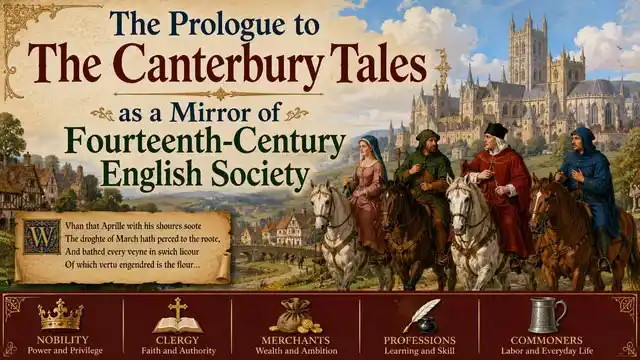
While discussing the history of poetry of the period, Compton-Rickett remarks: ‘Chaucer symbolises, as no other writer does, the Middle Ages. He stands in much the same relation to the life of his time as Pope does to the earlier phases of the 18th century, and Tennyson to the Victorian era; and his place in English literature is even more important than theirs……. Chaucer presents a representative picture of his society that was passing through a phase of transition for the Middle Ages were decaying and the Renaissance was knocking at the door.
The Representative Nature of the ‘Prologue’:
The representative nature of the ‘Prologue’ is exposed at the very beginning when the poet tells about the most suitable period for such pilgrimages. He tells about the month suitable for pilgrimage. It marks the turning of weather from rough to pleasant. The heat of March disappears when in April showers of rain bless the dry earth. It is the time when flowers bloom and the atmosphere becomes suitable to travel. Now the west wind blows a gentle breeze and affects all the places whether forests or moors; plants and flowers burst everywhere. It is the season of spring when the sun is young. It has covered half of its annual course in the Ram. Changes in nature affect feelings of birds and provoke them to sing the whole night. He classifies pilgrims in two categories also. He points out that it is the most suitable period when people desire to visit holy places. Some carry a branch of palm and wander from one place to the other. The branch of palm becomes the mark of their holy motive and people help them throughout the way of the journey. They visit unknown distant places. Mostly pilgrims wish to visit Canterbury to pay their respect to the holy martyr Thomas a Becket who sacrificed his life for the cause of public welfare. These pilgrims come from every district of England. They believe the pilgrimage to Canterbury makes them free from their sickness.
The Knight and the Spirit of Chivalry:
It was the age of chivalry in which a knight held the prime place. Chaucer tells about his qualities to prove that he was a perfect Knight. He was an ideal who could inspire others to be worthy. The Knight was worthy for he believed in Chivalry, truth, honour, freedom and politeness since the beginning of his Knighthood. He proved his worthiness in religious wars. He had visited distant fields to take part in battles in Christian as well as non- Christian countries. Everywhere he was honoured for his worthiness. He took part almost in all the famous battles. Another character to represent it is the Squire. In the concept of a squire, it was very clear that he was a knight under training. He had to look after the Knight’s weapons. He was not allowed to conduct a war. His duty was only to assist the Knight with whom he was attached for training.
The Romantic Nature of the Squire:
The Squire’s romantic nature is exposed in a very interesting way by the poet. With the knight there was a young squire who was the knight’s son. The squire was a loving enthusiastic young man. His hair was curly as if it were kept under pressure. The poet guesses the squire was twenty years old. His height was moderate. He was very strong and active. He had been in cavalry force at Flanders, Artois and Picardy. He had become an expert rider in a short period just to impress his beloved. There were embroidered white and red flowers on his gown that looked like a meadow of fresh flowers. He passed his whole day in singing and fluting. By nature, he was joyful like the month of May. His gown was short with long and wide sleeves. He knew well how to sit on a horse and ride it properly. He composed songs. He was expert in combats and dances also. He was skilled in drawing and writing. He was a passionate lover who used to sing like a nightingale at night.
The Yeoman as a Representative of Forest Life:
The Yeoman represents forest life. Being a forester, he has to guard himself against wild beasts and therefore he keeps weapons and puts on a green dress in which he can hide himself in a bush in case of an unavoidable danger. Chaucer points out that the Yeoman kept all the possible weapons with him for it was very dangerous to pass through thick forests full of wild animals. Besides he was wearing an arm guard. He had a sword and a shield at one side and a dagger on the other. The dagger was pointed like a spear. He wore a silver medal of Christopher on his breast. He had a horn hanging with his belt.
Chaucer’s Satire on the Nun, Monk and Friar:
Chaucer admires the Nun’s table manners on the one hand and on the other exposes her worldly nature. In fact, a nun ought to concentrate her mind in religious matters. It is a matter of surprise that she cares so much for such worldly things. She showed stately manners to be respected in society. The poet tells about her inner nature. It was helping and kind enough to make her weep on seeing a dead or bleeding mouse. She had pet puppies whom she fed with roasted flesh and high-class bread with milk. If any one of them was dead she wept bitterly. She could not bear if anybody beat or frightened them. A nun ought to be merciful towards orphan children, the sick and the old. She ought to look after them and feed them by borrowing money and food from the well to do people of society. But such things were below her dignity. She had no time for them. She fed her dogs with milk and bread of high-quality wheat. It exposes her vanity. Chaucer passes satire on growing worldliness among monks of that time by pointing out that the Monk who was going with them to Canterbury had no faith in ancient discipline of religious people. He was head or keeper of a monastery. He did not follow the strict rules of discipline for monks made by St. Maurus and St. Benedict. He did not like anything outdated. He wanted to go with the new world. In an ironic tone the poet comments that the friar was a worthy officer in his church. All the landlords and rich people loved him. He knew all the worthy i.e., corrupt women of the town. He had power to hear confession of sin and grant pardon to the sinner. He took interest in listening to the tale of sin. He claimed that he was more than a priest. He was a licence-holder. His way of pardoning the sinner after confession was easy. It is not the proper way of granting pardon but the Friar had made religion a source of corrupt earnings.
The Oxford Scholar and the Value of True Scholarship:
Chaucer tells about tells about a poor scholar from the university of Oxford. In the worldly society a true scholar suffers from poverty and unemployment. Chaucer points out that the Oxford scholar had studied law for many years. His horse was very thin. The scholar too was a thin man. He looked very weak and serious. His outer cloak was made of an ordinary cloth. He had not been able to make any earning. He was not worldly enough to get employment by unfair means. His character provides an opportunity to recognise the imperfection of contemporary society in a better way. Here corrupt churchmen like the Monk and the Friar are living like lords but a true scholar is suffering in utter poverty. Chaucer points out a universal fact that in a corrupt society true scholarship has no value and nobody can get employment without using unfair means.
The Lawyer and Public Reputation:
Chaucer tells about a lawyer who was highly learned and reputed. For his learning and reputation, he had earned much money, many robes and titles. He was a great purchaser of land. Much of that he had got as simple fee. His documents could never be proved false or defective. There was no nan more busy than him but he looked more busy than he was. Since the days of King William whatever judgements had been awarded, were known to him. He was perfect in drafting a document and no man could point out a defect in that. He had learnt all the rules by heart. Here the poet points out a universal fact that those who practice in public ought to pretend that they are very busy otherwise people don’t respect them. Besides it, to establish permanent reputation the person should be well qualified.
The Franklin and the Love of Pleasure:
In the character of the Franklin the poet presents the carefree living of a rich man in the contemporary society. This Franklin believed in the philosophy: eat, drink and be merry. He took wine with a piece of bread in the morning. He loved to lead a life of pleasure. In the way he was a true follower of Epicurus who said that highest pleasure was the highest good in life. He took bread and wine of high quality. No other person had a richer stock of wine. There was no want of baked meal, fish or flesh in his house with all imaginable variety.
The Guildsmen and Rising Social Status:
Chaucer points out that among those pilgrims there was a group of the Guildsmen. It consisted of a seller of small things like buttons and needles, a carpenter, a weaver, a dyer and a tapestry maker. They were in the uniform of a grand union. Their dresses were new, neat and pressed. Their knives were not covered in brass but in silver. Their belts and pouches were neat and clean. They looked like respectable citizens worthy enough to take a seat on dice of a guild-hall. It marks the change in social picture of the time. Under the impact of Renaissance all people had recognised their importance. All were eager to be as powerful as possible. The weaker section, therefore, had joined grand unions called Guilds at that time. The members of a Guild used to put on a uniform to show their faith in that. Now they were free from exploitation. Their income and social status were increasing. Chaucer points out a universal fact that economic condition and social status go on together. Being rich now the lower section of the society aspires for social recognition.
The Merchant and the Shipman:
Chaucer tells about a merchant and a shipman to throw light on the commercial activities of that time. The Merchant’s views were clear and he expressed them seriously. All the time he talked about earning money. He wanted that the sea between Middleburg and Orwell should be free for trade. He was expert in earning French coins. His mind was always busy in thinking about his trade. But nobody could ever know that he was in debt. Besides him the shipman was such a gentle man that he did not care for his conscience. At Bordeaux he drank wine secretly without payment when the merchant was asleep. None could surpass him in skill of making study of tides and streams, the handling of ships, the knowledge of harbours, the moon and the use of compass. He was aware of the dangers that hinder in navigation. He was bold and wise in trade dealings. Chaucer attempts at hitting the fundamental points while talking about his characters. Being a businessman, the shipman lacks in morality and humanity but excels in the knowledge of his trade.
Chaucer’s Doctor and Medieval Medical Science:
Chaucer’s Doctor represents the transitional nature of his period and stands for mediaeval as well as modern medical science. In the whole world there was none like him in field of physic and surgery. He was a scholar in study of stars. He treated his patients according to their stars with the supernatural power of divine glory. He knew the fortune of his patients. He knew the cause of every disease if it has root in hot or cold or dry or moist humour. He gave medicine accordingly. It may be interpreted in another way also that for the satisfaction of his superstitious patients he used calculate their nativity but for prescribing proper treatment he used to know the root cause of the disease. Mediaeval theory of medical science believed in four humours: hot, cold, dry and moist. According to it in a healthy person these humours are found in perfect balance. If any of them increases or decreases the person falls ill.
The Wife of Bath and the Self-Earning Woman:
Chaucer points out that among those pilgrims there was a good lady from the locality of Bath. She was expert in readymade garments. Being a self-earning woman, she was proud of her prosperity and position. In the whole parish there was no other woman who could enter the church to donate before her. If any woman dared, the wife of Bath grew angry and it was her great sense of charity. Her head cloth was finely woven. It weighed almost ten pounds on Sunday. Her hoses or skirts were of bright red colour. They were tightly tied. Her shoes were soft and new. Her face was bold. It was fair and red. Chaucer holds the opinion that self-earning woman grows corrupt and fashionable. In an effort of looking modern so often they adopt ridiculously designed garments. Being a self-earning woman, she suffered from a sense of superiority. Besides, she could donate more money than an ordinary house- wife. Therefore, in the whole parish there was no other woman who could enter the church to donate before her.
The Poor Parson as an Ideal Churchman:
Having discussed a number of corrupt churchmen Chaucer tells about the poor parson who is an ideal churchman. He truly preached Christ’ gospel i.e., teaching. He taught these gospels whole heartedly. He was kind and wonderfully laborious. He did not lose patience in misfortune. So often he had proved this quality. He never rebuked anybody for non-payment of the tithe i.e., donation to the church. For his poor parishioners he paid it by himself from his own pocket. He was satisfied in little. It shows he was free from worldly desires. It confirms the view point that he was free from selfish desires. He had devoted his whole life to public welfare.
The Ploughman as a True Worker:
As a representative of true workers there is the Ploughman in ‘Prologue’. The poor parson’s brother was a ploughman who had come with him. The ploughman had drawn many a cartload of dung. He was a true and gentle worker. He lived in perfect peace and charity. He loved God whole heartedly and never forgot Him whether he passed through prosperity or adversity. He loved his neighbour even as himself. For a poor he was ready to thrash, ditch and dig without payment in the name of God if it was in his power to do that. He was regular in paying his tithe fairly on his work and property. He was in a working man’s dress. He was riding on a mare. He too is an ideal man like his brother, the poor parson. His sympathy for the poor and firm faith in God makes him better than others.
The Miller and Physical Strength:
It was a period of physical strength that is at its best represented by the miller who reminds of Samson who had lifted the heavy gates of the city of Gaza and carried on his shoulders those gates as well as the two posts and the heavy bar. He carried the heavy load to the hill of Hebron. The miller was a strong fellow with large muscles and bones. He had proved his strength wherever he went. In wrestling he had won prizes. He was short armed, with broad thick body. There was no door he could not have off its hinges, only by running at it with his head.
The Maniciple, Reeve, Summoner and Pardoner:
The Maniciple surpassed all in wit. By drawing the Maniciple’s character the poet points out the difference between theory and practice. The lawyers are perfect in theory but the Maniciple befools them on account of his practical wit. The Reeve was a better buyer than his master for he had earned a handsome private property. He knew how to please his master by giving him loan on his property and receive thanks with a coat and hood. The Summoner was a kind rascal. It was difficult to find out a more wicked man. If a man could give him wine, he allowed him to enjoy himself with a mistress. If he lent his mistress to the Summoner the man could enjoy himself with her for the whole year for the Summoner was ready to excuse him. Privately he could cheat an ignorant person. The Pardoner was expert in befooling common people. In his bag he had a pillow-cover which he claimed was the veil of our lady. By selling such false relics to poor people he used to earn more than what a man might earn by working hard in two months. Thus, he befooled innocent people by talking with false sincerity and tricks.
Conclusion: The ‘Prologue’ as a Social Document:
Thus, Chaucer represents his contemporary society in his ‘Prologue’ that stands as a social document of the period. According to W.H. Clawson ‘This idea of pilgrimage as occasion for the telling of a sequence of stories was one of the happiest devices of Chaucer’s Canterbury Tales. The religious motive of a pilgrimage made possible the coming together on a friendly footing of representatives of many social classes and the relative safety and cheapness of such a form of travel, especially to so famous and long established a shrine as Canterbury, promoted a holiday spirit which encouraged music and storytelling and led to the free exchanges of the opinions and confidences. Thus, through his adoption of the pilgrimage device, Chaucer was enabled to make of his general Prologue an unsurpassed social document, and of his framing narrative a true human comedy’.
