Introduction:
Henry Fielding’s Tom Jones is widely regarded as one of the finest examples of the picaresque novel in English literature. Published in 1749, the novel presents the adventurous life of Tom Jones, a young man of uncertain birth, who travels through different places and encounters a variety of people and experiences. Like a typical picaresque hero, Tom is lively, impulsive, pleasure-loving, and often guided more by instinct than by strict moral principles.
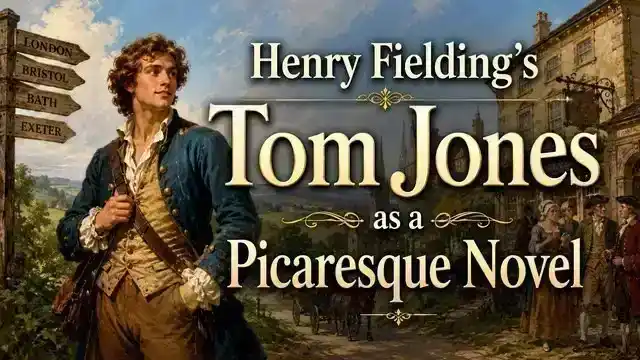
The novel Tom Jones is full of exciting incidents, journeys, comic situations, and realistic portrayals of society, all of which are important features of the picaresque tradition. Through Tom’s adventures, Fielding not only entertains the readers but also exposes the hypocrisy, corruption, and moral weaknesses of eighteenth-century English society. Thus, Tom Jones combines humour, realism, satire, and adventure, making it a remarkable picaresque novel.
Meaning and Origin of the Picaresque Novel:
The term ‘picaresque’ has been derived from a Spanish word ‘picaro’ which means a rogue or a villain. Originally, a type of romance that dealt with rogues or villains was called picaresque. A picaresque novel presented, in an extravagant style, a series of adventures and misadventures, mostly on the highways. Some more enterprising novelists sent their hero to the sea also. With the development of the novel, it was no longer considered essential to take only a rogue or a villain as the central character. A regular hero, gallant and chivalric, adventurous in spirit and liberal in outlook, came to be equally acceptable. As Edwin Muir points out: “In the eighteenth century the novel had not yet freed itself from the trammels of the story centred on a single figure who had always to be present, and though characterization was then considered the main thing, the narrator remained on the centre of the stage. Perhaps he doubted the capacity of his characters to hold the reader’s interest and felt that an exciting story, concentrated adventures, was necessary. In any case, a tale centred on a hero had to be kept going, and at the same time a number of characters had to be given an excuse for appearing. So, we have the hard worked travelling hero, passing from inn to inn, now in the country, now in London, knocking at the doors of the great, foregathering with rogues and thieves, languishing in prison or on board a ship, suffering every vicissitude good and bad and enduring them all not because the novelist has any tender regard for his hero’s sufferings or fortunes, but because he is avid for variety, and is determined to get a pass to as great a number of contrasting scenes as he can.”
Early Examples of the Picaresque Tradition:
The earliest examples of the picaresque novels are the two Spanish works Lazarillo de Tormes and Guzman de Alfarache. Gill Blas is the most famous picaresque novel in French. In English the famous picaresque novel upto the eighteenth century are Nashe’s The Unfortunate Traveller or The Life of Jack Wilton, Defoe’s Mall Flanders, Smollett’s Roderick Random and The Adventures of Ferdinand Count Fathom. Fielding in Joseph Andrews and Tom Jones followed the same tradition. The traces of this tradition are found even in Dickens and Thackeray.
Purpose and Structure of the Picaresque Novel:
The object of the picaresque novel then is to take a central figure through a succession of scenes, introduce a great number of characters, and thus build up a picture of society. This is exactly the pattern which the story of Tom Jones follows. The hero is taken through a succession of scenes and situations, and has a number of adventures on the roads and inside inns. He meets persons of different types and tempers. In this way, a picture of society is gradually built up. The novel which follows this design is known as the picaresque novel.
Advantages of the Picaresque Form:
The picaresque form offered many advantages to the novelist. It did not require a regular, well-organised, well-rounded plot. The novelist could afford to dispense with the episodical unity and just contrive a succession of sensational events involving his chief protagonist. Secondly, he got an opportunity to introduce a wide variety of events and characters. The hero is now in the country, now on the highways, now in London, confronting thieves, grappling with rogues, rescuing beautiful damsels and falling in love, fighting duels, getting arrested and languishing in prison, getting robbed by the most innocent looking people and helped by those who looked scoundrels, getting intimately in touch with a vast variety of people from the country squires to the haughty and rakish aristocrats, from the boorish and nagging landladies to the morose and ill-tempered military personnel, from hypocrites and imposters to gypsies and fiddlers. Finally, the picaresque form offered enough scope to throw light on the life, culture and morality of the age and to criticize the evils infesting it.
Tom Jones and the Picaresque Tradition:
Tom Jones is written on the lines of the picaresque tradition and embodies some of its outstanding characteristics. Its hero is, however, far from being a rogue, but preserves the essential feature of the picaresque novel-the travel and adventures of the hero. Like the hero of the picaresque novel Tom Jones sets out on a journey and meets with various adventures on his way to London. The story of Tom Jones moves on the lines of the picaresque novel. Tom Jones, the hero of the novel, is a foundling, mysteriously discovered in the bed of the wealthy, virtuous and benevolent Mr. Allworthy who brings him up and educates him. But Tom incurs the wrath of his benefactor, resulting in his expulsion from the house. Now his troubles set in. Accompanied by a school-master named Partridge, he takes the road to London. On way he meets with a number of adventures, some of which are amorous in nature. He goes from place to place, stopping at inns to break journey. He joins the army as a volunteer, but being seriously wounded in a fray he cannot go with the soldiers he wanted to accompany. He meets a number of strange persons, one of whom is the Man of the Hill who wilfully leads a lonely life. He descends upon gipsies with whom he spends a night, and finally reaches London. But his adventures pursue him even there. He meets Lady Bellaston, a lustful woman, who for some time, supports him in London. Misfortune, however, persistently dogs his heels and he is imprisoned in London. Thus, the story of Tom Jones is a long chain of adventures in different scenes and situations.
Major Picaresque Episodes in Tom Jones:
Tom Jones is not a regular picaresque novel. But it incorporates in its structure the major characteristics of the picaresque form. The first six Books depict Tom’s adventures in the countryside. The poaching incident, Molly’s battle in the church yard, Tom’s escapade with Molly in the bushes are all in the picaresque tradition. But strictly speaking, it is with Book VII when, dismissed by Squire Allworthy, Tom takes the road to Bristol, that the really picaresque nature of the novel becomes evident. Henceforward, for the next six Books, Tom is involved in some breath-taking, smashing adventures on the roadside. The most brilliant part of the book is perhaps that concerned with Tom’s adventures on the road from Gloucester to London. In Book VII, piqued by some scurrilous jests at Sophia’s expense by Ensign Northerton, Tom picks a quarrel with him and gets hit on the head with a bottle of wine. In this very Book, following Cervantes’s example, Fielding provides Tom with an English counter-part of Sancho Panza-the pedantic-garrulous-cowardly Partridge. Fielding also sends his heroine, with a suitable lady companion, on adventures along the highway. Tom’s next halt is at the Bell, which he is forced to leave on account of the rude and insulting behaviour of the landlady, though it is five o’clock in midwinter and the cowardly Partridge is little inclined to give up the security of the inn. The same evening, he rescues the Man of the Hill from being robbed by two ruffians and the next morning, he saves Mrs. Waters from being strangled by Ensign Northerton. After a night’s stay at the Upton Inn, where some hilarious comedy takes place, Tom is again on the roadside now to meet beggars, highwaymen and gypsies. Fielding finds an opportunity even to insert a puppet show. In London itself, there is a masquerade, an attempted rape with a timely rescue, an intrigue followed by a ghastly duel and the arrest of Tom and the final resolution.
Satire and Social Criticism in the Picaresque Novel:
The ‘picaresque’ novel offers a criticism of the age whose picture it presents. Cervantes in his great picaresque novel, Don Quixote, gives a smashing blow to the tradition of chivalry. He ridicules knight errantry by making his hero, Don Quixote, charge the windmills. The novels of Fielding and Smollett, too, carry a criticism of their age and society. In Joseph Andrews, for instance, Fielding ridicules the ways of a corrupt society. The laws of that society are meant to oppress the poor. Its lawyers are selfish and self-centred. Its priests are worldly minded. Its aristocracy is dishonest and lustful. A similar satirical picture of a corrupt society is present in Tom Jones also. Tom is a good man, and yet he suffers, for he falls a victim to deceit and treachery, cruelty and revenge. The ‘picaresque’ novel is not purely a novel of adventures. It has an innate moral, or satirical purpose. It exposes the vice and corruption inherent in a society. It ridicules its folly and frivolity. Its purpose is wider and universal as in Tom Jones, because it ridicules folly and frivolity, vice and weakness of the age it mirrors. Characters like Square and Thwackum, Bridget Allworthy, Captain Blifil and his son, Master Blifil, Mrs. Honour and Lady Bellaston are epitomes of hypocrisy and dishonesty and Fielding exposes them in the novel.
Tom Jones: A Modified Picaresque Novel:
Tom Jones does not follow the picaresque tradition in as much as its narrative is nowhere rambling or discursive. In fact, it offers one of the finest examples of an organically growing plot. Its adventures are not arbitrarily designed and inserted to adorn the narrative. Their incidence derives from the character of the hero and their course is not totally unpredictable.
