Introduction of the Poem “The Thought Fox”:
“The Thought Fox” is essentially a poem that explores the act of poetic creation rather than describing a real animal. First appearing in 1957, it is included in Ted Hughes’ poetry collection The Hawk in the Rain, a volume highly praised by renowned critics such as Marianne Moore, W. H. Auden, and Stephen Spender.
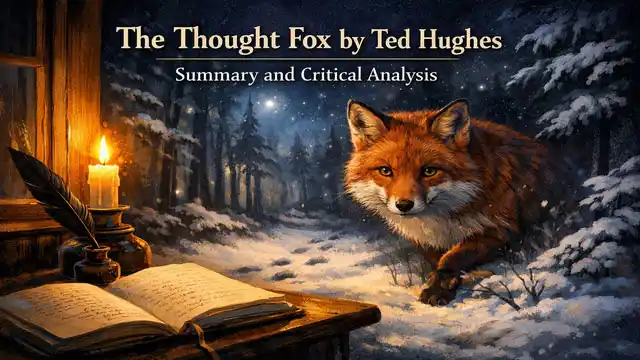
In the poem, the fox represents the creative force or inspiration that emerges from the poet’s inner darkness, that is, from his subconscious mind. This imaginative fox leaves ‘prints on snow,’ symbolising the marks made on the blank white page as the poem takes shape.
The fox image governs both the title and the symbolic movement within the poem. Hughes’ artistic finesse becomes evident as the poem unfolds; the motion described resembles the stealthy steps of a fox in the night. The rhythm and flow of the lines vividly bring this mental image before the reader. Overall, the poem contains a striking and effective metaphor at its core.
Summary of the poem “The Thought Fox”:
Poet at Midnight: Creative Emptiness:
The scene unfolds at midnight. The poet sits alone in his room, fully aware and awake, attempting to gather his thoughts so he can shape them into a poem. Yet his mind appears drained of creative force, empty of any poetic inspiration. At that moment, his imagination drifts to a snowy forest at midnight, and he senses himself standing within it. The forest is wrapped in complete darkness, with no trace of life anywhere. Everything around him suggests loneliness and barrenness.
Thought-Fox Appears:
Even so, he feels as if another living presence is awake somewhere in that moment. He imagines something alive entering his room. In the stillness and solitude, only the ticking of the clock breaks the silence. A blank sheet rests on the poet’s writing table, and though his fingers move across it, his mind remains empty and he cannot form words. Then, suddenly, the image of a fox appears in his imagination, filling the void in his mind. Inspired by this vision, he begins writing a poem that he titles “The Thought Fox.”
Vision of Snow-Covered Forest:
At midnight, the poet sits alone in his room, surrounded by silence. His mind feels numb, drained of creativity, making it impossible for him to gather ideas for a poem. Yet, at that very hour on another night, a vision of a snow-covered forest rises before him. He imagines himself standing within it. Everything is still; not a sound can be heard. Outside the room lies complete darkness. When he looks through the window, he notices that the sky holds no shining stars, leaving him without celestial inspiration. In the deep darkness, he senses movement—something seems to draw nearer, as though it wishes to break into his quiet isolation.
Struggle to Write
Sitting alone in his room at midnight, the poet hopes to create a poem. He makes every effort to transfer his thoughts onto the empty page before him, yet he feels almost unconscious, as if drained of all poetic power and inspiration. His mind then transports him to a snow-covered forest where thick darkness covers everything. Looking through his window, he sees no star shining in the sky. Still, he senses a living presence moving toward him through the deep darkness, attempting to break his solitude.
Symbolic Image of the Fox:
He imagines a fox—symbolising thought, creative force, and poetic inspiration—advancing through the forest. In his vision, the temperature suddenly seems to shift. On this freezing night, he pictures the fox’s nose, soft like snow, brushing lightly against a twig and then touching a leaf. Curiously, although the snow is white, it remains invisible in the pitch-black night. What he does see are the fox’s eyes: two bright points glowing sharply in the darkness. Their motion reveals the fox’s silent movement through the forest.
Moment of Inspiration:
At the stroke of midnight, the poet sits alone in his room, staring at a blank sheet of paper. He wishes to create a poem, yet inspiration refuses to come, leaving him in a numb and dream-like state. He begins to imagine that his room, where he waits for poetic strength and creativity, lies deep within a snowy forest. He senses something living drawing near, as though it intends to break his solitude. A sudden chill fills the air, and he feels a gentle, icy touch—much like a fox sniffing its way from a twig to a leaf.
Eyes and Footprints: Creative Traces:
He notices a pair of shining eyes: the fox’s gaze, which becomes the poet’s source of inspiration. He clearly observes the fox’s eyes shifting again and again. As the creature approaches, it leaves distinct tracks on the untouched snow. Symbolically, the fox represents creative thought and poetic energy; the snow stands for the empty white page; and the footprints suggest the emerging words and ideas forming on that blank surface.
Fox as Living Inspiration:
Thus, inspiration, in the shape of the fox, begins to enter the poet’s mind and illuminate his thoughts. The fox’s shadow drifts around the tree stumps, and because it exists as a spirit-like presence without a body, it has nothing to fear. Its bravery and confidence are evident as it moves steadily toward the poet.
Darkness and Creative Awakening:
In his imagination, the poet finds himself standing in a snow-covered forest swallowed by complete darkness. He senses a living presence approaching him—something that seems determined to break his isolation. This imagined fox, the symbol of his creative impulse, continues drawing nearer. Gradually, the poet catches sight of one of its eyes, suggesting that the animal’s focus is unwavering. That single eye shines with an extraordinary light of inspiration, allowing the poet to sense life and colour even within overwhelming darkness. Inspired ideas begin to flow into his mind. The creative faculty, previously lost in gloom, becomes illuminated by profound and vivid thoughts.
Fox Moving with Purpose:
When the poet finds himself unable to create verse—lacking both ideas and inspiration—his mind drifts into a vision of a snow-covered forest swallowed in complete darkness. Within this imagined scene, he senses a fox drawing near, symbolising the arrival of inspiration. He observes this fox steadily advancing, certain of its path, moving with unwavering purpose toward its goal.
Thought-Fox Joins the Poet’s Mind:
This fox, embodying the poet’s creative impulse, draws closer like a silent, unseen force. With a sudden, sharp sensation, it breaks into the dark recesses of the poet’s mind. Inspiration pierces the dim regions of thought just as a fox slips into its burrow and vanishes from sight. In this way, the imagined creature of thought merges with the poet’s inner world, becoming one with his mind and taking complete possession of him.
Page Transformed into Poem:
Around him, everything else—the ticking of the clock, the empty house, and the surrounding stillness—remains unchanged. Yet the moment this “thought-fox” enters the poet’s mind, it begins to leave prints upon the pure white page before him. The fox’s dark tracks transform into the black words written across that blank sheet—appearing as the poem now taking shape.
Critical Appreciation of the Poem “The Thought Fox”:
Introduction:
“The Thought-Fox” focuses on the creation of poetry rather than on an actual animal. The poem, taken from The Hawk in the Rain, uses the figure of a fox as a metaphor for poetic force or imagination that emerges from darkness—symbolically, from the poet’s subconscious. This creative impulse leaves its mark on the snow, which suggests the poet’s blank sheet of paper.
In the poem, the fox embodies the paradoxical character of inspiration and reality. Its symbolic value slowly rises from the personal level to a universal dimension. Through subtle hints, the poet reveals how a poem comes into existence. For a poet, inspiration is essential; without it, he can hardly begin the act of writing. Gradually, an idea shapes itself in the poet’s mind, lighting up the obscured spaces of thought, just as the fox moves deeper into the forest.”
Thought – Content:
The poet sits alone in his room on a dark night. He wishes to write a poem, yet no spark of inspiration reaches him. Everything around is silent. Even the faint ticking of the clock deepens his sense of darkness, stillness, and isolation. A blank sheet lies before him, and his fingers rest upon it. Outside, the night is pitch-black; not a single star can be seen.
The imagined fox represents the poet’s creative inspiration. It appears like a real fox, brushing its nose against twigs and scattered leaves. The poet first notices only a pair of glimmering eyes moving through the darkness, leaving trails on the snow. Then, slowly, a cautious and slightly limping body emerges, inching brilliantly toward the room. With the wild scent of a fox, it slips into the hidden space of the poet’s mind.
The window remains starless, and the night continues to be dark and solitary. The clock keeps ticking, and at last, the once-empty page now bears the footprints of the thought-fox—shaped into a poem.
The Connection Between the Literal and Metaphysical Levels:
In the opening lines, the poem unfolds simultaneously on two levels—one literal and the other metaphysical. On the literal plane, we encounter the solitary speaker, the silent night broken only by the ticking clock, the empty sheet of paper, and the poet’s physical movements. In contrast, the thought-fox belongs to the metaphysical dimension. It represents something abstract emerging from within the surrounding darkness and entering the poet’s isolation.
The interaction between these two planes is clearly drawn. The dense darkness and the indistinct presence imply that what the poet perceives is symbolic rather than something physically close or tangible.
Use of Metaphor and Imagery:
The poem centres on a striking metaphor. The Thought Fox represents the creative force behind poetry, symbolising the poet’s moment of inspiration. This inspiration emerges from darkness, which reflects the poet’s unconscious or hidden mind.
The fox itself functions as both the poem’s title and the central symbolic creature whose movements shape the poem’s progress. Throughout the piece, multiple vivid images appear, enriching its meaning and effect.The first line of the poem contains the image:
“I imagine this midnight moment’s forest.”
The poet imagines that he is sitting in a forest at midnight. Then comes the image of lonely clock. After that we have blank page and the feeling that something is also alive.
“Something else is alive
Beside the clock’s loneliness
And this blank page where my fingers move.”
Next the poet peeps out through the window but finds no star shining in the sky. The whole atmosphere out of this room is drowned in utter darkness, but the presence of something is felt:
“Through the window I see no star:
Something more near
Though deeper within darkness
Is entering the loneliness.”
Then comes the image of a fox’s nose touching a twig and a leaf. The brilliantly concentratedly eyes of the fox from another image of the poem:
“Cold, delicately as the dark snow
A fox’s nose touches twig, leaf;
To eyes serve a movement, that now
And again now, and now, and now”
Style and Language:
The language used in the poem is the language of the whole mind. The language is wakeful in all situations. He makes a skilful use of words and rhythms. The sound and the rhythm in the poem aptly capture the movement of the symbolic thought – fox as it advances towards the poet.
The poem has already set neat prints upon the page before we are told that the fox sets them into the snow. The repetition ‘again now and now, and now’ captures the movement of the thought fox in the verse. The syntax fully supports the slow, lame, shadow – like movement of the thought – fox:
“Two eyes serve a movement, that now
And again now, and now, and now
Sets neat prints into the snow
Between trees, and warily a lame
Shadow legs by stump and in hollow
Of a body that is bold to come. “
