Introduction to the Concept of Comic Epic in Prose:
Tom Jones by Henry Fielding is widely regarded as one of the greatest achievements of eighteenth-century English fiction and a perfect example of the “comic epic in prose.” Published in 1749, the novel combines the grandeur and structure of classical epic with the humour, realism, and lively spirit of comedy. Fielding himself described the work as a new kind of literary form in which the vastness and variety of human life could be presented through prose narrative instead of verse. Through its adventurous plot, vivid characters, moral vision, and satirical portrayal of society, Tom Jones rises above an ordinary novel and attains the dignity of an epic while retaining the entertainment and wit of comedy.
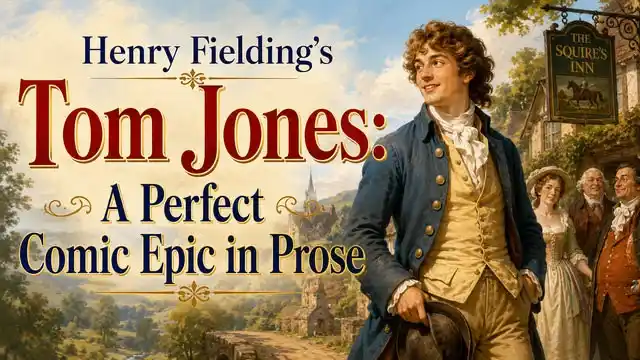
The story follows the life and adventures of the good-hearted but impulsive Tom Jones, whose journey through love, temptation, misunderstanding, and self-discovery reflects the complexities of human nature. Like the heroes of classical epics, Tom passes through numerous trials before finally achieving maturity and happiness. At the same time, Fielding fills the narrative with comic incidents, irony, and social satire that expose the hypocrisy and corruption of contemporary society. The novel presents a broad picture of eighteenth-century English life, including people from all social classes, thereby giving it an epic scope and universality.
What makes Tom Jones a perfect comic epic in prose is Fielding’s remarkable blending of epic magnitude with comic treatment. The novel possesses the structural unity, heroic journey, and moral seriousness of an epic, yet it remains deeply humorous and realistic. Fielding’s masterly narration, omniscient commentary, and artistic control further enhance the grandeur of the work. Thus, Tom Jones stands as a landmark in English literature, successfully establishing the comic epic in prose as a unique and enduring literary genre.
Fielding himself described Tom Jones as a comic epic in prose. That he had hit upon a new genre of literature and was keen to explore its possibilities is clear from his conscious attempts to expound a theory about it. He had behind him a tradition, though not fully established or developed, which he could adopt to suit his personal needs. Homer had long ago produced a comic epic which according to Aristotle bore the same relation to comedy as The Iliad and the Odyssey did to tragedy. The concept of a prose epic was also familiar. A work might, with appropriateness, be styled as a prose epic if it had all the parts of an epic poem-fable, action, character, sentiment, diction-with the single exception of metre. Combining these ideas of the comic epic and the prose epic, Fielding evolved a new genre— comic epic in prose.
Fielding’s Definition of Comic Epic in Prose:
In his preface to Joseph Andrews, Fielding has differentiated his comic epic in prose from both a comic romance and a serious romance:
Now, a comic romance is a comic poem in prose; differing from comedy, as the serious epic from tragedy: its action being more extended and comprehensive; containing a much larger circle of incidents, and introducing a greater variety of characters. It differs from the serious romance in its fable and action, in this; that as in the one these are grave and solemn, so in the other they are light and ridiculous; it differs in its characters by introducing persons of inferior rank, and consequently of inferior manners, whereas the grave romance sets the highest before us: Lastly, in its sentiments and diction, by preserving the ludicrous instead of the sublime.
Characteristics of the Comic Epic in Prose:
Thus, a comic epic in prose chiefly promises a variety of characters involved in very comprehensive action. The novelist’s tone is light, even frivolous, and he gives mildly satirical, ironical exposition of the ridiculous. It is epical in scale, and it is comic since it concerns ‘the ridiculous in human life. It is not a romance since it is highly, down- to-earth realistic. It is not history for it is not a superficial study of events, nor is it a burlesque, for a burlesque distorts while it does not. Behind the frivolous tone of the novelist, there is a strict moral responsibility which he shares with the writers of the serious epics. What Fielding was attempting was an entirely new species of literature in his language and he was right to claim, “This kind of writing I do not remember to have seen hitherto attempted in our language.”
Fielding’s Justification of the New Genre:
This is the gist of Fielding’s definition and it may seem strange to a modern reader that he feels constrained to drag in the classical epic and Aristotle’s analysis to tell us that his work as we can plainly see is a long continuous unified fictional narrative in prose-a novel. But we must remember two things; in 1741 there was no other example close to this except the epic with which to compare his idea. Secondly, he was claiming for this new kind of literature, the same respect accorded to the epic by an age that worshipped the classics; whose greatest poet, Pope had translated Homer into English, an age that regarded narrative fiction as the lowest form of literary endeavour. Thus, in effect Fielding is telling us that this is not a mere transcription of life, but a form of poetry which for all its realism, will give us a particular vision of reality.
Comic Tone in Tom Jones:
The description Fielding applied to Joseph Andrews, ‘a comic epic in prose’, is more applicable to Tom Jones. The comic tone of the novel is established from the very outset when Mrs. Wilkins, suddenly called by her employer and master, finds him coming before her dressed in a highly unbecoming manner, and she utters a loud shriek at the sight. Squire Allworthy’s confidence in the infallibility of his decision, his instance on dealing out justice and his expulsion of Tom Jones and Partridge, ironically revealing an utter lack of insight into human nature are given quite a light-hearted treatment.
Humorous Episodes in the Novel:
In Book II the reader is served with a highly amusing account of the tussle between Partridge, and his wife, originating in the suspicion on her part that he was the father of the foundling. The tussle takes on the form of virtually a battle when she showers invectives and blows and bites the poor school-master, leaving him utterly wrecked with in injuries. The scene at the Upton Inn presents a comic situation. When Tom and Mrs. Waters enter the Upton Inn, the landlady felt apprehensive that their stay would prove highly destructive to the sanctity of the place. She, therefore, furiously fell upon them and there ensued a skirmish in which members of both the sexes joined and every weapon of offence-verbal and manual; invectives, broom-stick and the cudgel were freely used. Another comic episode is when Sophia arrives with her maid, Mrs. Honour; the latter behaves ludicrously in the kitchen with a view to assuming gentility which she clearly lacks. An even more noisy comedy ensues on the arrival of Squire Western hot on the trail of Sophia. There is a fine ridiculous imitation of the state of law and justice in contemporary England when Tom is first charged with the theft of Sophia’s muff and then acquitted on Susan’s testimony. Mr. Fitzpatrick’s efforts to claim relationship with Squire Western and his negligence of her pleas are comic.
Humour as the Dominating Spirit:
Thus, humour occupies a very prominent place in Fielding’s very conception of the novel. Whenever the situation is in danger of getting a tragic colouring and whenever the chief protagonists find themselves in some precarious predicament, Fielding provides a comic turn or offers a timely resolution. The whole novel is steeped in comic spirit and even the serious moral purpose of the book is conveyed in a comic manner. Fielding is a born humorist and the fountain of his mirth is never exhausted.
Fusion of Comic and Epic Elements:
We see a very successful mixture of the comic with the epic elements in Tom Jones. The comic tone is sustained throughout the novel, while the scale is epical. Epic devices such as invocations, unity of action, time scheme, are combined with mock-heroic style and a consistently comic tone.
Epic Scale and Variety of Characters:
The scale of Tom Jones is epical. The novel has more than forty characters, of a variety in keeping with epical demands. We notice that the characters are drawn from several strata of society-the low classes, the middle classes, the landed gentry and the higher classes. We have lords, lawyers, judges, and high waymen, servants and squires, parsons and innkeepers, gypsies and thieves. Society is amply represented in the well- portrayed characters. Besides the wide variety of characters, there are other epic demands which are fulfilled by Tom Jones.
Observance of Epic Unities:
Fielding shows his intention to keep to the epic unities in Tom Jones. At the head of each Book in the novel, Fielding indicates the time taken by the particular action described in it. In Book I, we are told “as much of the birth of the foundling as is necessary.” In Books II and III, we are given a summary of events till Tom has reached the age of seventeen. Book IV spans a ‘year’. Book V contains “the portion of time somewhat longer than half a year.” The first four Books give us material antecedent to the actual action of the novel. After this antecedent material has been given, the action is restricted to fall within a year. The epics such as the Illiad and the Odyssey and the Aeneid followed the time-scheme of one year within which the action was completed, and Fielding, too followed the practice.
Unity of Action in Tom Jones:
The most important unity is that of action. More than the unity of time, it is the unity of action which Aristotle stressed upon. The action of Tom Jones is comprehensive and well-extended in space. It included the countryside, the highways, and the urban society of London. We have an almost complete picture of the rural and the urban society of England of Fielding’s time. The action of Fielding’s novel is given an organic unity which is remarkable. Its action is constructed along dramatic lines. Everything is pivotal on a single action, which is the discovery of a child in Allworthy’s bed and the unravelling of the secret of that child’s birth. The action of Tom Jones is an organic and coherent whole. The action of Tom Jones develops slowly but there is a proportion about the entanglement and the unravelling of action. The first six Books develop the complication in Somersetshire, ending with Tom’s expulsion from the Allworthy household. The next six Books develop the action on the road. The complications reach the climax in the middle, at Upton Inn, where all the important characters turn up almost together. The last six Books concentrate on London, with the novel ending with the unravelling all the mysteries.
Use of Mock-Heroic Style:
Fielding has freely used mock-heroic style and diction. In Book IV, the jealous attack made upon Molly by some women who resent her fine dress has a clear touch of the mock-heroic. Even the title given to the chapter describing this battle suggests its mock- heroic character: A Battle Sung by the Muse in the Homeric Style and which none but the classical Reader can Taste. The entire Upton episode has been written in the mock- heroic style. Even the rape attempted on Sophia is described in the same style.
Aristotle’s Formula of Discovery:
Fielding uses the formula of discovery as outlined by Aristotle and made much of in the works of epic theorists. In the scene in which the mystery of Tom Jones’s parentage is being straightened out, Fielding makes use of this sort of discovery. Tom ultimately is recognised as the child of Mrs. Bridget, the sister of Squire Allworthy. The entire thing comes to light in the last scene and it appears that Tom Jones felt perhaps, just a little less anxiety in this interval then Oedipus himself whilst his fate is being revealed. The author obviously has the Greek sources of this practice clearly in mind when he makes use of a very old device for bringing about a reversal of fortune. But Fielding differs somewhat from the epic tradition because in an epic there is no secret, whereas the novel Tom Jones has it. In the novel the secret of the parentage of Tom Jones has been maintained persistently till the end of the novel. In the novel the readers are kept in dark regarding the real parentage of Tom Jones as much as the characters themselves.
Narrative Technique and Structural Complexity:
Tom Jones’s speed of the narrative is that of an epic. In this new province of writing, he works wonders. As we proceed with the saga the satellites come, propping up from nowhere to decorate the main story. Several episodes ornate the main theme. But the book enjoys the greater ingenuity of the writer than the writer of a mere epic. As a matter of fact Tom Jones seems to elude any classification. It is neither a pure novel nor a pure epic. It is of the order of a drama, a novel and an epic. The elements of three fuse finely in the novel. We can only call it a novel for the convenience of a nomenclature. It cannot be classified under one single heading. It is, in fact, an amalgam of both, deriving its matter and approach from the novel and the epic with the touch of a drama.
Tom Jones as an Unheroic Epic Hero:
If it is an epic, it is of a different type altogether. An epic has an ideal hero for the central character. The hero of Tom Jones is an ‘unheroic one’. Tom Jones is a young man of good impulse, but he falls from grace because he has not learnt to temper his impulses with good sense or prudence. Tom is not possessed of all the virtues. In other words, he is not perfect. He has his share of shortcomings, more so because Fielding was writing a ‘comic’ epic, and in any comic writing the writer deals with ordinary men and women. The history of the character brings the novel on the verge of an epic. The atmosphere that fills the narrative is of the cosmic order. It is of the order of an epic.
Moral Purpose of the Novel:
Fielding had a serious purpose behind the writing of this novel. Tom Jones was called an epic also on account of the writer’s solemn purpose of instructing the reader. The novel was not to be taken as mere entertainment. It was to be considered as a fit vehicle for propounding serious thoughts which would influence the readers’ behaviour and ideas. Tom Jones was to be a means through which the readers would realize the loveliness of virtue and the ugliness of vice, the need to follow virtue and avoid vice in one’s own interest, and the need to temper good intentions with intelligence.
Significance of the Phrase “In Prose”:
We can understand Fielding’s contention that Tom Jones is a comic epic, but why does he insist on appending the term ‘prose’, when it is self-apparent. A novel, after all, is written in prose. There is, however, a greater significance in the use of the phrase ‘comic epic in prose’. It was a well-known belief that poetry is appropriate to the expression of the more elevated thoughts and the celebration of great actions. ‘In Prose’ plants us firmly once and for all in the ordinary world with which Fielding was primarily pre-occupied. As a realist attempting a comic epic, he found prose a better medium of expression in which he could indulge his comic sense.
Conclusion:
Tom Jones is thus a manifestation of Fielding’s theory of the ‘comic epic in prose’ a genre which he claimed to have pioneered. On the whole the novel is a comic epic in prose combining the genius of a dramatist and the novelist. The classical touch in the book makes it lean more towards an epic than a novel. But it is not a conventional epic, as it admits of different literary shades.
