Introduction:
Walt Whitman’s “O Captain! My Captain!” is a famous elegiac poem written in memory of Abraham Lincoln, the sixteenth President of the United States. The poem expresses Whitman’s deep sorrow over Lincoln’s assassination in April 1865, shortly after the Union’s victory in the American Civil War.
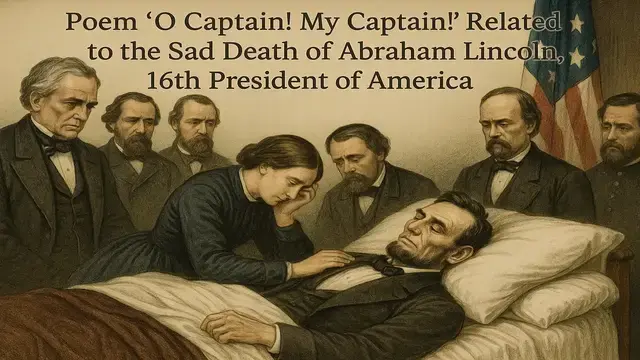
Lincoln had guided America through four years of civil war and helped preserve the Union. However, just when the nation was approaching peace, he was assassinated by John Wilkes Booth on 14 April 1865 and died on 15 April 1865.
Whitman expresses this tragedy through the symbolic image of a ship that has successfully completed a dangerous voyage, while its captain lies dead. The ship represents America, the captain represents Lincoln, and the successful voyage symbolizes the Union’s victory in the Civil War.
Historical Background:
Abraham Lincoln became the sixteenth President of the United States in 1861. During his presidency, America experienced the Civil War between the Union and the Confederacy. Lincoln’s principal objective was to preserve the Union, and his leadership became closely associated with the abolition of slavery.
In April 1865, the Union’s victory was approaching completion. General Robert E. Lee surrendered his principal Confederate army to General Ulysses S. Grant on 9 April 1865.
However, the nation’s relief was soon replaced by grief. On the evening of 14 April, Lincoln was shot by John Wilkes Booth at Ford’s Theatre in Washington, D.C. He died the following morning.
Lincoln’s death was particularly tragic because he did not live to witness the full restoration of peace. Whitman transformed this historical tragedy into an emotional poetic tribute to the fallen president.
Summary of the Poem:
The poem consists of three stanzas, each expressing the speaker’s sorrow over the death of the captain.
First stanza: Victory and Tragedy:
The speaker announces that the dangerous voyage has ended and the ship has successfully reached its destination. The people are celebrating, and the bells are ringing. However, the speaker suddenly discovers that the captain is dead.
The lines “our fearful trip is done” and “the prize we sought is won” symbolize America’s success in surviving the Civil War. The captain’s death represents Lincoln’s assassination at this moment of victory.
Second stanza: Grief and Disbelief:
The speaker desperately asks the captain to rise and hear the bells, see the flag, and receive the people’s honours. Calling him “dear father,” the speaker expresses deep affection and admiration.
The speaker wishes that the captain’s death were merely a dream. These appeals reveal the difficulty of accepting the loss of a beloved leader.
Third stanza: Acceptance of Death:
The speaker finally recognizes that the captain cannot respond. His lips are pale, his body is motionless, and he has no pulse.
Although the ship has reached safety, the speaker cannot celebrate. The poem ends with the repeated expression “Fallen cold and dead,” emphasizing the finality of Lincoln’s death and the speaker’s continuing grief.
Symbolic Connection with Abraham Lincoln:
| Symbol in the poem | Historical significance |
| The Captain | Abraham Lincoln |
| The Ship | The United States of America |
| The Fearful Voyage | The American Civil War |
| The Prize | The preservation of the Union |
| The Safe Harbour | Victory and the approach of peace |
| The Dead Captain | Lincoln’s assassination |
| The Celebrating People | The American nation rejoicing at victory |
| The Speaker’s Grief | The nation’s sorrow over Lincoln’s death |
Major Theme: Victory and Sorrow:
The principal theme of the poem is the contrast between national victory and personal tragedy. America has survived the Civil War, but its leader has died before he can enjoy the results of his efforts.
The ship’s safe arrival creates an atmosphere of celebration, while the captain’s lifeless body creates an atmosphere of mourning. Whitman shows that even a great national achievement cannot remove the pain of losing a beloved leader.
Significance of the Title:
The title “O Captain! My Captain!” expresses the speaker’s love, respect, and grief. The word “Captain” symbolizes Lincoln as the leader who guided America through the Civil War, while “My” suggests a personal emotional attachment.
The repeated exclamation reveals the speaker’s desperate desire for the captain to respond, even though death has made such a response impossible.
Critical Appreciation of the Poem:
Introduction:
Walt Whitman’s popular poem entitled “O Captain! My Captain!” was first published in the year, 1865. It came out in the fourth edition of the great and popular poem “Leaves of Grass”. The occasion for writing this poem by the poet was the murder of President Abraham Lincoln, the sixteenth President of the United States of America.
Background:
The murder of the president was made just after the Civil War. Such Civil War took place between the northern and the southern states due to the Negro slavery. As Abraham Lincoln was elected the President of the U.S.A. in 1860, at the end of the Civil War, Lincoln declared the abolition of slavery from America.
In this way, the different States of America were also united. President Lincoln was killed in a theatre by an actor named John Wilkes Booth on April 14th, 1865. His murder was a great blow to the great poet, Walt Whitman. He composed the present elegy under the title, “O Captain! My Captain!” to give an expression to his hearty feelings of his personal sorrow, suffering and deep grief.
An Elegy: A Cry of Broken Heart:
This poem is regarded one of the masterpieces composed by the great poet. As we study the poems and other compositions of Walt Whitman we find that “O Captain! My Captain!” is one of his very popular elegies composed on the death of President Abraham Lincoln. His murder was a personal loss for the poet because he used to regard Lincoln as his beloved and coveted leader.
This poem is certainly a cry of the broken and injured heart. As the opening lines of this poem show that the poet has expressed his grief not in direct address to the President. On the other hand, the poet has expressed his grief indirectly by using symbol and Metaphor.
In the second line of the poem the country of the United States of America is addressed as a ship and Abraham Lincoln is addressed as the captain of the ship. The captain of the ship was the man of great courage, so he brought the ship home after the successful voyage. As the War concluded, the people of his country were very happy. They had gathered at the sea – shore to welcome their captain. The following lines express it clearly:
“O Captain! My Captain! Our fearful trip is done,
The ship has feather’d every rack, the prize we sought is own,
The port is near, the bells I hear, the people all exulting,
While follow eyes the steady keel, the vessel grim and daring.”
Style and Language:
The poet made use of musical and melodious language to express the red drops of blood of the captain spread on the deck of the ship. These lines indicate the deep grief of the poet’s heart who used to love his President very deeply and affectionately.
He again addressed his captain to “Rise up and hear the bells”. His captain was dead, so he could not hear the sound of the bells, nor he could see the flying national flag of America. He was dead like a statue so he could not receive the “bouquets and ribbon’d wreaths” from the people of his country who had gathered at the sea – shore for his welcome.
The poet further addressed his captain as his dear father that he had belied the expectations of the people by not responding to the call of the people’s welcome. Its reason was that he had been lying dead on the deck of the ship. The following lines from this great poem, “O Captain! My Captain!” are quoted here to express the idea of the poet’s grief clearly and effectively.
“Here Captain! dear father!
The arm beneath your head!
It is some dream that on the deck,
You’ve fallen cold and dead.”
In the closing lines of this poem the poet further says that his captain could not answer the welcome – call of the people because “His lips are pale and still”. He could not feel the poet’s arm because he had no moving pulse because of his death. Though the ship had returned “safe and sound” after its fearful trip but the captain was not alive anymore.
The last and the closing lines of this great poem show the deep grief of the poet’s heart. He was very unhappy because his captain was lying “cold and dead” on the deck of the ship. These are very pathetic lines of this poem which express the sense of grief both to the poet as well as to the masses of America. The last four lines are quoted in support of this.
“Exult O shores, and ring O bells!
But I with mournful tread
Walk the deck my Captain lies,
Fallen cold and dead.”
Walt Whitman is remembered by the modern critics and his readers as an unconventional and a revolutionary poet who had made use of his own form and style in the composition of this poem as well as his many other poems . This is the reason that he did not use his poetical material under any traditional pattern.
It is true that “O Captain! My Captain!” is the poet’s best poem so far as the use of rhyme and metre is related. The poem is divided into three stanzas which contain eight lines respectively. Each stanza is composed by the poet under a regular rhyme pattern. The use of allegory shows only ineffective expression of grief. With this reason there is no poignancy of pathetic expression.
The poet, in this poem, has made use of some conventional methods like that of alliteration as it is shown in the words, “Flag is flung”. The poet further shows the use of personification and Apostrophe when he has written the words, “O Heart! heart! heart!”.
The poet in this poem has made use of the power of his imagination effectively. Though the language used in this poem by the poet is very simple, yet the expression is highly poetic and musical. His diction showed the voice of the common masses.
It is true that the spirit and the feelings of the people of America are well – expressed in a highly pathetic manner. His style is perfectly free from vulgarity. The concluding lines of “O Captain! My Captain!” are not only the best part of the poem but they are memorable.
Conclusion:
Walt Whitman’s “O Captain! My Captain!” is a moving tribute to Abraham Lincoln and a powerful expression of America’s grief following his assassination. Through the metaphor of a ship and its captain, Whitman portrays the successful preservation of the Union alongside the tragic loss of its leader.
The poem’s central message is that America achieved victory, but Lincoln’s death turned the moment of national triumph into one of profound sorrow. The repeated words “Fallen cold and dead” remain the poem’s most powerful expression of the irreversible loss of a great leader.
