Introduction:
Matthew Arnold’s essay on John Keats is a thoughtful and influential critical appreciation of one of the greatest poets of the Romantic age. Written as an introduction to a selection of Keats’s poems, Arnold’s essay reflects his characteristic approach to literary criticism—calm, balanced, and guided by high standards of poetic excellence. He examines Keats’s poetic genius with particular attention to his sensuousness, his love of beauty, and his deep responsiveness to nature and art.
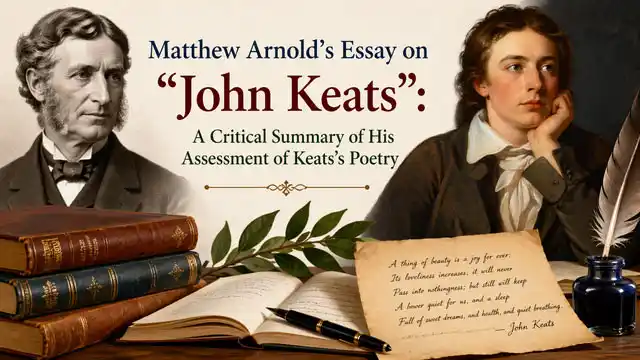
Arnold acknowledges Keats as a true poet endowed with remarkable imaginative power, yet he also points out certain limitations, especially his lack of intellectual depth and maturity when compared to poets like William Shakespeare or John Milton. Despite this, Arnold appreciates the richness and intensity of Keats’s poetry, emphasizing its vivid imagery and emotional appeal.
Overall, the essay serves as both an appreciation and a critique, presenting Keats as a poet of extraordinary sensibility whose work, though not flawless, holds a permanent place in English literature. Arnold’s analysis helps readers understand Keats’s unique poetic qualities while situating him within the broader tradition of great poets.
Keats and the Dominance of Sensuousness:
Arnold’s ‘John Keats’ was prefixed to the Selection from Keats in Ward’s ‘English Poets’ Vol. IV. 1880.
Milton observes that poetry should be simple, sensuous and impassioned. Keats’ poetry is rich in the element of sensuousness. As a poet he surpasses all the romantics in sensuousness. Some critics, therefore, begin to ask whether he is anything else? No doubt he is greatly dominated by senses. It seems he desires nothing better. Therefore, at one place in one of his letters he exclaims:
‘O for a life of sensation rather than thoughts.’
Criticism of Keats’ Devotion to Beauty and Lack of Purpose:
Some critics give importance to Keats’ devotion to Beauty. They claim that Keats’ sense of Beauty overcomes every other consideration. It is remarked that Keats had no decision of character; no object upon which to direct his great powers.
Character, Self-Control, and Keats’ Emotional Life:
Character and self-control are necessary for every kind of greatness. For a great artist too they are very important. But it seems Keats was lacking in it. Keats’ ‘Letters to Fanny Brawne’, at least, creates such an impression about the great poet. It is thought that it was better not to publish those letters. Keats wrote them when he was near his end. A letter that he wrote some months before he was taken ill expresses his inward feelings. Keats wrote in it that Fanny had absorbed him. He had the sensation as if he were dissolving. He was longing to see her. He did not approve to be so separated from her. He wished for a change in her feelings for him. His love had no limit. He received her letter. He could not live happy away from her. Love was his religion and he was ready to die for that. He was willing to die for her. She had attracted him by a Power he could not resist. Ever since he had seen her, he had endeavoured to reason against the reasons of his Love. His love was selfish. He could not breathe without her.
Arnold’s Critique of Keats’ Passionate Nature:
Arnold thinks a man of such feelings is bound to have misfortune in love-affairs. Here Keats creates the impression of being a passion’s slave. It is an expression of a youth ill brought up having no training of keeping feelings under control. It is the sort of love letter read out in a breach of promise case or in the Divorce Court. The sensuous man speaks in it. But he is badly bred and badly trained. Those who are like him may enjoy it. They may regard it as beautiful and appreciate their lovely and beloved Keats for it. Such admirers harm to the fame of Keats. It is desirable to appreciate what is good in him. For example, the lines drawing a sensuous word picture of a beautiful lady. But Keats has something more than it. He is one of the very greatest of English poets not because of sensuousness but because his poetry interprets life. Keats has the elements of high character and makes efforts to develop them. Unfortunately, his effort is unsuccessful because of his disease and time.
Testimony of Character: Lord Houghton and Keats’ Moral Nature:
According to Lord Houghton the faults of Keats’ behaviour were contrary to the common opinion about him. In this reference, he gives a letter written after the death of Keats by his brother George, speaking of the fantastic Johnny Keats that Keats had great manliness and courage. Keats wrote to his brothers that probity and disinterestedness hold and grasp the tip-top of any spiritual honours. Keats shows signs of virtue in the true and large sense of the word, the instinct for virtue passing into the life. Keats regards it unfortunate that men should bear with each other. There is no man who may not be cut up or cut to pieces on his weakest side. The best of men have but a portion of good in them. Keats loved people in spite of knowing their faults. If there was any dispute among his friends, he hoped to bring them together. Keats wrote to Charles Brown who had always been helping him in all difficulties that he wished to make his friend free from that responsibility. He hopes that at the end of another year Charles would praise him not for verses, but for conduct.
Keats’ Response to Criticism and Literary Reviews:
It is significant to pay attention to Keats’ words after the unjust reviews of ‘Endymion’. He claims that praise or blame has but a momentary effect on the man whose love of beauty in the abstract makes him a severe critic on his own works. His own criticism has given him pain without comparison beyond what ‘Blackwood’ or the ‘Quarterly’ could possibly inflict. Keats writes further that he has done nothing except for the amusement of a few people who refine upon their feelings till anything in the un-understandable way will go down with them. He has no cause to complain. He is sure all would have cheered him if he had written ‘Othello’. He does not wish to lose his patience.
Keats’ Attitude Towards Public and Popularity:
Keats is not foolish enough to overrate his merit. He says that he has no trust whatever in poetry. He does not wonder at it. He wonders why people read it so much. He has a strong attitude towards the public. He claims that public is debtor to him for verses. He is not debtor to them for admiration. He writes that he has not the slightest feeling of humbleness for the public or to anything in existence, but to the Eternal Being, the Principle of Beauty and the memory of Great Men. He would be subdued before his friends with thanks but before multitudes of men he has no feeling of stooping. He hates the idea of humbleness to them. He never writes anything keeping in mind their opinion. He claims that he can’t live without the love of his friends. For public good, he is ready to make great sacrifices, but he hates weak and sentimental popularity. He never wishes to be among the commonplace crowd.
Keats’ Love for Fanny Browne and Emotional Complexity:
Keats loves Fanny Brawne the more because he believes that she has liked him for his own sake and nothing else. He does approve those women who would like to be married to a poet or novelist for falling in love with his works. Arnold calls it a tone of too much bitterness which he corrected when he wrote his beautiful preface to ‘Endymion’. It shows Keats had a strong character. Keats had remarkable clear-sightedness and lucidity. He had overpowering feeling for beauty and sensuousness. Keats says with resolution that he knows nothing, he has read nothing but he believes in get learning and get understanding. He knows that the road lies through application, study and thought.
Influence of Milton and Intellectual Development:
Keats looked upon Milton’s fine phrases like a lover. According to him, Milton had extraordinary passion for what is properly poetical luxury. Milton devoted himself rather to the eagerness than the pleasures of song. Keats too passes into intellectual production. Keats claims that he cares and lives for the best sort of poetry. Arnold finds it curious to observe how this devotion to the best sort of poetry affects him with a certain coldness towards love and women. He regards women as children to whom he would rather give sweets than his time. He writes to Fanny Browne that he knows women would hate him. His heart seems now made of iron for them.
The Intellectual and Spiritual Nature of Keats’ Love of Beauty:
Keats’ yearning passion for the Beautiful is in fact an intellectual and spiritual passion. It is ‘connected and made one with the ambition of the intellect’. It is ‘the mighty abstract idea of Beauty in all things’. In his last days Keats wrote if he should die, he had left no immortal word behind him to make his friends proud of his memory, but he had loved the principle of beauty in all things, and if he had time, he would have made himself remembered. He is remembered as no merely sensuous poet could be, and he has done it by having loved the principle of beauty in all things.
Beauty, Truth, and Keats’ Philosophical Insight:
To see things in their beauty is to see things in their truth and Keats knew it. He believed that Beauty must be Truth. He claims in ‘Endymion’.
‘A thing of beauty is a joy forever.’
Arnold comments that it is not a small thing to love the principal of beauty combining it with truth and joy. Keats observes that nothing surprises him more than the moment the setting sun will always set him to rights or if a sparrow comes before his window. Unfortunately, he could not live long. He wrote to Reynolds he could last eighty years if he had a free and healthy and lasting organization of heart and strong lungs. The blind force of Fortune was against him.
Keats’ Achievement and Comparison with Shakespeare:
By virtue of his feeling for beauty and of his perception of the strong connection of beauty with truth, Keats accomplished so much in poetry that he stands with Shakespeare. No one else in English poetry, save Shakespeare, has in expression quite the attraction of Keats and his perfection of loveliness. He hoped to be among the English poets after his death and he is with Shakespeare.
Limitations and Strengths in Keats’ Poetry:
Keats was not ripe or mature for works like ‘Agamemnon’ or ‘Lear’. His ‘Endymion’ is a failure and ‘Hyperion’ is not a success. But in shorter poems he is perfect. Therefore, Arnold has chiefly spoken of Keats the man poems and of the elements in him which explain the production of such work. Arnold claims that it is Shakespearean work that is not imitative of Shakespeare, but Shakespearean because its expression has perfection and loveliness. Shakespeare is the great master of these qualities.
