Introduction
Matthew Arnold is a great literary critic. In ‘The Study of Poetry’ he evaluates a few poets and during the process brings to light some very important principles of literary criticism and theories of poetry.
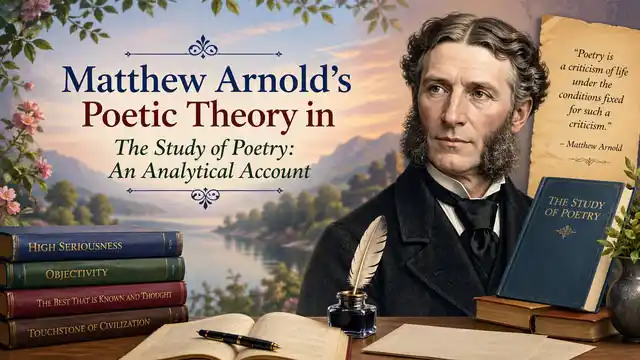
Matthew Arnold stands as one of the most influential literary critics of the Victorian age, whose critical work significantly shaped modern approaches to poetry. In his seminal essay The Study of Poetry, Arnold presents a systematic and thoughtful evaluation of poetry, emphasizing its moral, intellectual, and aesthetic functions. He regards poetry as a “criticism of life,” capable of offering profound truths and enduring values, especially in an age where traditional religious beliefs were weakening.
Arnold’s poetic theory is grounded in his concept of “high seriousness,” which he considers the hallmark of great poetry, along with his famous “touchstone method” for evaluating poetic excellence. Through these ideas, he establishes objective standards to distinguish superior poetry from inferior works. This analytical account aims to explore Arnold’s poetic theory in depth, examining its key principles, critical methods, and lasting impact on literary criticism.
Bright Future of Poetry:
Arnold begins the essay with the assurance that poetry has a bright future. There is no need to fear that modern people have no interest in great literature or the standard of poetry is decaying fast. Undoubtedly the future of poetry is great. Traditional beliefs based on mere faith have been shaken. All those faiths decay that are not based on facts of life. Religion too is growing more and more rational. Poetry depends on ideas related to facts of human life. It makes it definite and durable. The rest is a world of illusion.
“The future of poetry is immense, because in poetry, where it is worthy of its high destinies, our race, as time goes on, will find an ever surer and surer stay. There is not an accredited dogma which is not shown to be questionable, not a received tradition which does not threaten to dissolve. Our religion has materialised itself in the fact, in the supposed fact; it had attached its emotion to the fact, and now the fact is failing it. But for poetry the idea is everything; the rest is a world of illusion, of divine illusion. poetry attaches its emotion to the idea; the idea is the fact. The strongest part of our religion to-day is its unconscious poetry.”
Great Purpose of Poetry:
Arnold has contributed the essay ‘The Study of Poetry’ to ascertain the great purpose of poetry. He makes it clear that the purpose behind the essay is to discover the stream of English poetry. Arnold advises to recognize the great purpose of poetry. Poetry interprets life for us. It teaches how to live. In this sense it has power to replace religion and philosophy. Science too aims at making life as happy as possible. In this sense poetry becomes the breath and finer spirit of all knowledge. Without it science too is incomplete. Poetry deals with truth of life. Without it religion and philosophy look hollow. We should poetry worthily, and more highly than it has been the custom to conceive of it. We should conceive of its as capable of higher uses, and called to higher destinies, than those which in general men have assigned to it hitherto. More and more mankind will discover that we have to turn to poetry to interpret life for us, to console us, to sustain us. Without poetry, our science will appear incomplete; and most of what now passes with us for religion and philosophy will be replaced by poetry. The purpose of poetry is so great that Wordsworth call poetry “the impassioned expression which is in the countenance of all science”; Again, Wordsworth finely and truly calls poetry “the breath and finer spirit of all knowledge”; our religion, parading evidences such as those on which the popular mind relies now; our philosophy, pluming itself on its reasonings about causation and finite and infinite being; what are they but the shadows and dreams and false shows of knowledge? The day will come when we shall wonder at ourselves for having trusted to them, for having taken them seriously; and the more we perceive their hollowness, the more we shall prize “the breath and finer spirit of knowledge” offered to us by poetry.
Need of High Standard for Poetry:
Poetry has high order of excellence. It is possible only by following strict norms of criticism. Boastful pretenders have no place in it. Poetry is thought and art in one. It has glory and eternal honour. In poetry it is of the greatest importance that clear distinction is made between excellent and inferior, sound and unsound or only half sound, true and untrue or only half- true. Poetry is a criticism of life under the conditions fixed for such a criticism by the laws of poetic truth and poetic beauty. Charlatanism or boastful pretending has to be discarded. In poetry, which is thought and art in one, it is the glory, the eternal honour, that charlatanism shall find no entrance; that this noble sphere be kept inviolate and inviolable. Charlatanism is for confusing or obliterating the distinctions between excellent and inferior, sound and unsound or only half-sound, true and untrue or only half-true. It is charlatanism, conscious or unconscious, whenever we confuse or obliterate these. And in poetry, more than anywhere else, it is unpermissible to confuse or obliterate them. For in poetry the distinction between excellent and inferior, sound and unsound or only half-sound, true and untrue or only half-true, is of paramount importance. It is of paramount importance because of the high standard for poetry. It is to be observed for we do not want low poetry or the sub- standard poetry but the best.
“The best poetry is what we want; the best poetry will be found to have a power of forming, sustaining, and delighting us, as nothing else can. A clearer, deeper sense of the best in poetry, and of the strength and joy to be drawn from it, is the most precious benefit which we can gather from a poetical collection such as the present. And yet in the very nature and conduct of such a collection there is inevitably something which tends to obscure in us the consciousness of what our benefit should be, and to distract us from the pursuit of it. We should therefore steadily set it before our minds at the outset, and should compel ourselves to revert constantly to the thought of it as we proceed.”
Need of Real Estimate in Poetry:
Arnold does not approve historical or personal estimate. Both of them lead to error and misunderstanding. Historical importance may be useful for a student of history but, here, in poetry only that is accepted which has universal importance. So many poets were regarded as the greatest in their own times but now they do not seem great at all for their greatness was not real. Likewise, the personal estimate is guided by either positive or negative feelings and the reality goes in the dark. It is, therefore, only real estimate should be honoured. But this real estimate, the only true one, is liable to be superseded, if we are not watchful, by two other kinds of estimate, personal estimate, the historic estimate and both of which are fallacious. A poet or a poem may count to us historically, they may count to us on grounds personal to ourselves, and they may count to us really. They may count to us historically. The course of development of a nation’s language, thought, and poetry, is profoundly interesting; and by regarding a poet’s work as a stage in this course of development we may easily bring ourselves to make it of more importance as poetry than in itself it really is, we may come to use a language of quite exaggerated praise in criticising it; in short, to overrate it. So arises in our poetic judgements the fallacy caused by the estimate which we may call historic. Then, again, a poet or a poem may count to us on grounds personal to ourselves. Our personal affinities, likings, and circumstances have great power to away our estimate of this or that poet’s work, and to make us attach more importance to it as poetry than in itself it really possesses, because to us it is, or has been, of high importance. Here also we overrate the object of our interest, and apply to it a language of praise which is quite exaggerated.
Touchstone Method:
In order to judge the true excellence of poetry, Arnold recommends the “touchstone” method. In “The study of Poetry”he writes: “Indeed, there can be no more useful help for discovering what poetry belongs to the class of the truly excellent, and therefore do us most good, than to have always in one’s mind lines and expressions of the great masters, and to apply them as a touchstone to other poetry. Of course, we are not to require this other poetry to resemble them; it may be very dissimilar. But if we have any fact we shall find them, when we have lodged them well in our minds, an. infallible touchstone for detecting the presence or absence of high poetic quality, and also the degree of this quality, in all other poetry which may place beside them”. It is a way to determine if a piece of poetry is truly excellent or not, Arnold suggests to apply expressions of great masters as a touchstone to other poetry. It may help in detecting the presence or absence of high quality of poetry as well as the degree of this quality. According to Arnold short passages or even single lines may serve this purpose quite sufficiently. If we have tact only few lines are enough to keep clear and sound our judgements about poetry.
Qualities of High Class of Poetry: Matter and Manner:
The high quality of poetry is found in the substance and matter and the style and manner of poetry. The very excellent must be perfect in the both. The matter should have truth and seriousness which should be supported by the superiority of style and manner of that poetry. In this matter we can’t ignore what Aristotle thinks. Arnold approves Aristotle’s viewpoint that poetry possesses a higher truth and higher seriousness than history. Besides the style and manner of the best poetry should have excellent diction and movement. The superior quality of truth and seriousness in the matter and substance of the best poetry, is inseparable from the superiority of diction and movement that is the mark of style and manner. Poetry suffers from weakness if any part of these is missing or imperfect. Arnold observes:
Only one thing we may add as to the substance and matter of poetry, guiding ourselves by Aristotle’s profound observation that the superiority of poetry over history consists in it possessing a higher truth and a higher seriousness. Let us add, therefore, to what we have said, this that the substance and matter of the best poetry acquire their special character from possessing, in an eminent degree, truth and seriousness. We may add yet further what is in itself evident, that to the style and manner of the best poetry their special character, their accent, is given by their diction, and, even yet more, by their movement. And though we distinguish between the two characters the two accents, of superiority, yet they are nevertheless vitally connected one with the other. The superior character of truth and seriousness, in the matter and substance of the best poetry, is inseparable from the superiority of diction and movement marking its style and manner. The two superiorities are closely related, and are in steadfast proportion one to the other. So far as high poetic truth and seriousness are wanting to a poet’s matter and substance, so far also, we may be sure, will a high poetic stamp of diction and movement be wanting to his style and manner. In proportion as this high stamp of diction and movement, again, is absent from a poet’s style and manner, we shall find, also, that high poetic truth and seriousness are absent from his substance and matter.
Besides, the high-class poetry should have high seriousness that is missing in Chaucer. It is therefore, he is regarded as a great poet but not a classic by Arnold.
Criticism of Life:
Arnold regards poetry not merely a reflection of life but as a criticism of life under the conditions fixed for such a criticism by the laws of poetic truth and poetic beauty, the spirit of our race will find, we have said, as time goes on and as other helps fail, its consolation and stay. But the consolation and stay will be of power in proportion to the power of the criticism of life. And the criticism of life will be of power in proportion as the poetry conveying it is excellent rather than inferior, sound rather than unsound or half-sound, true rather than untrue or half-true. Arnold could not conceive of poetry as something apart from life. It was never to him ‘art for art’s sake’—an experience delighting the poet only, or just a holiday exercise, from which one returned to the same world again. It was a serious preoccupation with the art of living itself. Arnold defines poetry ‘as a criticism of life under the conditions fixed for such a criticism by the laws of poetic truth and poetic beauty.” In it, as thus conceived, “the spirit of our race will find, as time goes on and as other helps fail, its consolation and stay.” He also said, “the best poetry will be found to have a power of forming, sustaining, and delighting us, as nothing else can.” Arnold himself explains ‘criticism of life’ as ‘the noble and profound application of ideas to life’; and ‘law of poetic truth and poetic beauty’ as ‘truth and seriousness of substance and matter’ and ‘felicity and perfection of diction and manner.’ But Arnold does not believe in qualities in parts. He wants them together.
According to Arnold mere powerful application of ideas to life is not enough. In fact, it must be an application under the conditions fixed by the laws of poetic truth and poetic beauty. Those laws fix as an essential condition, in the poet’s treatment of such matters as are here in question, high seriousness: the high seriousness which comes from absolute sincerity. Arnold claims that high seriousness born of absolute sincerity gives power to criticism of life. In Dante’s poetry this quality is present. Burns lacks in it. He seems preaching. He does not seem speaking from the depth of inmost soul. Like Chaucer, Burns also falls short of the high seriousness of the great classics, and the virtue of matter and manner. At moments he touches it in a profound and passionate melancholy. It is the real estimate of Burns that his work has truth of matter and truth of manner but lack in poetic virtue of the highest masters. His genuine criticism of life is ironic. Like Chaucer his view is large, free, shrewd, gentle and truly poetic. It is the basic difference in the both that freedom of Chaucer is heightened in Burns by a fiery reckless energy; the gentleness of Chaucer deepens in Burns into a deep sense of pathos. Chaucer has fluidity of manner; Burns has spring bounding swiftness. Burns has greater force but less charm. The world of Chaucer is fairer, richer, more significant than the world of Burns. But when largeness and freedom of Burns get full sweep, it becomes stronger and more splendid. It has breadth, truth and power which are only matched by Shakespeare and Aristophanes.
